

When you're trying to nail the perfect layout, under counter fridge dimensions are designed to slide right under a standard 36-inch high countertop. Most units you'll find are between 32 and 34.5 inches tall, which is perfect for leaving that critical breathing room for ventilation. Getting this standard sizing right is a huge piece of the puzzle for an efficient kitchen.
Mastering Kitchen Space with Standard Dimensions
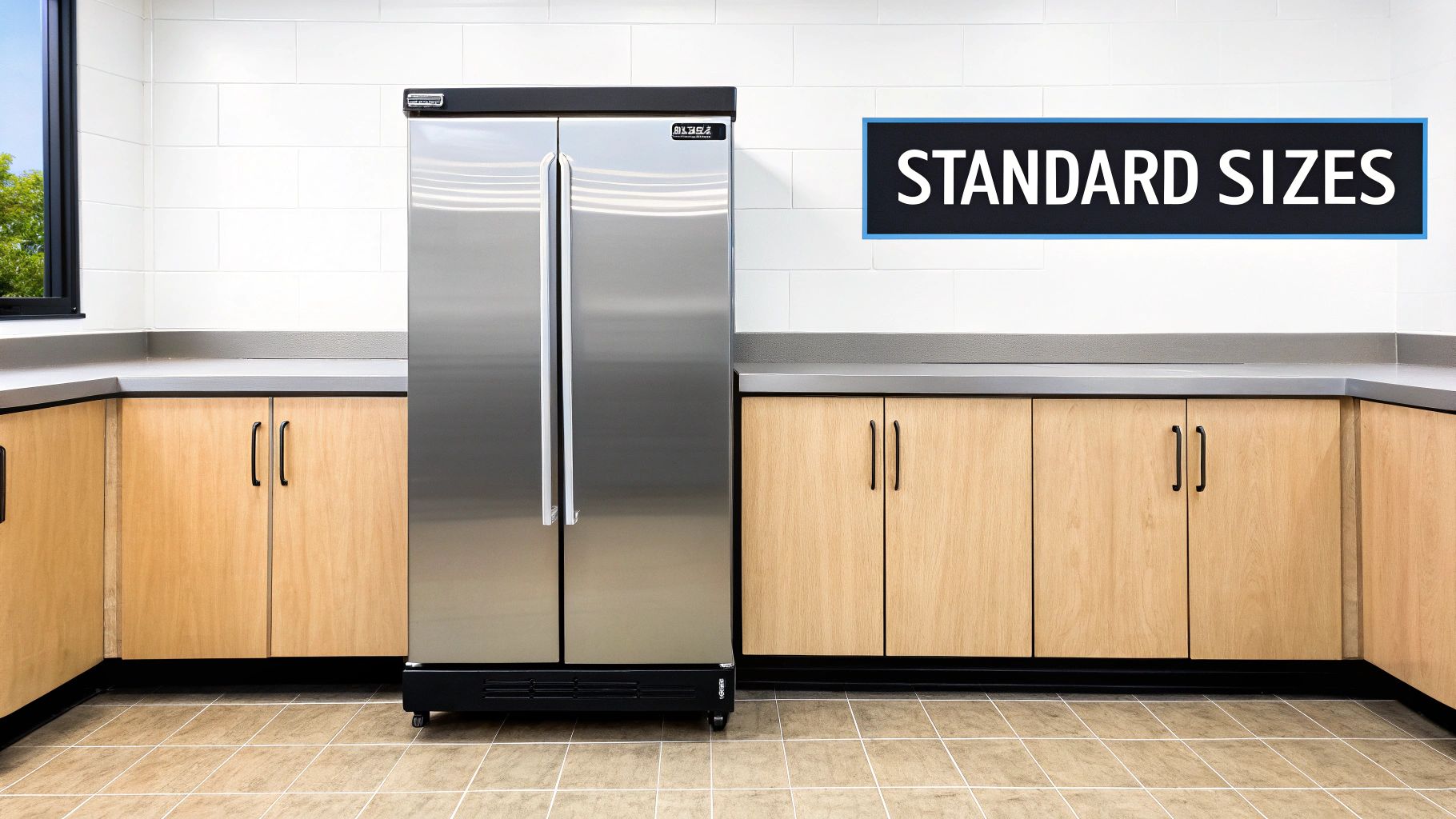
For any Los Angeles restaurant owner—whether you're running a busy downtown pizza joint like Los Angeles Pizza, a tight-on-space food truck, or a classic Mexican restaurant—every single square inch counts. Undercounter refrigerators are absolute game-changers, letting you tuck cold storage right where the action is at your prep stations. Understanding their standard dimensions is the first, most important step to getting that seamless installation and smooth workflow you're after.
In the fast-paced commercial kitchens across Southern California, where real estate is at a premium, standard dimensions have become a lifesaver. You’re typically looking at units that are 34 to 36 inches in height, 24 inches in depth, and come in common widths of 15, 24, or 30 inches. This precision engineering allows them to fit perfectly under those ubiquitous 36-inch countertops. It's all about ensuring proper airflow while making the most of every inch of your prep line. You can find more great insights about undercounter refrigerator sizes to help guide your decision.
Getting these measurements right from the get-go saves you from expensive mistakes and major operational headaches down the line. A unit that fits properly not only gives your kitchen a clean, professional look but also runs more efficiently. That means real savings on your energy bills and a longer life for your restaurant equipment.
Before you pull the trigger on a purchase, always double-check these key factors:
- Height: This is crucial. It ensures the unit can actually slide under your counter with enough clearance for air to circulate. No one wants an overheating compressor.
- Width: This really dictates the unit's storage capacity and how much floor space it’ll take up in your line.
- Depth: The right depth allows the fridge to sit flush with your other cabinets, giving you that clean, integrated look that keeps your kitchen pathways clear.
Choosing the Right Undercounter Fridge Size for Your Kitchen
Picking out an undercounter fridge isn't just about what will squeeze into an open spot under the counter. The real goal is to match the unit's size to the actual, day-to-day grind of your kitchen. The most important dimension you'll look at is the width, as it directly dictates how much you can store and how the fridge fits into your service flow.
Commercial undercounter fridges generally come in one, two, or three-door models. Each one is built for a different scale of operation, and it's a mistake to think a single-door is just a smaller version of a triple-door. They're specialized tools. A big three-door beast is designed for the busiest prep lines, while a compact single-door unit shines in tight spots or for holding very specific items.
Single-Door Models: The Compact Workhorse
Single-door undercounter fridges usually measure somewhere between 27 to 32 inches wide. These are lifesavers when space is tight or you need dedicated cold storage for a specific task. Think about bustling Los Angeles food trucks – a single-door model is perfect for a beverage station, keeping drinks ice-cold without eating up precious prep space.
You'll also see them in small cafes or bakeries, tucked under the front counter to hold milk, cream, and grab-and-go snacks for customers. Their small footprint makes them incredibly versatile.
Two-Door Models: The Industry Standard
Walk into most professional kitchens, and you'll find a two-door undercounter fridge. Typically running 48 to 60 inches wide, this size hits the sweet spot between storage capacity and physical footprint, making it the true workhorse of the industry.
For any busy SoCal Mexican restaurant, a 48-inch unit on the prep line is absolutely essential. It’s big enough to hold pans of chopped cilantro, onions, multiple salsas, and meats, keeping everything right where the cooks need it during a hectic dinner rush. The right restaurant equipment makes all the difference for authentic Mexican food.
This size is great because it gives you enough separate space to keep different foods organized and avoid cross-contamination—a non-negotiable in any professional kitchen. From prepping salads and sandwiches to holding finished desserts, it can do it all. The market for this kind of equipment is growing fast, expected to jump from USD 11.4 billion in 2024 to an estimated USD 15 billion by 2032. That growth is all about kitchens needing smart, space-saving gear that makes them more efficient. You can dig deeper into the numbers by checking out these commercial refrigeration market trends to see how demand is shaping equipment design.
Three-Door Models: Maximum Capacity for High Volume
When your line needs a massive amount of cold storage right at arm's reach, the three-door model is your answer. These units are big, ranging from 60 inches to over 72 inches wide, and they offer all the capacity you could ask for.
A high-volume pizza joint in LA, like Los Angeles Pizza, would rely on a three-door unit to keep huge quantities of cheese, dough, sauce, and toppings on the line. This means cooks aren't constantly running to the walk-in to restock during peak hours, which keeps the whole kitchen flowing smoothly.
Before we move on, let's put these sizes into perspective. Choosing the right width isn't just about a tape measure; it's about picturing your team in action. This table breaks down the common sizes and where they fit best in the fast-paced LA and Orange County food scene.
Commercial Undercounter Fridge Sizing Guide
| Model Type (Width) | Typical Capacity (Cu. Ft.) | Best For (LA/OC Business Type) | Common Use Case |
|---|---|---|---|
| Single-Door (27"-32") | 6 - 9 cu. ft. | Los Angeles Food Trucks, Coffee Shops, Small Bars | Dedicated beverage cooler, holding milk/cream at a service station, storing grab-and-go items. |
| Two-Door (48"-60") | 12 - 18 cu. ft. | Most Restaurants (including Mexican Food spots), Cafes, Delis | Main prep line station for salads/sandwiches, holding sauces and prepped ingredients. |
| Three-Door (60"-72"+) | 18 - 25 cu. ft. | High-Volume Restaurants, Pizzerias (like Los Angeles Pizza), Catering Kitchens | Storing bulk toppings on a pizza line, holding large pans of prepped food for a busy service. |
Hopefully, seeing it laid out like this makes the decision clearer. The right size directly impacts your kitchen's efficiency—too small and you're wasting time on restock runs; too big and you're wasting valuable floor space.
How to Measure Your Space for a Perfect Fit
There’s nothing worse than the thud of a new undercounter fridge arriving, only to discover it’s a quarter-inch too wide for the opening. In a fast-paced Los Angeles kitchen, that kind of mistake isn't just frustrating—it's a costly delay you can't afford. To nail the fit on the first try, you need to measure with absolute precision. This is about more than just a quick height-width-depth check; it's about accounting for the quirks of your actual space.
Many of the older buildings we work with in LA have floors and walls that are anything but square. A single measurement can be misleading. That’s why you should always take three measurements for both height and width: one on the left, one in the middle, and one on the right. The golden rule? Always use the smallest of the three measurements for your final number. This guarantees the unit will slide in without a fight.
Accounting for Obstructions
Once you've got your core dimensions, it’s time to play detective. Look for the little things that can completely derail an installation.
- Plumbing and Electrical: Peek into the back of the space. See any water lines, drains, or electrical outlets sticking out from the wall? You need to measure the depth from the front of your cabinet opening to those obstructions, not just to the back wall.
- Baseboards and Trim: Don’t let molding or baseboards catch you by surprise. They can easily eat up an inch of usable depth or width right where you need it most.
- Uneven Surfaces: Grab a level and check the floor. Is it sloped? Most commercial units come with adjustable legs to compensate, but you need to know what you’re up against before the delivery truck arrives.
This chart gives you a quick visual on the typical widths you'll encounter for common undercounter models.
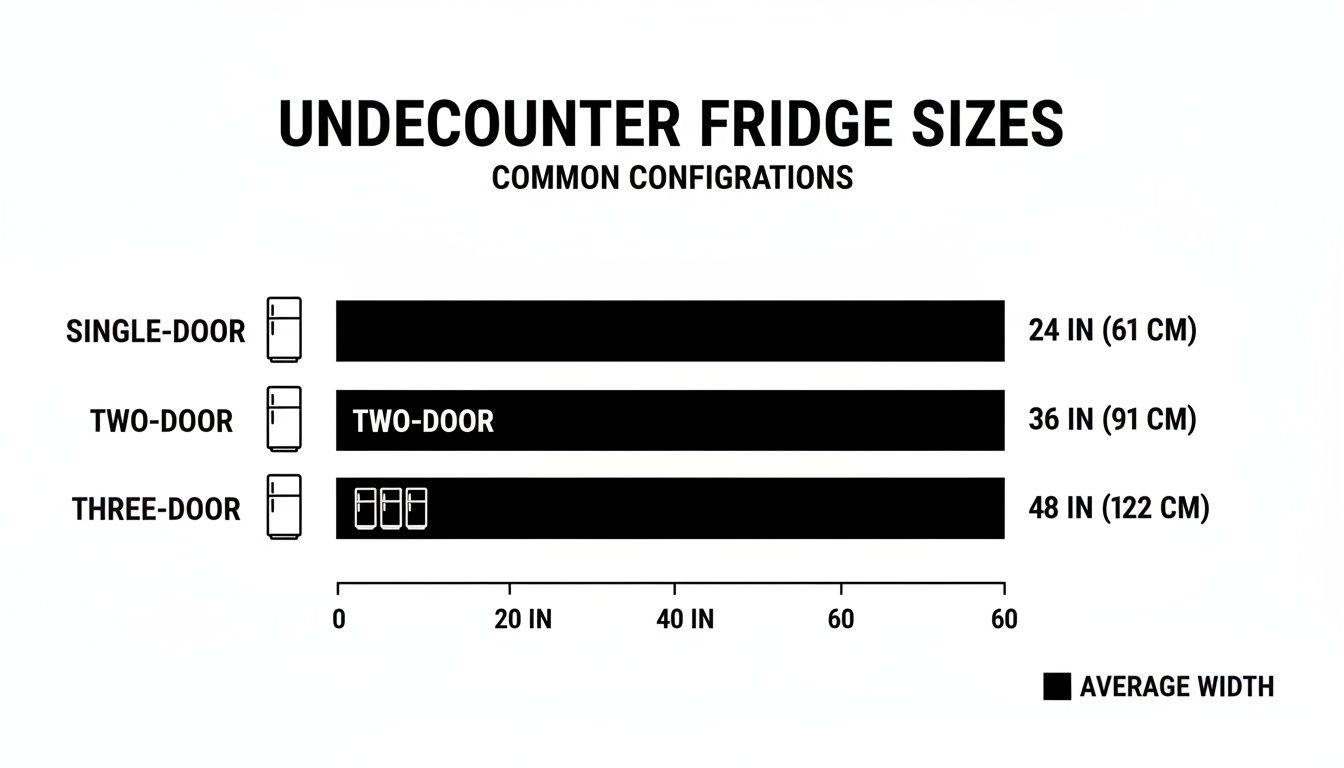
As you can see, the width expands with each additional door, which directly impacts both the unit’s footprint and how much product you can store. Getting your measurements right is a foundational step in any successful kitchen build-out. To learn more about making every inch count, check out our complete guide to commercial kitchen layout design. A few extra minutes with a tape measure now will save you a massive headache later.
Understanding Ventilation and Clearance Requirements
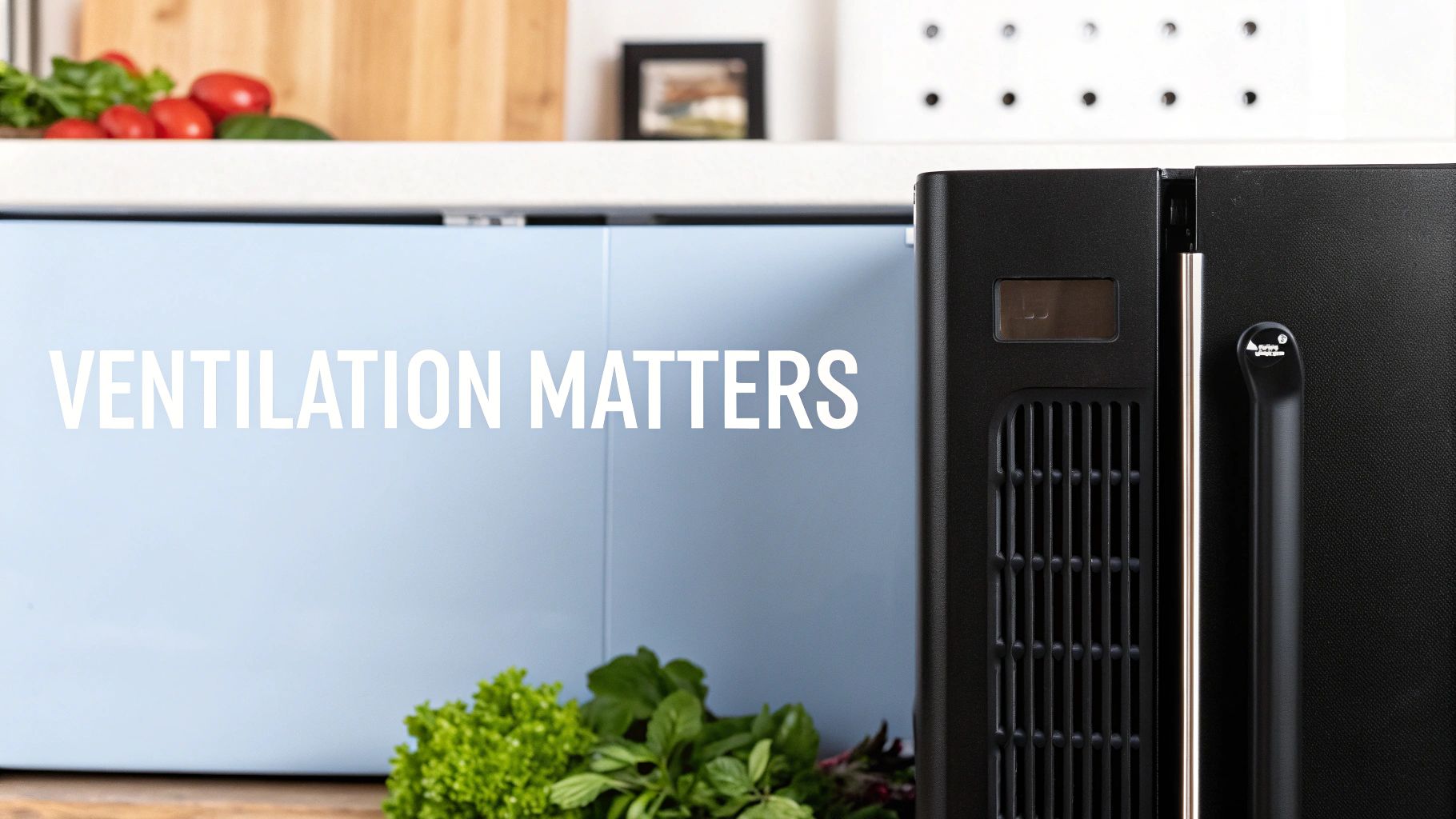
Getting the right under counter fridge dimensions is about more than just sliding a unit into a space. You absolutely have to account for ventilation. Proper airflow isn't just a suggestion; it's non-negotiable for the health of your restaurant equipment. Think about it: the compressor is constantly working, and that generates a lot of heat.
If that heat gets trapped, the unit has to work overtime just to keep its cool. This leads to two big problems every Los Angeles restaurant owner hates: sky-high energy bills and a machine that dies long before its time. Even worse, inconsistent cooling puts your inventory on the line, risking food safety and creating unnecessary waste.
Front-Breathing Versus Rear-Breathing Units
The layout of your line or back-of-house will pretty much decide what kind of ventilation you need. Knowing the difference between front-breathing and rear-breathing models is key, especially when you're working in tight quarters like a food truck or a crowded prep station.
- Front-Breathing Models: These are the pros of tight spaces. They're designed with vents on the front grille, which means you can build them right in and push them flush against the back wall. No rear clearance needed. They're the go-to solution when every inch counts.
- Rear-Breathing Models: This is the more traditional style, and they need room to breathe—literally. Heat dissipates from the back and sides, so you need to leave about 2-4 inches of clearance around the unit. They can be easier on the budget, but you have to plan for that extra space.
Trapped heat is the number one enemy of refrigeration efficiency. Forcing a rear-breathing unit into a zero-clearance space is like asking an athlete to run a marathon while holding their breath—failure is inevitable.
This isn't just true for kitchen coolers. Proper ventilation is vital for all sorts of commercial equipment, including highly specialized laboratory refrigerators, to keep them running safely and efficiently.
Before you install anything, always check the manufacturer's spec sheet for the exact clearance numbers. It’s the best way to protect your investment. If you want more tips on saving money, check out our guide on energy-efficient commercial refrigerators to see how the right unit can impact your bottom line.
Matching Fridge Capacity to Your Menu and Volume
The outside under counter fridge dimensions are just one piece of the puzzle. What really matters for your kitchen's workflow is the internal capacity, almost always listed in cubic feet (cu. ft.). This number tells you exactly how much product you can cram inside. For any busy L.A. restaurant, you have to translate that number into something real—like how many 1/6 pans it can hold.
It's an easy mistake to make: buying restaurant equipment that's either way too big or frustratingly small for what you actually do day-to-day. A fridge that's too large is just an expensive, energy-guzzling box taking up prime real estate. On the other hand, a unit that's too small means your cooks are constantly making disruptive trips to the walk-in, slowing down the line right in the middle of a chaotic dinner rush.
From Cubic Feet to Real-World Application
So how do you get it right? It all comes back to your menu and your customer volume. You need to take a hard look at your daily operations to figure out what you truly need.
A pretty standard two-door, 48-inch undercounter refrigerator will give you about 12 cubic feet of space. In practical terms, that’s usually enough to hold somewhere between 8 to 12 standard full-size (12" x 20") food pans, though the exact number depends on how deep your pans are.
Think about a popular spot for Mexican food in East L.A. That 12 cu. ft. means having enough room on the line for pans of carne asada, carnitas, grilled chicken, and all the salsas and toppings. Everything is chilled and right there, making sure tacos and burritos are flying out of the kitchen without a single delay.
Analyzing Your Restaurant's Needs
To nail down the capacity you need, you have to consider a few key things about your specific operation:
- Menu Complexity: The more diverse your menu is, the more fresh ingredients you'll need to keep at arm's reach. That means more refrigerated space is non-negotiable at every single prep station.
- Customer Traffic: Keep an eye on your daily cover counts. Higher volume means you're burning through product faster, which demands more storage right on the line.
- Inventory Turnover: How often are your food deliveries coming in? If you’re getting daily drops, you can probably get by with less line storage than a restaurant that only stocks up a couple of times a week.
Let’s put it this way: a high-volume food truck from the Los Angeles Food Trucks scene slinging gourmet sandwiches needs a unit that can hold a ton of pans with sliced meats, cheeses, and fresh veggies. A 12 to 18 cu. ft. model would be a smart move. But a small coffee shop in Silver Lake might only need a 6 cu. ft. unit for milk, cream, and a few grab-and-go items. When you match the capacity to your actual business, you're buying a valuable asset, not a daily headache.
Key Installation Considerations for LA Kitchens
A successful installation is about more than just checking your under counter fridge dimensions and sliding the unit into place. For restaurant owners here in Los Angeles and Orange County, a few smart pre-installation checks are the key to making sure your new restaurant equipment runs perfectly from day one. Taking this time now will save you from some serious operational headaches and costly downtime later.
The absolute first thing on your list should be to verify your kitchen's electrical setup. Commercial refrigeration units are workhorses that pull a lot of power, and they almost always require a dedicated circuit. This isn't just a suggestion—it's what keeps you from tripping breakers during a hectic dinner rush. Double-check that the outlet provides the exact voltage and amperage listed on the unit's spec sheet. An electrical mismatch can fry the compressor or create a fire hazard, so this is one step you can't afford to skip.
Power, Plumbing, and Placement
Next up, let's talk plumbing. A lot of modern undercounter refrigerators come with a condensate evaporator. This handy feature is basically a small pan that uses heat from the condenser coil to evaporate moisture, meaning you don't need a drain line. But you have to confirm this feature exists before you buy. If the model you want needs a drain, you’ve got to make sure there's a floor drain close by.
Now, think about where this unit will actually live. Fitting it into an opening is only half the battle; you also have to consider the real-world workflow of your kitchen staff.
- Door Swing Direction: Before you even think about ordering, figure out if you need a left-hinged or right-hinged door. A door that swings the wrong way can completely block a busy walkway, creating a bottleneck and a safety hazard for your team.
- Reversible Doors: Many models offer reversible doors, which gives you incredible flexibility if you ever rearrange your kitchen layout down the road. It’s a smart feature to look for, especially for a growing business.
Proper planning for door swing and traffic flow is one of the most overlooked aspects of kitchen design. A door that opens into a main path can reduce efficiency by up to 15% during a busy service due to staff having to constantly navigate around it.
Mobility vs. Stability: Casters or Legs?
Finally, you need to decide between making your unit mobile or keeping it in a fixed spot. Most commercial undercounter fridges give you the option of installing either casters (wheels) or stationary legs.
Casters are a fantastic choice for any Los Angeles kitchen. They make it incredibly easy to roll the unit out for deep cleaning underneath—a huge plus for staying on the right side of the health department. That mobility also makes a world of difference when it’s time for maintenance. On the other hand, stationary legs give you a more permanent, level installation, which might be better if you know for a fact the unit will never need to move.
For a deeper dive into organizing your workspace, our guide on setting up a restaurant kitchen offers some really valuable insights. Taking the time to sort out these installation details ensures your new equipment becomes a seamless, productive part of your operation.
Your Final Checklist Before You Buy
Alright, you’re on the home stretch. Picking out a new undercounter refrigerator is a big deal, and before you pull the trigger, it’s smart to run through one last quick check. This isn't just about avoiding a headache—it’s about preventing a costly mistake that could disrupt your whole operation. This final look-over will make sure the under counter fridge dimensions and features you’ve picked are truly the right fit for your restaurant.
First things first, grab that tape measure one more time and confirm your physical space measurements. Seriously. Did you factor in that weird pipe along the baseboard or the unevenness of the wall? Always, always use the smallest number you get for height and width. This one simple step is the best way to dodge a delivery day nightmare.
Next up, let's get technical. You need to make sure the unit’s specs actually match what your kitchen can handle.
The Pre-Purchase Verification
Making the right call goes way beyond just the unit’s size. Your final check should hit these key points:
- Ventilation Clearance: Is this a front-breathing model built for a tight, zero-clearance install, or does it need breathing room on the back and sides? Double-check that you have the space it needs for proper airflow, or you're asking for trouble.
- Electrical Compatibility: Take a look at your outlet. Is it on a dedicated circuit? Does the refrigerator’s required voltage and amperage match up exactly with what you've got? No guesswork here.
- Door Swing and Workflow: You’ve got a busy Los Angeles kitchen. Have you picked the right door hinge side (left or right)? You don't want a fridge door constantly blocking a major walkway during a dinner rush.
- Capacity vs. Menu Needs: Does the internal cubic footage realistically handle your daily prep and service flow? You want the Goldilocks fit—not too big and not too small for what you’re actually storing.
One final thought: protecting your investment. Before you sign on the dotted line, think about whether an extended appliance warranty makes sense for you. For a piece of commercial equipment that’s going to be working hard every single day, it can offer some serious peace of mind against surprise repair bills down the road.
By taking a few minutes to walk through this checklist, you can place your order with total confidence, knowing you’ve bought a reliable unit that will serve your business well for years to come.
Got Questions? We’ve Got Answers.
When you're trying to figure out under counter fridge dimensions, a few last-minute questions always seem to pop up. This is especially true for busy restaurant and food truck owners here in Los Angeles. Getting these final details sorted is the key to a smooth purchase and install. Here are the clear, straight-to-the-point answers we give operators across Southern California every day.
Can I Just Use a Regular Mini Fridge Under My Counter?
We hear this one a lot, and the answer is a hard no. A standard mini-fridge is a freestanding unit, meaning it’s designed to push heat out from its back and sides. It needs a few inches of open air all around to breathe.
If you box one into a tight cabinet, you’re trapping all that heat. The compressor will be forced to run nonstop just to keep things cool. It's a classic mistake that leads straight to sky-high energy bills, a fried compressor, and even a potential fire hazard. You have to go with a model specifically made to be "built-in" or "undercounter." These units have grilles on the front to ventilate properly, allowing them to be installed flush with your cabinetry.
What Is an ADA-Compliant Undercounter Fridge?
You might come across models with an "ADA-compliant" label. This just means the unit is designed to follow the guidelines from the Americans with Disabilities Act.
An ADA-compliant undercounter fridge will have a maximum height of 32 inches, a little shorter than the standard 34-inch models. That lower profile lets it slide perfectly under a 34-inch high countertop, which puts all the controls and contents within easy reach for staff members who use wheelchairs. It’s a key detail for building a workspace that’s accessible and functional for your whole team.
How Much Clearance Does an Undercounter Fridge Really Need?
The clearance you need all comes down to how the unit ventilates, so your first stop should always be the manufacturer's spec sheet. That said, there are some good rules of thumb to follow.
- Built-In, Front-Venting Models: These are the ones designed for that clean, seamless look. They usually need very little wiggle room—often just 1/8 of an inch on the sides and top to slide it into place.
- Freestanding or Rear-Venting Models: These units need space to breathe. You should plan for at least 1-2 inches of clearance on each side and as much as 4 inches at the back to keep air flowing and prevent it from overheating.
Ready to find the perfect fit for your Los Angeles or Orange County spot? At LA Restaurant Equipment, we have a huge selection of commercial-grade undercounter refrigerators built for the grind of a professional kitchen.
Explore our collection online or give our team a call for a personalized quote today.