

When you’re running a restaurant in Los Angeles, every single dollar on that utility bill matters. An energy-efficient commercial refrigerator isn’t just some fancy appliance; it’s a smart piece of equipment built to do its job without draining your bank account.
These units use better parts—think advanced compressors, top-notch insulation, and modern refrigerants—to keep food perfectly chilled while using a lot less electricity. Whether you're running a busy Los Angeles pizza joint, a fleet of food trucks, or a classic Mexican food spot, this is one of the smartest investments you can make for your kitchen's bottom line.
Why Your Refrigerator Is Your Kitchen's Silent Spender
In the non-stop world of LA's food scene, you’re focused on the food, the customers, and the staff. But there’s a silent employee in your kitchen working 24/7 without ever taking a break: your commercial refrigerator. Because it never stops running, your refrigeration system is quietly one of the biggest energy hogs in your entire operation.
Think of an old, inefficient fridge like a car with a slow, steady gas leak. It'll still get you where you need to go, but it’s wasting fuel and costing you money with every mile. That’s exactly what an outdated refrigeration unit is doing—quietly siphoning off your profits, month after month, by forcing its compressor to work way harder than it should.
The Hidden Costs of Inefficiency
The financial hit from all that wasted energy is bigger than most operators realize. Commercial refrigerators are notorious power consumers. A standard unit might pull around 17,000 kWh of electricity a year, but larger walk-ins can easily guzzle up to 38,000 kWh.
For businesses like grocery or convenience stores, refrigeration can be responsible for nearly half of the entire energy bill. You can discover more insights about commercial refrigeration energy efficiency to get a sense of just how massive this cost can be.
This is why you have to start looking at an energy-efficient commercial refrigerator as a strategic financial move, not just another piece of restaurant equipment. Upgrading is a direct investment in the long-term health and profitability of your restaurant.
By choosing a modern, efficient model, you are actively cutting down a major operational expense, freeing up capital that can be reinvested into other critical areas of your business, like menu development or marketing.
The perks go beyond just a lower electricity bill, too. Modern units hold their temperature more consistently, which means better food safety and less spoilage—another hidden cost that chips away at your profits. They also tend to run quieter and throw off less heat, making your kitchen a more comfortable and productive place for your team to work. It's a chain reaction: a smarter choice in refrigeration leads to real savings and better performance across your whole business.
How to Read and Compare Refrigerator Efficiency Ratings
Stepping into the world of commercial refrigeration can feel like you're learning a new language, with spec sheets full of acronyms and technical data. But it's simpler than it looks. Just like the MPG sticker on a car gives you a clear picture of its fuel economy, refrigerator efficiency ratings tell you exactly how a unit will perform and what it will cost to run.
For any Los Angeles restaurant, from a bustling pizza parlor to a nimble food truck, understanding these numbers is the key to making a smart investment. Your coolers and freezers are working 24/7, and they're one of the biggest energy hogs in your kitchen.
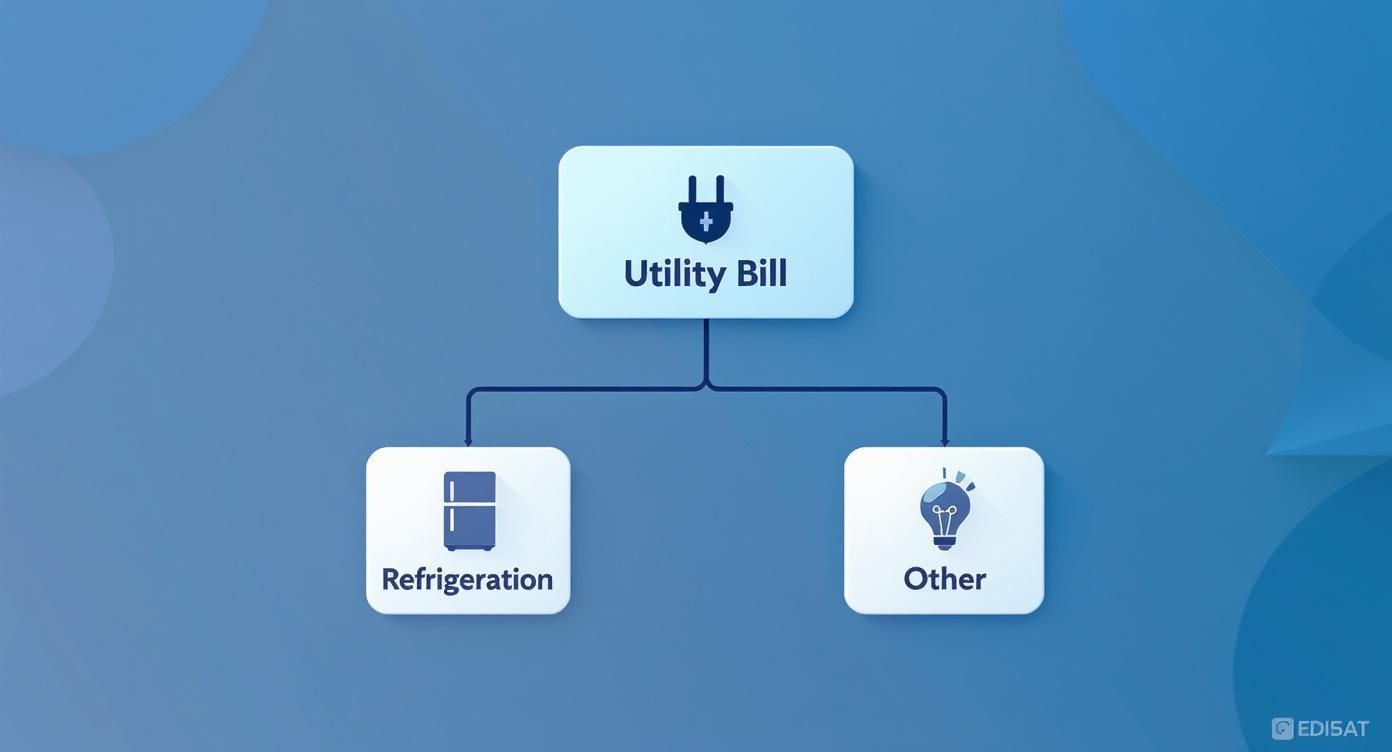
As you can see, your refrigeration equipment is a massive slice of your utility bill. Getting a handle on efficiency isn't just a "nice-to-have"—it's a critical part of managing your operational costs.
Key Efficiency Metrics at a Glance
To make it easy, we've broken down the most important ratings you'll see. Think of this table as your cheat sheet for decoding spec sheets and making quick, informed comparisons on the fly.
| Metric/Rating | What It Measures | Why It Matters for Your Kitchen |
|---|---|---|
| DOE Standards | The mandatory minimum energy efficiency required for a refrigerator to be legally sold in the U.S. | This is your baseline. If a unit doesn't meet DOE standards, you can't even buy it. It's the bare minimum for performance. |
| ENERGY STAR | A voluntary certification for units that significantly exceed the minimum DOE standards—often using 10-30% less energy. | The blue ENERGY STAR label is your shortcut to finding a high-performance, money-saving machine. It's the "honor roll" of efficiency. |
| kWh/yr | The total estimated kilowatt-hours the unit will consume in one year of typical use. This is your most direct cost indicator. | Lower kWh/yr means a lower electricity bill, period. This number lets you calculate real-dollar savings between different models. |
Knowing these three metrics puts you in the driver's seat. You'll be able to quickly size up any piece of equipment and understand its true cost over time.
Decoding the Labels: ENERGY STAR and DOE
The two most important seals of approval you'll see are from the Department of Energy (DOE) and ENERGY STAR.
Think of the DOE standards as the mandatory passing grade for any commercial refrigerator sold in the United States. These regulations set the minimum efficiency requirements, making sure that even the most basic models don't guzzle an insane amount of energy.
The ENERGY STAR label, on the other hand, is like the honor roll. This blue sticker is only awarded to models that go way beyond the minimum DOE standards, often using 10-30% less energy than their conventional cousins.
An ENERGY STAR certified refrigerator is more than just an appliance; it's a guarantee from the U.S. Environmental Protection Agency that you are buying one of the most efficient products in its class, designed to deliver superior performance while saving you money.
When you see that ENERGY STAR logo, you can trust the unit has been rigorously tested and proven to cut down on energy consumption. For busy restaurant owners, it’s a trusted shortcut that translates directly into lower utility bills for your business.
The Most Important Number: kWh per Year
While certifications are a great starting point, the single most powerful metric for comparing the running costs of different refrigerators is the kWh/yr rating. This stands for kilowatt-hours per year.
This number tells you exactly how much electricity the unit is expected to consume over 12 months of normal use. A lower kWh/yr figure always means a more energy-efficient commercial refrigerator.
Imagine you're comparing two similar reach-in coolers for your kitchen:
- Model A: Rated at 2,200 kWh/yr
- Model B: Rated at 1,500 kWh/yr
Right off the bat, you know Model B will use 700 fewer kilowatt-hours of electricity every single year. You can multiply that number by your local Los Angeles electricity rate to calculate your exact annual savings in dollars and cents.
This simple piece of data empowers you to look beyond the initial price tag and see the long-term financial impact of your decision.
Ultimately, mastering these simple ratings transforms you from a casual buyer into an informed investor. It gives you the confidence to assess any refrigerator's spec sheet and choose the model that will best protect your ingredients, support your kitchen's workflow, and strengthen your restaurant's bottom line.
Matching the Right Refrigerator to Your LA Kitchen
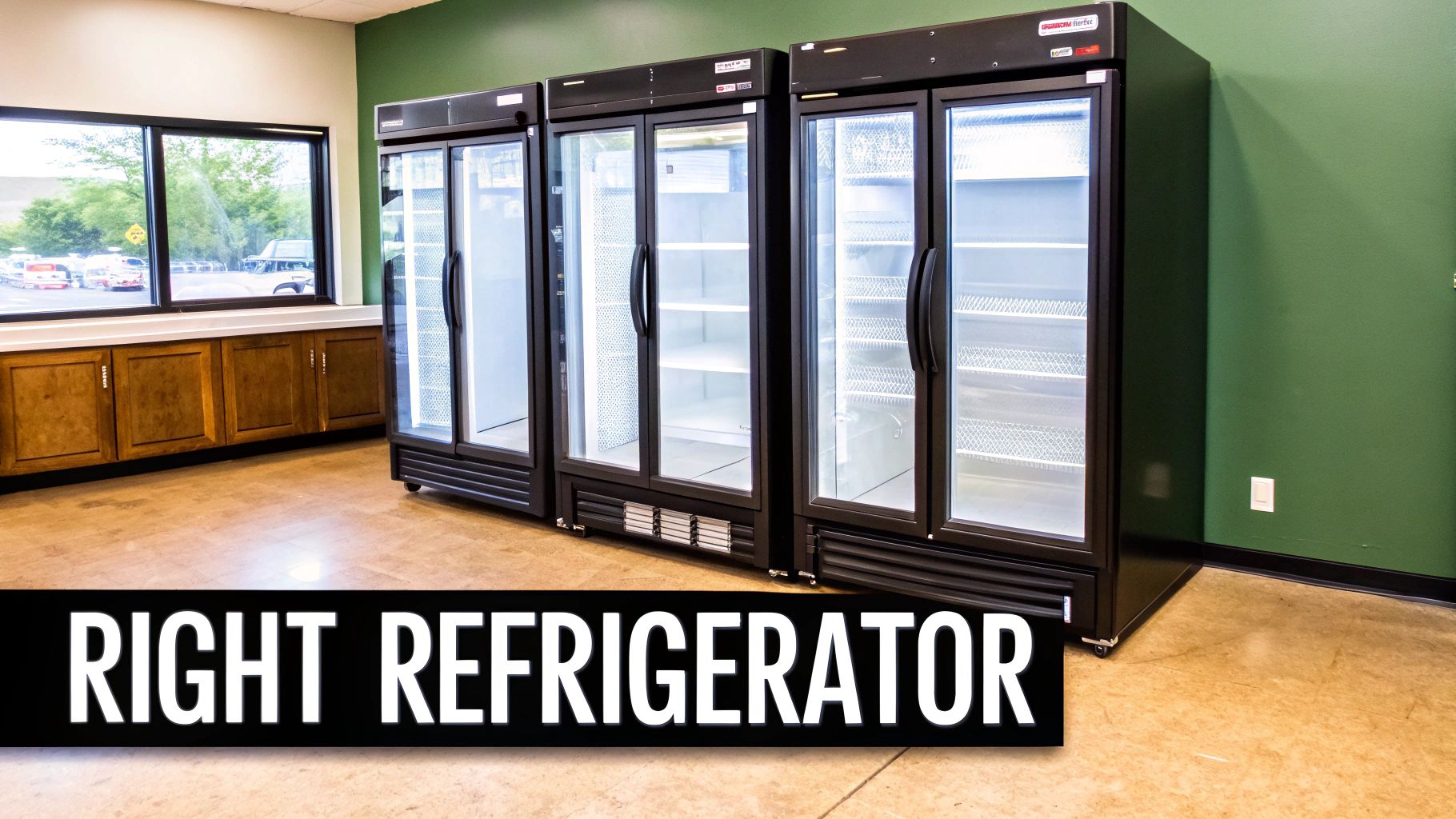
The LA food scene is a wild mix of concepts, each with its own unique footprint and flow. A one-size-fits-all approach to restaurant equipment just doesn't cut it here. The perfect fridge for a slammed Mexican food spot in East LA would be a disaster for a tiny artisanal pizza truck cruising through Venice. Picking the right energy efficient commercial refrigerator isn't just about how big it is; it’s about matching the unit’s design to your actual workflow to max out both efficiency and savings.
This is more critical than ever, as the whole industry pushes toward sustainability. Demand for eco-friendly gear is through the roof. The global market for commercial refrigeration is expected to jump from USD 42.94 billion in 2024 to a whopping USD 67.80 billion by 2033. This boom is fueled by tougher environmental rules and smart new tech like intelligent defrost cycles and better compressors that slash energy use. You can dive deeper into the market trends shaping commercial refrigeration and see why efficiency is the new normal.
Reach-In Refrigerators: The Backbone of Bulk Storage
Let's be real—for almost any restaurant, the reach-in refrigerator is the undisputed workhorse. These are your classic upright units for stashing bulk ingredients, from cases of produce to Cambros of house-made sauce. The best Mexican food restaurants rely on a big multi-door reach-in to hold mountains of avocados, meats, and cheeses, making sure they’re ready for the dinner rush.
When you're shopping for an energy-efficient model, look for things like self-closing doors—a lifesaver for preventing cold air from escaping—and top-mounted compressors. Top-mounts are great because they don't suck in all the dust and grease from the kitchen floor. In a hectic kitchen where doors are flying open constantly, these details really matter.
Undercounter and Prep Tables: For Streamlined Workstations
In so many LA kitchens, space is gold, especially if you're operating one of the many Los Angeles food trucks or a pop-up. This is where undercounter fridges and refrigerated prep tables become your best friends. They pull double duty, giving you cold storage right underneath valuable counter space, creating a super-efficient, all-in-one workstation.
Think about it in these real-world scenarios:
- Los Angeles Pizza Parlor: A pizza prep table is non-negotiable. It's got refrigerated wells on top for pepperoni, mushrooms, and cheese, with a chilled cabinet below for dough. Everything is right there, which makes slinging pies during the lunch rush way faster.
- LA Food Trucks: For a taco truck, a small undercounter unit is perfect. It tucks right under the counter, holding salsas, marinated meats, and fresh cilantro. Its compact size is key to making every inch count in a mobile kitchen.
- High-End Bistro: Here you’ll find a chef base. It’s a low-profile refrigerated unit tough enough to hold a griddle or charbroiler right on top. This keeps steaks and fish perfectly chilled right where the chef is searing them.
For these kinds of stations, energy efficiency is about more than just the power bill. It’s about optimizing your workflow. A good unit holds its temperature precisely, which is crucial for food safety and quality right in the heat of service.
Merchandisers and Bar Coolers: For Customer-Facing Appeal
Sometimes, your fridge needs to do more than just keep things cold—it needs to sell. Glass door merchandisers and back bar coolers are built to both chill and merchandise your products. A hip cafe in Silver Lake might use a slick glass door merchandiser to show off bottled cold brews and fancy sandwiches, tempting people while they're in line.
A downtown bar needs the same thing from its back bar cooler. Bright, low-energy LED lights not only keep beers and wine at the perfect temp but also make the selection look irresistible, pushing patrons to try that new local craft beer. With these units, efficiency pays you back twice: lower operating costs and a better presentation that can give your sales a direct lift.
When you thoughtfully choose the right type of energy efficient commercial refrigerator for each part of your operation, you’re not just buying an appliance. You’re investing in a piece of restaurant equipment that actively supports your menu, your crew, and your bottom line.
Calculating Your True Return on Investment
When you’re buying new restaurant equipment, it’s all too easy to get laser-focused on the upfront cost. But the real value of an energy efficient commercial refrigerator isn't on the price tag—it’s something you see over its entire working life. The number that truly matters is the Total Cost of Ownership (TCO), which is the purchase price plus all the energy costs you'll rack up over the years.
A cheaper, less efficient unit might look like a great deal today, but it can quickly turn into one of the most expensive items in your kitchen. Those higher monthly utility bills will slowly but surely chip away at your profits. On the flip side, a modern, efficient model delivers savings that add up month after month, making it a much smarter financial play for any Los Angeles restaurant, whether you're running a local pizza joint or a high-volume Mexican spot.
A Simple Formula for Calculating Savings
You don't need to be an accountant to figure out your potential return. A quick, back-of-the-napkin calculation can give you a surprisingly clear picture of what a new energy-efficient unit will save your business every year. It’s a simple, three-step process.
-
Find the Energy Difference: Start by comparing the annual energy consumption (kWh/yr) of your old unit with a new, efficient model. If you have no idea what your old fridge is pulling, a safe bet for a standard reach-in is somewhere around 2,500-3,000 kWh/yr. A new ENERGY STAR model might come in at 1,500 kWh/yr. Right there, you're looking at 1,000 to 1,500 kWh in annual savings.
-
Calculate Annual Dollar Savings: Next, just multiply those saved kWh by your local electricity rate. Business electricity rates in Los Angeles can easily hit $0.25 per kWh (and sometimes more during peak hours). Using our example, saving 1,500 kWh a year means you’re putting $375 back in your pocket—from just one refrigerator.
-
Determine the Payback Period: Finally, divide the extra upfront cost of the new refrigerator by your annual savings. Let's say the new unit costs $1,500 more than a standard model. Your payback period would be just four years ($1500 / $375).
This simple math shows just how fast an investment in efficiency starts paying you back. Over a typical 10-year lifespan, that one refrigerator would save you $3,750, easily covering its higher initial cost and then some.
Don't Forget About Rebates and Incentives
For Southern California business owners, the deal gets even sweeter. Local utility companies and government programs are practically begging you to upgrade by offering rebates and tax incentives for buying ENERGY STAR certified equipment. These programs can dramatically shorten your payback period.
These financial incentives are a massive piece of the ROI puzzle. A rebate can instantly knock hundreds of dollars off the net cost of your new refrigerator, making the financial case for upgrading almost a no-brainer.
Think about it: a $300 rebate on that $1,500 price difference drops your real investment to $1,200. Suddenly, your payback period shrinks from four years to just over three. To see how these equipment costs fit into the bigger picture, check out our complete restaurant startup costs breakdown.
When you stack long-term energy savings on top of immediate financial perks, the choice becomes clear. Investing in an energy efficient commercial refrigerator isn't just an expense; it’s a strategic move that boosts your bottom line and helps build a more profitable, sustainable kitchen for years to come.
Best Practices for Maintaining Peak Efficiency
Dropping some cash on a new, energy-efficient commercial refrigerator is a brilliant move. But let's be real, that's only half the job.
Think of it like getting a high-performance car; you wouldn't just drive it without ever changing the oil, right? To keep it running like a dream, you’ve got to give it regular tune-ups. The exact same logic applies to your refrigeration. Consistent care is how you protect that investment and make sure it keeps delivering on its promise of peak performance and lower bills for years.
If you let maintenance slide, even the most advanced, top-of-the-line unit will start losing its edge. Dust will inevitably clog up the important bits, seals will wear down, and tiny problems will start to snowball. Before you know it, the compressor is working overtime, chugging power just to keep up. It’s a slow creep that can sneak up on you, quietly padding your utility bills month after month.

Simple Habits for a More Efficient Kitchen
Here’s the good news: keeping your refrigerator’s efficiency high doesn't mean you have to completely rework your kitchen's flow. It really just comes down to building a few simple, high-impact habits into your team's daily and weekly rhythm.
Here's a practical checklist to keep your units running strong:
- Clean Condenser Coils Regularly: The condenser coils are your fridge’s radiator—they push heat out. In a busy kitchen, they get caked with dust and grease fast. When that happens, they can't shed heat properly, forcing the compressor into overdrive. A quick brush-down every month makes a huge difference.
- Inspect and Clean Door Gaskets: Those rubber seals (gaskets) around the doors are the only thing keeping the cold air in. If they get cracked, brittle, or grimy, cold air leaks out, and your unit has to run constantly to hold its temperature. A daily wipe-down and a quick check for a tight seal is all it takes.
- Organize for a Quick Grab: Every single second a refrigerator door is open, you're swapping precious cold air for warm kitchen air. By organizing your ingredients logically—keeping the most-used items right at the front—your staff can grab what they need and shut the door in a flash. That tiny habit seriously cuts down on energy waste.
The Bigger Picture
These little actions add up to something much bigger. Globally, refrigeration and air conditioning account for a staggering 17% of all electricity consumption, making it a massive piece of the energy puzzle. The upside is that technology has made incredible leaps; a standard household fridge today, for instance, uses about 65% less energy than its counterpart from 15 years ago. You can see the full picture with more worldwide refrigeration statistics.
A proactive maintenance plan is one of the single most effective ways for Los Angeles restaurants—from pizza shops to food trucks—to lower their own operational costs while doing their part.
Adopting these habits does more than just trim your electricity bill. It also extends the life of your equipment, slashes the risk of a surprise breakdown (and the costly emergency repair bill that comes with it), and promotes better food safety with more reliable temperatures.
For a deeper dive, check out our complete guide on commercial kitchen equipment maintenance. It’s a playbook to help your whole team protect your assets and keep your kitchen running at peak financial and operational form.
Finding Your Restaurant Equipment Partner in Los Angeles
Okay, so you've crunched the numbers on energy efficient commercial refrigerators. You understand the specs, you get the ROI, but now comes the real challenge: turning all that knowledge into the right piece of equipment sitting in your kitchen. That's where a good partner comes in.
The perfect fridge isn't just about a good Energy Star rating. It's about finding the one that actually works for your layout, your menu, and your vision for the next five years. From a cramped food truck kitchen to a massive, high-volume Mexican spot in DTLA, every restaurant in this city has its own unique puzzle to solve. We live and breathe those puzzles.
Why a Local Partner Matters
Choosing a supplier shouldn't feel like a one-off transaction. You're building a relationship with a team that gets the Southern California scene—from the nuances of local health codes to the best utility rebates you can snag right now. We don't just move boxes; we offer support that’s built for the speed of your business.
Here’s what that actually looks like:
- A Curated Selection: We don't overwhelm you with endless options. We stock a focused inventory of proven, warranty-backed models from brands we trust, like Atosa. You get performance without the guesswork.
- Rebate Expertise: Our team is always on top of the latest local incentives. We’ll help you find every dollar of savings to shorten that payback period on your investment.
- Smart Financing: Need the equipment now but want to manage cash flow? We connect you with financing options that turn a big purchase into a manageable monthly payment.
Think of the right equipment partner as an advocate for your restaurant's bottom line. We sweat the logistics so you can focus on what you do best: creating incredible food.
Our goal is to be more than just a name on an invoice. We’re here to give you the confidence to make a smart, profitable decision for your kitchen. You can learn more about what to look for by reading our guide to commercial kitchen equipment suppliers in the LA area.
With warehouse-direct pricing and fast, free shipping across Southern California, we're built to support independent operators. Whether you’re launching a new pizza joint or finally upgrading your prep line, our team is ready to talk. Let’s find the perfect refrigeration solution to help you win.
Frequently Asked Questions
When you're thinking about a big equipment purchase, you're going to have questions. That's a good thing. It means you're thinking strategically about your restaurant's future. Let's tackle some of the most common questions we hear from LA restaurant owners about switching to an energy-efficient commercial refrigerator.
How Much Can I Realistically Save with an ENERGY STAR Refrigerator?
This is always the first question, whether you're running a pizza parlor in the Valley or a food truck in Venice. The exact number depends on your local electricity rates and the specific model, but a typical restaurant can expect to save anywhere from $80 to over $400 per year on a single ENERGY STAR certified unit.
Now, imagine you're running multiple refrigerators and freezers. Those savings start to add up, fast. A high-efficiency model can cut its energy use by 10% to 30% compared to a standard unit that just meets the basic DOE rules. Over the 10+ year life of that machine, you're talking about thousands of dollars straight back to your bottom line.
Are Energy Efficient Models Less Powerful?
This is a persistent myth, and it’s time to bust it. The idea that efficiency means sacrificing cooling power is totally outdated. In fact, it's the other way around. These refrigerators save energy because they use smarter, better technology—not because they're weaker.
Think about it like a high-end insulated cooler versus a cheap foam one. The better cooler keeps things ice-cold for longer with less ice. Modern fridges do the same thing with superior components:
- High-efficiency compressors deliver more cooling muscle while using less electricity.
- Better insulation is a huge factor. It locks the cold air in, so the unit doesn't have to constantly kick on to fight the kitchen heat.
- Smart defrost cycles only run when they absolutely have to, which prevents pointless energy spikes.
What this really means is that an energy-efficient model often gives you more stable and consistent temperatures. In a busy Mexican food kitchen where the doors are flying open all day, that’s a massive win for food safety and quality.
What Is the Average Lifespan of a New Commercial Refrigerator?
New equipment is a serious investment, and you need it to last. A quality, well-maintained commercial refrigerator should give you 10 to 15 years of solid service, and sometimes even more.
The real secret to hitting that 15-year mark and beyond? Simple, consistent maintenance. Taking a few minutes to clean condenser coils and check door gaskets protects the compressor—the heart of the machine—from burning out early.
By choosing an energy-efficient model, you're not just saving on your utility bills. You're getting a unit built with modern, durable components designed for the grind of a commercial kitchen. It’s an investment in pure reliability that pays you back year after year.
Ready to find the perfect energy-efficient refrigeration solution for your LA restaurant? At LA Restaurant Equipment, we offer a curated selection of top-tier, warranty-backed equipment at warehouse-direct prices. Explore our inventory and see how much you can save at https://larestaurantequipment.com.