

Getting your grease trap sizing right isn't just about ticking a box for the health inspector—it's a massive business decision for any restaurant owner in Los Angeles. A unit that's too small is a recipe for messy sewer backups and painful fines from the city. Go too big, and you're just wasting money and precious kitchen space. Whether you're running one of the many Los Angeles food trucks, a classic pizzeria, or a beloved spot for Mexican food, choosing the right restaurant equipment is key.
The whole game is about matching the trap's capacity to your kitchen's specific output of fats, oils, and grease (or FOG, as we call it in the industry).
Why You Can't Afford to Get Sizing Wrong
For any LA eatery—from a slammed downtown pizza joint to a beloved East LA food truck—dealing with FOG is non-negotiable. Every time your cooks fire up a fryer, griddle, or wok, that grease-heavy water is headed straight down the drain. This is a critical aspect of managing restaurant equipment that many owners overlook.
Without a properly sized grease trap doing its job, that FOG hits the city’s sewer system. Down there, it cools, hardens, and creates monstrous blockages people call "fatbergs." These clogs are a nightmare, causing sewer overflows, environmental damage, and public health risks. Trust me, the City of Los Angeles takes this stuff very seriously.
But an incorrectly sized trap creates immediate headaches right inside your own four walls.
The Problem with Undersized and Oversized Units
You're really caught between a rock and a hard place if you guess wrong on sizing.
-
Going Too Small: A trap that can't handle your volume will get overwhelmed fast, especially during a dinner rush. The first signs are slow drains and nasty odors that can send customers running. The worst-case scenario? Sewage backing up into your sinks and all over the kitchen floor. That's not just a mess; it's a guaranteed health code violation that can shut you down for emergency plumbing repairs you didn't budget for.
-
Going Too Big: It might feel like a safe bet to oversize, but that can backfire, too. If wastewater sits in a massive trap for too long, the FOG and food solids start to decompose and produce corrosive hydrogen sulfide gas. This stuff will literally eat away at the trap, whether it’s made of concrete or steel, causing it to fail way sooner than it should. Then you're on the hook for another expensive replacement.
The financial hit from a bad decision here can be brutal. An undersized trap needs to be pumped out way more often—sometimes weekly instead of quarterly—which sends your maintenance costs through the roof. On top of that, LA and other SoCal cities don't mess around with fines for FOG violations, which can easily hit thousands of dollars for a single incident.
Think of it this way: choosing the right grease trap is just as foundational as picking the right oven or walk-in cooler. It protects your investment, prevents operational nightmares, and keeps you in the good graces of the health department.
Ultimately, taking the time to size your trap accurately is a proactive move that protects your entire operation. It avoids the kind of disruptive emergencies that kill profits, keeps your kitchen humming, and helps you dodge huge financial penalties. It's a key piece of the puzzle when managing your overall restaurant startup costs, making sure you put your money where it counts from day one.
Here at LA Restaurant Equipment, we specialize in helping Southern California kitchens find the exact unit that fits their real-world needs.
Figuring Out Grease Traps vs. Interceptors
Before you even think about crunching numbers, you need to speak the language. Plumbers, health inspectors, and your friendly equipment suppliers (like us!) all use specific terms. Getting it wrong can be a costly mistake, easily setting you back thousands if you buy the wrong unit.
The two big ones you have to know are grease trap and grease interceptor.
People throw these terms around like they’re the same thing, but they absolutely are not. Think of it this way: one is a small prep fridge you tuck under a counter, and the other is a massive walk-in cooler. They both keep things cold, but they’re built for completely different jobs.
The Small Contender: Grease Traps
A grease trap is the smaller of the two systems. These are compact units, the kind you usually see installed indoors right under a sink. In the plumbing codes, you'll sometimes see them called hydromechanical grease interceptors (HGIs), but most people in the kitchen just call them traps.
These are built for kitchens that aren't cranking out a ton of greasy wastewater. They use a smart system of baffles to slow the water down, giving all that nasty FOG (Fats, Oils, Grease) a moment to cool off, separate, and float to the top for easy cleaning.
- Capacity: Usually under 100 gallons. You'll commonly see 20, 35, or 50-gallon models.
- Location: Almost always inside, typically right under a 3-compartment sink.
- Best For: Lower-volume spots like a small coffee shop, a deli, or an L.A. food truck with a simple menu.
Imagine one of the many Los Angeles food trucks cruising along Venice Beach. Space is tight, and their FOG output is manageable. A compact, under-sink grease trap is the perfect fit.
The Heavyweight Champion: Grease Interceptors
Now, a grease interceptor is a whole different beast. These are huge, high-capacity systems, often holding 500 to 1,500 gallons or even more. You won't find these under a sink; they’re almost always massive tanks buried in the ground outside.
These big boys, often called gravity grease interceptors (GGIs), don’t need fancy baffles. They rely on pure size and time. Wastewater flows into the tank and just sits there for a while, letting gravity do all the hard work of separating the grease from the water.
- Capacity: They usually start at 500 gallons and can go way up from there.
- Location: Buried outside, connected directly to your main sewer line.
- Best For: High-volume restaurants, especially places with automatic dishwashers, big cook lines, and menus heavy on the fried stuff.
A busy restaurant serving Mexican food in East L.A. with a battery of fryers, a flat-top griddle, and a high-temp commercial dishwasher? The Los Angeles health department will almost certainly demand a large, in-ground grease interceptor. No question.
The real game-changer is often the commercial dishwasher. The sheer volume and scorching hot water blasting out of those machines will completely overwhelm a small indoor trap. If you have one, a big interceptor is pretty much non-negotiable.
Key Performance Metrics You’ll Hear About
Beyond just the type of unit, you'll hear a couple of other terms thrown around when you're getting quotes and talking to plumbers. Knowing what they mean will make the whole process much smoother.
Flow Rate (GPM): This stands for Gallons Per Minute. It’s a measure of how much wastewater your sinks and dishwashers can dump down the drain at full blast. Think of it like rush hour on the 405—you need enough lanes to handle the peak traffic without everything backing up into your kitchen.
Retention Time: This is simply how long the wastewater gets to hang out inside the trap or interceptor. The longer it stays, the more FOG has a chance to separate. Big gravity interceptors have long retention times because of their huge tanks. Smaller traps use those internal baffles to slow things down artificially and get the job done faster in a smaller space.
Nailing these basic concepts is the first step. It ensures you’re not just picking the right size, but the right type of equipment for your specific Los Angeles restaurant. This is how you avoid expensive mistakes and keep your kitchen running without a hitch.
Alright, let's get into the nitty-gritty: the actual math behind sizing your grease trap.
Getting this right isn't just about passing an inspection; it's about preventing the kind of plumbing nightmares that can shut down your kitchen during a Friday night rush. You want to invest in a piece of equipment that actually does its job. The industry generally leans on two different methods, and which one you use depends on what you're trying to size.
This is more than just plugging numbers into a formula. It's about understanding why you're using them.
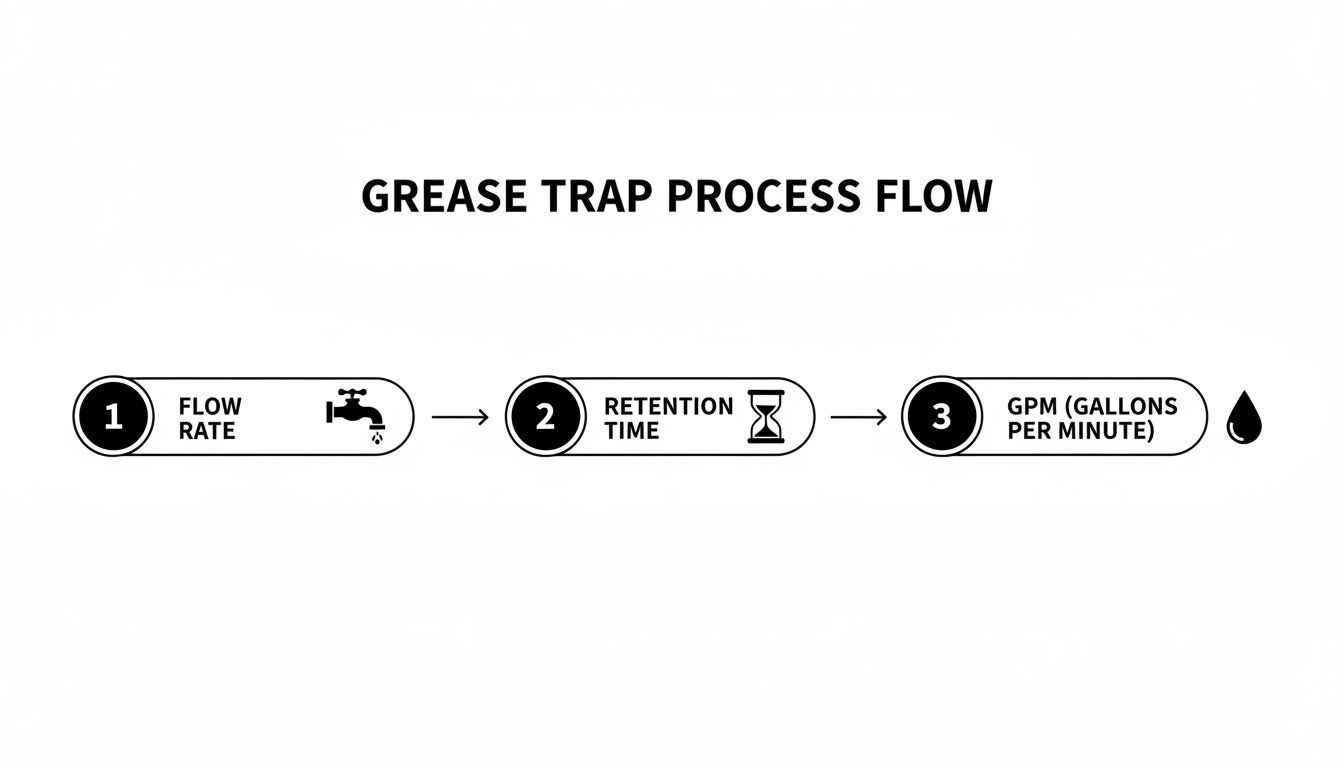
Think of it like this: the water rushing out of your sinks (Flow Rate) needs to sit in the trap long enough (Retention Time) for the grease to actually separate. The whole process is measured in Gallons Per Minute (GPM). If the water moves through too fast, the grease goes right down the drain with it, and your trap is basically useless.
The Flow Rate Method Based on Sink Dimensions
The most direct way to figure out your needs is to simply measure the fixtures spitting out the greasy water. This approach is perfect for smaller, under-sink grease traps dedicated to a specific station, like a 3-compartment sink.
The logic is simple. A sink can only hold so much water, and that's the absolute maximum it can dump into your trap at once.
Here’s the formula to start with:
Sink Volume (in gallons) = [Length (in) x Width (in) x Depth (in)] / 231
Once you have the total volume, you need to find the actual flow rate. Nobody fills a sink to the absolute brim, so inspectors and plumbers typically work with a 75% capacity assumption.
Flow Rate (GPM) = Sink Volume (gallons) x 0.75 / Drainage Period (minutes)
Most commercial sinks drain in about one minute, so you’ll usually use 1 for the drainage period. If you have a slow drain, you might use 2.
Real-World Example: A Taco Truck in East LA
Imagine a bustling taco truck—a classic example of popular Los Angeles food trucks—with a standard 3-compartment sink. Each basin measures 18" x 18" x 12".
-
First, find the volume of a single basin:
(18 x 18 x 12) / 231 = 16.8 gallons -
Next, calculate the GPM for that one basin (assuming a 1-minute drain):
16.8 gallons x 0.75 / 1 minute = 12.6 GPM -
Finally, find the total GPM for all three:
In a busy kitchen, it's entirely possible all three sinks could be draining at once. You have to account for that peak scenario.
12.6 GPM + 12.6 GPM + 12.6 GPM = 37.8 GPM
For this taco truck, the owner needs a grease trap rated for at least 38 GPM. On the market, they'd look for the next size up—probably a 40 GPM or 50 GPM model—to give themselves a little breathing room.
The Fixture Unit Method for Whole Kitchens
When you're sizing a bigger system for an entire kitchen, especially a large in-ground interceptor, the game changes. Health inspectors will almost always use the Drainage Fixture Unit (DFU) method. This approach is more holistic, assigning a standard value to every single piece of equipment that connects to your drain lines.
Different fixtures dump different amounts of water, so they get different DFU values. These are all laid out in the Uniform Plumbing Code (UPC), but here are a few of the usual suspects in a restaurant:
- 3-Compartment Sink: 3 Fixture Units
- Prep Sink: 2 Fixture Units
- Mop Sink: 2 Fixture Units
- Automatic Dishwasher: 6 Fixture Units
Real-World Example: A Downtown LA Pizza Place
Let's work through the sizing for a high-volume Los Angeles pizza joint. Here’s what they’re running:
- Two 3-Compartment Sinks (3 FU each) = 6 FU
- One Prep Sink = 2 FU
- One High-Temp Dishwasher = 6 FU
- One Mop Sink = 2 FU
- Two Floor Drains (1 FU each) = 2 FU
-
First, add up all the fixture units:
6 + 2 + 6 + 2 + 2 = 18 Total Fixture Units -
Next, calculate the required interceptor capacity:
This is a two-step calculation based on standard plumbing code.
18 FU x 3 GPM = 54 GPM Flow Rate
54 GPM x 12 minutes (standard retention time) = 648 Gallons
This pizza place needs a grease interceptor that can hold a bare minimum of 648 gallons. To be safe and compliant, they'll have to buy the next standard size up, which is usually a 750-gallon interceptor.
Don't Forget to Adjust for Your Menu
Here’s a step that too many people miss. The formulas give you a baseline based on plumbing, but your menu is what really determines how much grease you're producing. A vegan cafe and a Southern BBQ joint might have identical sinks, but their FOG output is wildly different.
You have to apply a sizing factor adjustment based on what you actually cook.
Grease Trap Sizing Factors by Menu Type
This table shows how different menu types impact grease output and the recommended sizing adjustments, helping restaurants choose a more accurately sized unit.
| Menu Type | Grease Output Level | Sizing Factor Adjustment |
|---|---|---|
| Vegan Cafes, Juice Bars, Coffee Shops | Low | No adjustment needed (1.0x) |
| Los Angeles Pizza, Mexican Food, Italian | Medium | Increase sizing by 25% (1.25x) |
| Fried Chicken, BBQ, Diners, Burgers | High | Increase sizing by 50% (1.50x) |
Considering your menu type is a crucial final check to ensure your investment matches the reality of your kitchen's daily operations.
Let's go back to our downtown pizza place. Since they fall squarely in the "Medium" grease category, we need to adjust their number.
648 gallons x 1.25 = 810 gallons
Suddenly, that 750-gallon unit looks a little small. With this final adjustment, a 1,000-gallon interceptor becomes the much safer, smarter choice. It will handle their actual FOG load much more effectively and likely reduce how often they need to pay for pump-outs.
Navigating Los Angeles FOG Regulations
Figuring out the right grease trap size for your LA restaurant isn't just a simple math problem. It’s about navigating a maze of local codes that are taken very, very seriously. In a place as dense as Southern California, officials don't mess around when it comes to Fats, Oils, and Grease (FOG) management. One misstep can land you with crippling fines, a forced shutdown, and a black mark on your reputation.
Knowing these rules isn't just a good idea; it's a fundamental part of keeping your doors open here. The whole point is to protect the public sewer system from those massive "fatberg" clogs that cause overflows—a major public health nightmare nobody wants to be responsible for.
Your Rulebook The Uniform Plumbing Code
The starting point for almost every local regulation is the Uniform Plumbing Code (UPC). Think of it as the official playbook for plumbers, health inspectors, and city officials. But here’s the catch: while the UPC sets the foundation, cities and sanitation districts all over Los Angeles and Orange County often pile their own, stricter requirements on top.
What this means for you is that the rules in one city might get you a failing grade just a few miles down the road. A restaurant in Santa Monica, for instance, could have totally different maintenance schedules for their interceptor than a similar spot in Anaheim. This is exactly why grabbing a generic calculator online is a recipe for disaster and can lead you straight into a compliance violation.
In the FOG world, retention time is everything. For about two decades now, since major updates to the Uniform Plumbing Code, 12 minutes has been the magic number for liquid holding capacity. It's why cities often mandate no traps under 100 gallons and a 500-gallon minimum for any kitchen with a dishwasher. Local data is pretty revealing: a shocking 62% of commercial kitchen violations in Southern California are linked to undersizing. This can trigger fines up to $10,000 per incident and has contributed to sewer spills impacting 20% more waterways since 2020. Old-school sizing calculators from the 90s didn't account for grease types, leading to 40% failure rates. Now, with discharge temperatures capped at a 140°F maximum, even big operations like breweries can sidestep 75% more clogs. You can explore more about these sizing fundamentals to see how the standards have evolved.
Non-Negotiable Rules to Know
While the specifics can change from city to city, a few rules are practically universal across Southern California. These are the big-ticket items inspectors look for, and ignoring them will get you in hot water fast.
Here are a few of the non-negotiables:
- The 25% Fill Rule: This is probably the most important maintenance rule you need to know. Your grease trap or interceptor must be pumped out by a professional service once the gunk—the combined FOG and solids—fills up 25% of the unit's liquid depth. Inspectors will demand to see your maintenance logs to make sure you're sticking to this schedule.
- Maximum Hot Water Discharge Temperature: You can't let water hotter than 140°F drain into your grease trap. Super-hot water, especially from a commercial dishwasher, will just melt the trapped grease and send it flowing right into the city sewer, making your trap completely useless.
- Minimum Size Mandates: A lot of cities have hard-and-fast minimums for any new installation, no matter what your calculations might suggest. It's very common to see a required minimum of a 500-gallon in-ground interceptor for any restaurant using a commercial dishwasher.
The single biggest mistake a new restaurant owner can make is purchasing equipment before talking to their local sanitation district. A quick phone call can save you from buying a multi-thousand-dollar piece of equipment that will never be approved for installation.
The High Cost of Getting It Wrong
Let's be clear: the penalties for non-compliance are severe for a reason. They're meant to be a powerful deterrent. If your restaurant is traced as the source of a sewer blockage because of an undersized or poorly maintained grease trap, the financial fallout can be absolutely brutal.
Fines often start in the thousands and climb quickly if you're a repeat offender. Worse, you could be on the hook for the entire cost of the city's emergency cleanup and repair crew, which can easily soar into the tens of thousands of dollars. In the most extreme cases, the health department can pull your permit and shut you down until everything is fixed. For any restaurant in Los Angeles, that kind of downtime can be a death sentence.
Before you spend a dime on new restaurant equipment, your very first move should be to find and call your local sanitation or public works department. Ask them for their specific FOG program guidelines and grease interceptor requirements. Taking this one proactive step is the only surefire way to know your decision is the right one—both for your kitchen's workflow and your financial future.
Installation, Placement, and Maintenance: Getting It Right
You've done the math and figured out the perfect size for your grease trap. That's a huge step, but the job isn't quite done. Now it's time to think about the real-world stuff: where this thing is going to live and how you’re going to keep it clean.
Nailing these practical details is what makes your investment pay off. Get it wrong, and you’ll be right back to dealing with the messy, expensive problems you were trying to avoid in the first place.
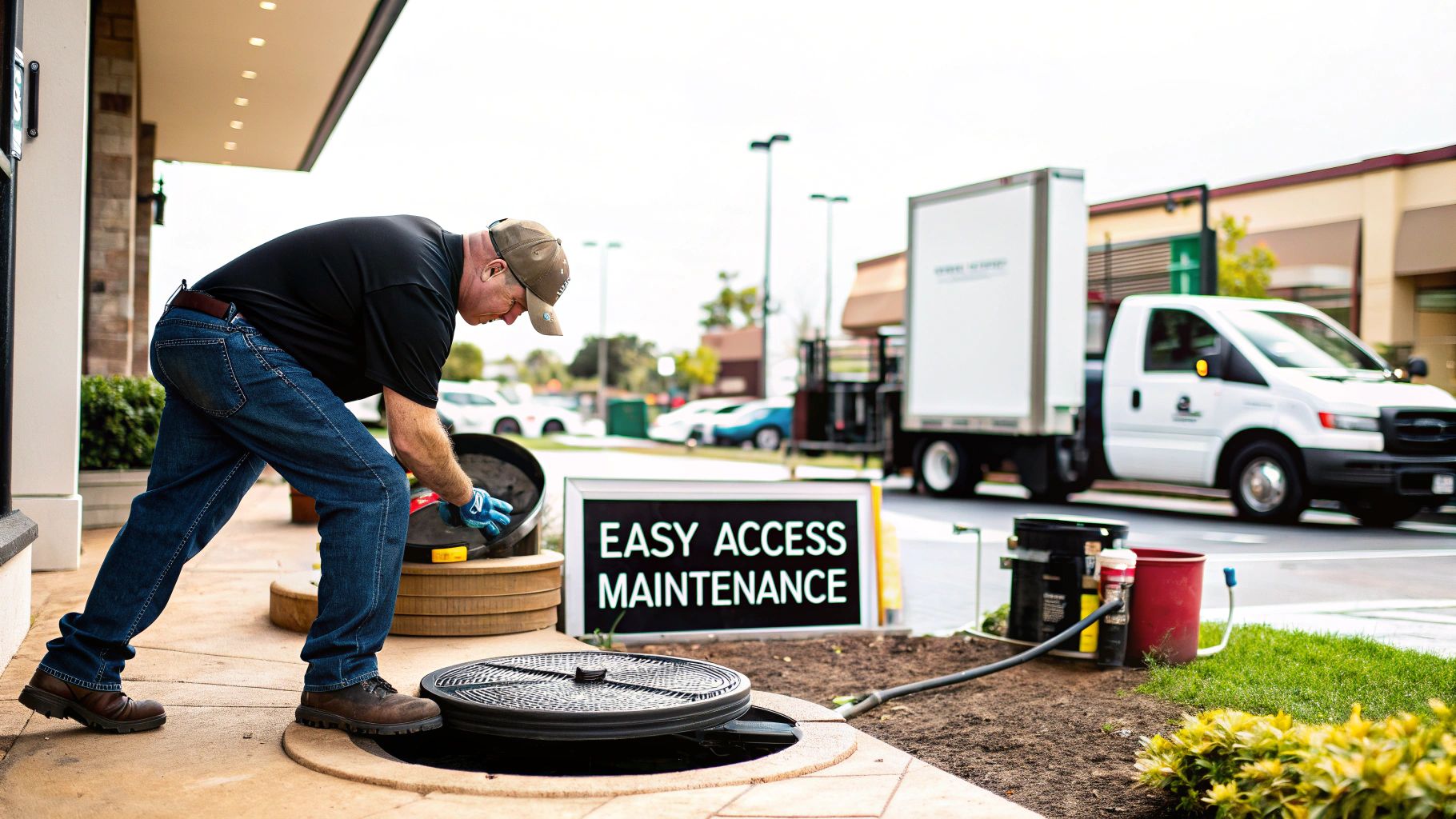
The placement of your grease trap or interceptor is everything. Your number one goal should be easy access for cleaning. An outdoor, in-ground interceptor has to be somewhere a big pump truck can easily get to it without creating a traffic jam or ruining your customers' dining experience. For an indoor trap, don't let your plumber cram it into a tight corner behind the ice machine—that’s a recipe for a maintenance nightmare.
This isn't just about making life easier for your crew. It’s about staying on the right side of the health department. If they can’t get to the unit, cleaning gets skipped or done poorly, which leads straight to clogs and violations. Proper installation also means the unit is perfectly level, has the right venting to prevent siphoning, and is equipped with a flow control fitting to keep water from overwhelming the trap.
The Financial Reality of Maintenance
Let's be clear: regular maintenance isn't a suggestion—it's a requirement. The golden rule, especially here in Southern California, is the 25% rule. This regulation mandates that you get your unit professionally pumped out as soon as the fats, oils, grease, and solids fill up 25% of its total liquid capacity.
This isn't a new thing. Back in 2010, after a wave of FOG-related sewer overflows hit 15% of commercial properties in California, this "one-quarter rule" became law. For a standard 100-gallon trap, that could mean bi-weekly pump-outs, costing $200-$400 a pop. If you ignore it, you’re looking at blockages that can jack up repair bills by 300%. We've seen it happen—85% of undersized traps in major markets fail within just 6 months.
Think of your maintenance schedule as a report card on your sizing. If you feel like you're constantly calling the pump truck, that’s a blaring signal your unit is too small for what your kitchen is actually putting out.
How Smart Sizing Impacts Your Bottom Line
This is where your initial investment in the right-sized equipment directly connects to your monthly operating costs. An undersized unit forces you into a painful cycle of frequent, expensive service calls just to stay compliant. You’ll burn through your profits paying for pump-outs month after month.
But being smart and even slightly oversizing your unit can be a brilliant financial move. A larger trap simply holds more FOG, which naturally buys you more time between cleanings.
- Undersized Unit: Hits the 25% mark every 3-4 weeks.
- Correctly Sized Unit: Needs cleaning every 6-8 weeks.
- Slightly Oversized Unit: Could go 10-12 weeks between services.
Fewer pump-outs a year means real, tangible savings on maintenance. It's a proactive strategy that not only keeps inspectors happy but also pads your restaurant's bottom line. For professional help with installation and upkeep, specialized Grease Trap Services are invaluable. Remember, proper maintenance is a cornerstone of your equipment strategy—for more tips, check out our guide on commercial kitchen equipment maintenance.
Your Grease Trap Questions Answered
Running a restaurant in Los Angeles is demanding enough without having to navigate the maze of grease trap regulations. Whether you're launching a food truck or managing a full-service restaurant, getting clear, straightforward answers is the key to making the right choice for your kitchen.
Do I Need a Grease Trap for My Los Angeles Food Truck?
Yes, you absolutely do. In Los Angeles County, every mobile food facility, a key part of the vibrant Los Angeles food trucks scene, is required to have a properly sized grease trap on board. For a food truck, sizing usually comes down to the number of meals you serve per hour and what kind of fixtures you're using.
Don't even think about trying to get by with an undersized unit. It'll cause immediate clogs, and you'll get hit with violations during your next health inspection. It’s critical to calculate your needs based on your busiest service times to make sure you get a compact, efficient unit that both meets code and fits your mobile setup.
Can I Install a Grease Trap Myself?
While the DIY approach might look like a good way to save a few bucks, installing a grease trap is a job that should always be left to a licensed plumber. The process is a lot more complex than it appears, and a botched installation can lead to leaks, terrible performance, and a failed city inspection.
Hiring a pro ensures the unit is connected correctly, vented properly, and is fully compliant with all local Los Angeles or Orange County codes. This one step will save you from a world of expensive mistakes and potential fines down the road.
What Is the Difference Between a Grease Trap and an Interceptor?
The real differences come down to size, flow rate, and location. A grease trap is the smaller of the two, usually rated under 100 gallons, and installed indoors—often right under a sink. You might also hear them called hydromechanical grease interceptors.
A grease interceptor, or gravity grease interceptor, is a much larger tank. We're talking 500 gallons or more, buried underground outside your building. A small cafe might get by with a trap, but most full-service restaurants, especially a busy Los Angeles pizza joint with an automatic dishwasher, will be required by code to have a big interceptor to handle that high volume of wastewater.
The game-changer is almost always the commercial dishwasher. The sheer volume and intense heat of the water it discharges will overwhelm a small indoor trap in no time, making a large outdoor interceptor a non-negotiable requirement for most restaurants.
How Often Should I Clean My Grease Trap?
Here in Southern California, we live by the "25% Rule," sometimes called the "one-quarter rule." This rule is simple: your grease trap or interceptor must be pumped out by a licensed hauler as soon as the grease and solid waste fill up 25% of its total liquid capacity.
If you're running a busy kitchen with a trap that's too small, you could be looking at cleanings every few weeks. With a correctly sized unit, that schedule might stretch to every one to three months. Regular cleaning isn't just a suggestion—it's mandatory for staying in compliance and preventing foul odors and nasty backups.
Figuring out grease trap sizing and compliance can feel like a headache, but having the right partner makes all the difference. For expert advice and top-quality, warranty-backed equipment designed for your Los Angeles or Orange County restaurant, check out the solutions at LA Restaurant Equipment. We offer warehouse-direct pricing and fast, free shipping to keep your kitchen running without a hitch. Find the perfect equipment for your needs at https://larestaurantequipment.com.