

Think of a commercial countertop convection oven as a compact, high-performance workhorse for a professional kitchen. It uses a fan to push hot air all around the food, cooking everything faster and more evenly. You get all the power and resilience of a full-size commercial oven, but in a package that fits right on your counter. It's the perfect solution for businesses tight on space.
Why a Countertop Convection Oven is a Kitchen Game Changer
In the buzzing Southern California food scene, every inch of space and every minute of the day counts. Whether you're running a packed Los Angeles Food Truck, a bustling Los Angeles Pizza shop, or an authentic Mexican Food restaurant, getting more done without needing a bigger kitchen is the name of the game. That’s exactly where a commercial countertop convection oven becomes one of the most valuable pieces of restaurant equipment you can own.
The Commercial-Grade Difference
First off, let's be clear about what separates a commercial model from the one you'd find at a big-box store. It’s like comparing a commercial delivery van to your everyday car. Sure, both can get you from point A to point B, but only one is built to handle the constant, grueling demands of a professional operation.
Commercial ovens are built tough. We're talking heavy-duty stainless steel and components designed to fire up day in and day out without quitting. They also pack a much bigger punch in terms of power and precision, giving you perfectly consistent results with every single batch—something that’s absolutely essential in any professional kitchen.
Maximizing Space and Versatility
For so many Los Angeles restaurants, where counter space is prime real estate, this oven’s small footprint is its biggest selling point. It gives you serious baking and roasting power without eating up your precious floor space. This kind of versatility opens up a world of menu possibilities for all sorts of establishments.
A commercial countertop convection oven isn't just another appliance; it's a smart move for your kitchen's entire workflow. By cooking up to 25% faster than a standard oven, it lets you push more orders out the door and slash ticket times. In a competitive market like LA, that's a massive advantage during the dinner rush.
This guide is here to walk you through everything you need to know. We'll dig into the key benefits and help you figure out exactly what your business needs to find the perfect fit. From baking fresh pastries for your cafe to getting that perfect roast on chiles for your restaurant, this little powerhouse delivers incredible value and proves itself to be a true kitchen game changer.
Decoding the Specifications That Matter Most
When you're picking out a countertop convection oven commercial model, it's easy to get focused on the shiny stainless steel. But the real magic happens under the hood. Reading a spec sheet can feel like trying to decipher a secret code, but a few key numbers will tell you everything you need to know about how an oven will perform in your busy Los Angeles kitchen.
Getting these details right is the difference between a workhorse that churns out perfect results and a piece of equipment that just causes headaches. Think of these specs as the oven's DNA—they dictate its power, its capacity, and how well it will fit into your daily workflow.
Capacity and Tray Size
The first and most obvious thing to look at is capacity. How much can you actually cook in it? This is determined by the size and number of sheet pans the oven can hold, and it directly impacts your kitchen’s output. Whether you're a food truck slinging empanadas or a cafe with a killer morning pastry program, this spec is everything.
You'll generally run into two standard pan sizes:
- Quarter-Size Pans: These are the little guys, measuring around 11" x 8". They're best for super low-volume tasks or for finishing individual dishes to order. You won't see them as often in high-traffic commercial kitchens.
- Half-Size Pans: Measuring a solid 13" x 18", these are the undisputed champions of the countertop oven world. They strike the perfect balance between cooking capacity and a compact footprint, letting you bake, roast, or reheat a serious amount of food. Most countertop units will hold between three and five half-size pans.
Before you even start shopping, do a little math. How many scones, cookies, or portions of roasted chicken do you need to push out during your busiest hour? That simple calculation will tell you whether a three-rack or a five-rack model is the right call for your operation.
Power Source: Gas vs. Electric
Your kitchen’s existing setup is a huge factor here. The choice between gas and electric will be one of the first decisions you make, and each has its own pros and cons for LA-area businesses.
Key Specifications: Electric vs. Gas Models
To help you decide, let's break down the main differences between electric and gas countertop convection ovens. This table compares the essential factors you should consider for your Southern California foodservice business.
| Specification | Electric Countertop Convection Oven | Gas Countertop Convection Oven | Best For... |
|---|---|---|---|
| Power Measurement | Kilowatts (kW) | British Thermal Units (BTU) | N/A |
| Installation | Simple plug-and-play (standard or 240V outlet) | Requires a professional gas line connection and ventilation | Food trucks, pop-ups, cafes, kitchens without existing gas infrastructure |
| Performance | Excellent, even heating; slower preheat times | Very fast preheating and powerful heat recovery | High-volume kitchens, bakeries, operations with existing gas hookups |
| Operating Cost | Dependent on SoCal Edison rates; generally predictable | Dependent on SoCalGas rates; can be more cost-effective for heavy use | Operations running the oven for many hours per day |
| Availability | The most common type of countertop model; wide selection | Less common in countertop sizes; more prevalent in full-size units | Businesses that specifically need the power and speed of gas |
Electric models are, by far, the most common choice for countertop units. They're incredibly easy to get up and running, often just needing a standard or 240V outlet. This makes them a no-brainer for food trucks, pop-ups, or any kitchen that isn't already plumbed for gas.
Gas models, on the other hand, are known for their raw power and quick preheating. While less common in these smaller sizes, if your kitchen is already set up for gas, they can be a fantastic option and might even save you a bit on your utility bills over the long haul.
Key Takeaway: For the vast majority of smaller operations in Southern California—think cafes, coffee shops, and food trucks—an electric countertop convection oven is going to offer the best mix of convenience, performance, and hassle-free installation.
Airflow Technology and Fan Systems
What makes a convection oven a convection oven? It's all about the fan. The fan is the heart of the machine, circulating hot air to zap away cold spots and cook food up to 25% faster than a regular oven. But not all fan systems are built the same.
The feature you absolutely want to look for is a reversing fan. This means the fan periodically switches the direction it spins, pushing hot air around with maximum efficiency. This is the secret to getting perfectly even browning on roasted veggies and preventing lopsided results on delicate baked goods like macarons. A quality airflow system is what delivers the kind of consistent, reliable results that keep customers coming back.
Rack Spacing and Adjustability
Last but not least, take a look at the oven's interior flexibility. The distance between the rack slides dictates what you can cook. If all you're making is cookies and flatbreads, fixed racks might be fine. But if you want the freedom to cook taller items like small roasts or loaves of bread, you need adjustable racks.
Check the spec sheet for the distance between each rack, usually measured in inches. An oven that offers 3 to 4 inches of clearance gives you fantastic versatility for a diverse, evolving menu. It might seem like a small detail, but it’s what makes your oven a valuable long-term asset instead of a one-trick pony.
For a deeper look at these features, you can learn more about commercial convection oven essentials in our comprehensive guide.
Real-World Uses in SoCal Kitchens
Specs and numbers are one thing, but where the rubber really meets the road is in the kitchen. In the tight, fast-moving kitchens of Los Angeles, a countertop convection oven commercial model isn't just another appliance—it's a game-changer. This key piece of restaurant equipment lets you do more with less.
From a bustling DTLA ghost kitchen to a chill beachside cafe, chefs and operators are finding brilliant ways to make these ovens the heart of their operation, especially when space is at a premium. A single unit can wear many hats throughout a busy service.
The LA Food Truck and Pizza Powerhouse
For any Los Angeles Food Truck, counter space is gold. A countertop convection oven gives you the power of a full-size oven without eating up that precious real estate. Suddenly, your menu can go way beyond what a griddle or fryer can handle.
- Small Pizzas & Flatbreads: An oven is essential for any Los Angeles Pizza operation. You can fire off personal-sized pizzas to order, a huge profit-maker.
- Roasted Vegetables: Give your tacos and bowls a serious flavor upgrade by roasting chiles, onions, and corn.
- Finishing Dishes: Perfectly melt cheese over nachos or toast buns for those next-level sandwiches.
With just one box, a simple truck transforms into a legit mobile kitchen, ready to pump out a menu that'll have lines forming down the block.
Essential for Cafes and Bakeries
In a local cafe or small bakery, the morning rush is everything. A countertop convection oven is your best friend for baking off morning pastries, scones, and muffins. It provides that consistent, even heat you need for delicate baked goods, ensuring every single item comes out perfect.
You get that fresh-baked quality without the massive footprint or energy bill of a full-size deck oven. This lets smaller shops compete with the big guys without a huge upfront investment.
A countertop convection oven allows a business to pivot quickly. A coffee shop can easily add a lunch menu with toasted sandwiches, or a bar can start offering late-night appetizers, all using the same compact unit. It’s about maximizing profitability per square foot.
The Mexican Restaurant Secret Weapon
You'd be surprised how much work this oven can do in a restaurant serving Mexican Food. Beyond the obvious, it becomes a key player in daily prep, boosting both flavor and speed. Think about perfectly roasting tomatillos and chiles for your salsas to get that smoky depth you just can't get on a stovetop.
It's also a champ for baking fresh batches of bolillo rolls or gently warming stacks of tortillas so they're soft and perfect for service.
This diagram shows you the core specs—capacity, power, and airflow—that make all these jobs possible.
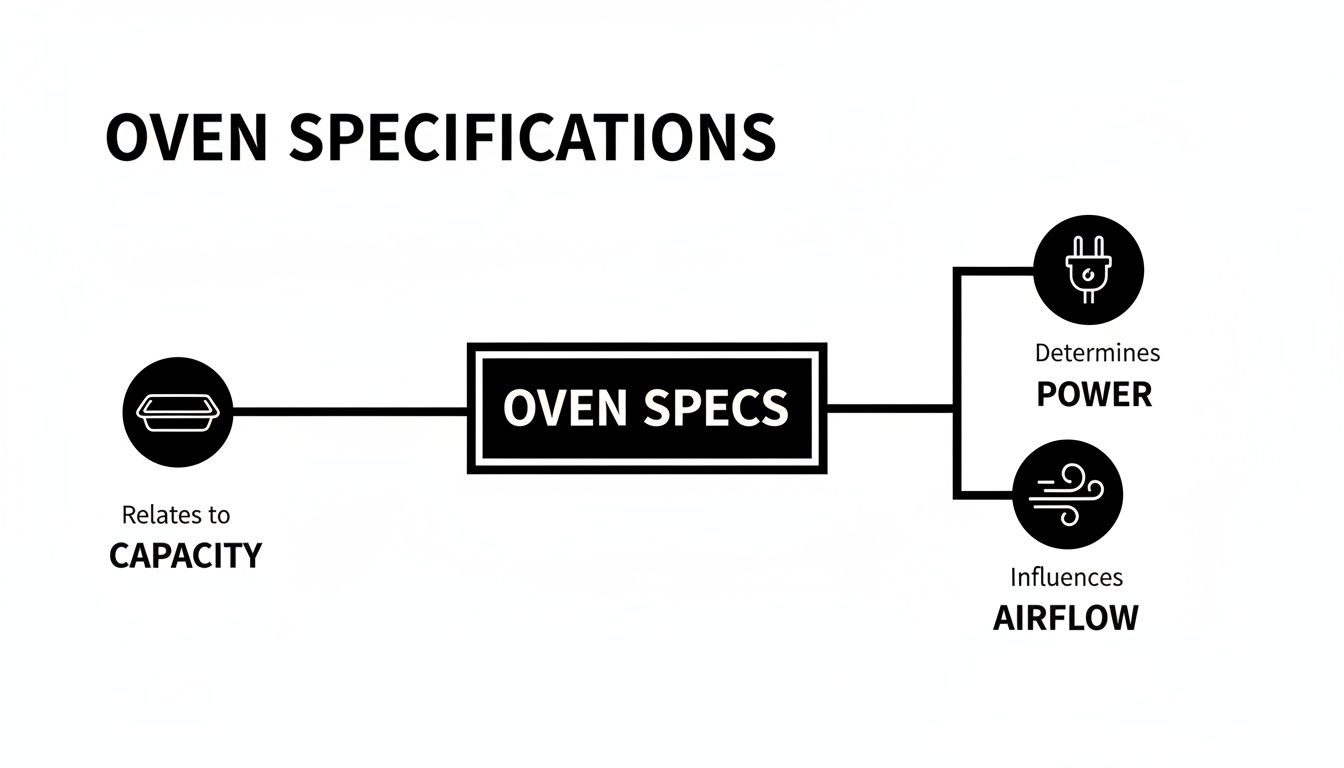
Getting a feel for how these elements work together is the key to picking an oven that can truly handle your menu, whether you're baking delicate pastries or roasting at high heat.
Fueling Ghost Kitchens and Catering Operations
The boom in delivery-only concepts and ghost kitchens has made small-footprint equipment more valuable than ever. These operations absolutely depend on compact commercial countertop convection ovens to juggle diverse menus from one small spot. Their power to bake, roast, and reheat makes them non-negotiable.
The market for these ovens is expected to hit USD 631.4 million by 2035, and that growth is tied directly to the rise of cloud kitchens. Those places need equipment that can do it all in a tiny space, which is exactly what these ovens deliver. You can see more on the countertop oven market trends from this report.
Likewise, caterers and bars lean on these ovens to quickly fire up appetizers, bake off small bites, and add food to their menu with almost no hassle. This incredible adaptability makes the countertop convection oven one of the smartest buys for any culinary business in SoCal.
Navigating Installation and Kitchen Requirements
Bringing a new commercial countertop convection oven into your kitchen is a great move, but you can’t just drop it on a counter and plug it in. A little prep work is non-negotiable to make sure it runs safely and gives you the performance you paid for.
Think of it like laying the foundation for a house—if you don't get the groundwork right, you’re going to run into problems down the line. Before that shiny new oven even arrives, you need to be sure your space is ready to handle it. We’re talking about your electrical setup, ventilation needs, and even just the physical space for the unit to breathe.
Electrical and Gas Connections
First things first: power. Most countertop convection ovens are electric, but that doesn't mean they're all the same. Your kitchen has to be equipped for the specific connection your oven needs.
- Standard 120V: This is your basic wall outlet. Lower-power models often use this, making installation a breeze—literally just plug it in. The trade-off? They might offer a bit less power and take longer to preheat.
- Powerful 208/240V: High-performance ovens demand a more robust connection, the kind you’d see for a residential clothes dryer. This setup delivers the consistent juice needed for quick heat recovery and high-volume cooking.
It is absolutely crucial to check your circuit breaker's capacity before you buy anything. An overloaded circuit is a serious fire hazard. As you plan the installation, it's a good time to ensure your commercial kitchen's electrical panels and meters meet the demand to avoid any nasty surprises. If you're looking at a gas model, professional installation is mandatory. You want those gas lines connected safely and up to code, no exceptions.
Ventilation and Local Health Codes
Ventilation is a massive topic, especially in a place like Los Angeles County where health codes are notoriously strict. The kind of hood you need—or if you even need one—boils down to what you’re cooking.
A common mistake is assuming all electric ovens are ventless. The rules are dictated by what you cook, not just the oven itself. Cooking grease-producing foods like bacon or fatty meats will almost always require a Type I hood, regardless of the oven type.
Here’s a quick breakdown of what you might need:
- Type I Hood: This is the heavy-hitter, built to capture and filter out all those grease-laden vapors. If you're roasting meats or cooking anything that creates a lot of smoke and grease, the Los Angeles health department is almost certainly going to require one.
- Type II Hood: This hood is just for heat and condensation. It's a perfect fit if you're exclusively baking bread, cookies, or other pastries where grease just isn't part of the equation.
- Ventless Ovens: Some really advanced electric ovens are certified for ventless operation, but only for specific types of food. These units have built-in catalytic converters that scrub the air clean. They can be a total game-changer for businesses in historic buildings or food trucks where installing a full hood system would be a nightmare.
Always, and I mean always, check with your local health department to confirm their requirements before you spend a dime.
Clearance and Airflow
Finally, give your oven some personal space. These machines kick out a ton of heat, and their internal fans need room to pull in cool air and keep the components from frying.
Check the manufacturer’s spec sheet for the required clearance—it’s usually just a few inches on each side and in the back, but it's critical. Proper placement is a huge part of your overall commercial kitchen layout design, affecting both safety and how long your equipment will last. If you block that airflow, you're just asking for parts to fail early and for your food to cook unevenly.
How Convection Cooking Saves You Money
An oven isn't just a one-time purchase; it’s an ongoing hit to your utility budget. When you're running a restaurant in Los Angeles where operational costs are sky-high, every dollar you can shave off your electricity or gas bill goes straight to your bottom line.
This is where a modern countertop convection oven commercial model stops being just a cooking tool and becomes a savvy financial decision. Its real money-saving power comes from the way it works—by using a fan to actively push hot air around the food, it cooks far more efficiently than an old-school oven that just radiates heat.
This simple difference has a huge impact on your expenses.
Lower Temperatures and Faster Cooking
Think about it like this: standing in the sun on a calm day feels warm, but on a windy day, you feel much colder. That wind is stripping heat away from you faster. A convection oven does the exact opposite, using that moving air to transfer heat to the food much more effectively.
Thanks to this efficiency boost, you can get the same results at lower temperatures. You can typically drop the thermostat by 25-30°F compared to a conventional oven. That directly translates to less energy burned every single time you fire it up.
Even better, that circulating hot air slashes cooking times by up to 30%. Shorter cooking cycles mean the oven is running for less time, cutting your utility bills even further. For a busy LA food truck or a bustling cafe, those saved minutes and kilowatts really add up over a year.
Maximizing Your Energy Efficiency
Honestly, the energy performance is one of the strongest arguments for picking a convection design over older equipment. That ability to cut energy use—lowering temperatures while still getting better browning and more even results—is a game-changer. It's a key reason electric countertop models have become so popular, especially in spots like strip malls or older buildings where running a new gas line just isn't an option.
To really squeeze the most savings out of your oven, keep an eye out for a few key features:
- ENERGY STAR Certified: These ovens are independently verified to be more efficient than standard models. They almost always have better insulation to trap heat and more advanced heating elements that don't waste energy.
- Solid-State Controls: Precise digital controls are way better than old-school manual dials. They prevent the wide temperature swings that force the oven to constantly kick on and off, which is a major energy drain.
For a small restaurant, the savings from an energy-efficient convection oven can easily hit hundreds, if not thousands, of dollars a year. It's not about the sticker price; it's about the total cost of owning that appliance over its entire life.
Investing in an efficient oven is a smart way to manage your expenses from day one. If you're mapping out your budget, check out our complete guide on understanding your restaurant startup costs breakdown for more tips. By choosing wisely, you’re buying a piece of equipment that will literally pay for itself in savings.
Choosing the Right Equipment Partner in Los Angeles
Picking the perfect countertop convection oven commercial model is only half the job. Finding the right partner to buy it from is just as crucial for your restaurant's success. Think of it this way: an oven is a long-term investment, and you need a supplier who’s a real local partner, someone who gets the intense pressure of the Southern California food scene.
At LA Restaurant Equipment, we've built our entire business around supporting independent restaurant owners just like you. We don't do expensive showrooms or have high-pressure salespeople working on commission. That lets us offer warehouse-direct pricing on brand-new equipment that’s fully backed by a warranty. It's a simple approach that gets you top-tier gear without the painful price tag.
The LA Restaurant Equipment Advantage
Our support for local businesses is about more than just saving you money. We know that in the fast-paced L.A. market, you can't afford to wait weeks for a critical piece of equipment to show up.
- Fast, Free Local Shipping: We ship for free from our warehouse in Brea, CA, to businesses all over Los Angeles and Orange County. Your new oven will usually be at your door in just 1-2 business days, so you can get cooking right away.
- Flexible Financing Options: We don't think budget should stop you from getting the tools you need to grow. We offer flexible financing that turns a big upfront cost into a simple, manageable monthly payment.
- Dedicated Local Support: When you call us, you're not getting a random person in a distant call center. Our team is right here, ready to help you choose the right product, get a quote, and answer any questions after your purchase.
Why a Local Partner Really Matters
For independent spots in a packed metro area like Los Angeles, every single square foot counts. Kitchen space can easily run you USD 50–100 per square foot per month in a good location, which makes the small footprint of a countertop oven a huge financial win. As more small-format concepts and ghost kitchens pop up, industry analysts see these compact, efficient units as a major growth category. You can learn more about the market trends for commercial countertop convection ovens here.
We aren't just another vendor. We're a dedicated partner invested in the success of the Southern California culinary community. Our whole goal is to give you the tools and support you need to thrive.
When you're looking at different suppliers, it's also a smart move to ask if they have a restaurant equipment financing guide to help you manage the investment. A great partner won’t just sell you a piece of equipment; they'll also give you the resources to make sure that purchase is a smart, sustainable decision for your business. We're committed to being that partner for you.
Got Questions About Commercial Countertop Ovens? We Have Answers.
Investing in new equipment is a big step, and it's smart to have questions. A countertop convection oven is a major purchase for any LA-area kitchen, and getting straight answers is key to making the right call for your business. We've heard it all, so let's tackle some of the most common questions we get from local restaurant owners.
Getting these details right from the start can save you a world of hurt when it comes to performance, safety, and local health codes.
Can I Just Use a Home Oven in My Commercial Kitchen?
Let me stop you right there—that's a hard "no." We strongly advise against ever using a residential oven in a professional kitchen, whether it's a food truck, cafe, or a full-blown restaurant. Home ovens simply aren't built to take the heat of a commercial environment.
They don't have the NSF and UL certifications required for commercial use, which means they haven't been tested for professional safety standards. Using one is a recipe for disaster: it will break down constantly, void your business insurance if a fire starts, and get you an immediate health code violation. Commercial ovens, on the other hand, are built like tanks with heavy-duty stainless steel and parts designed to run all day, every day without skipping a beat.
Do I Really Need a Special Hood for My Oven in Los Angeles?
The short answer is: it depends. Los Angeles County has some of the strictest ventilation rules in the country, and they're based on what you cook, not just the oven itself. If you're cooking anything that produces greasy vapor—think roasting fatty meats or anything with a lot of oil—you will almost certainly need a Type I hood.
But there are a few exceptions:
- Baking bread or pastries: For items that don't produce grease, a much less expensive Type II hood (which just handles heat and steam) might be all you need.
- Ventless Models: Some of the newer electric countertop ovens are certified as "ventless." These are total game-changers. They have built-in filtration systems that scrub the air, making them perfect for spots where installing a full hood system is a nightmare.
Crucial Tip: Before you buy anything, you have to confirm the specific requirements with the Los Angeles County Department of Public Health. This is non-negotiable. It will save you from massive fines and being shut down before you even get started.
What’s the Best Way to Clean and Maintain the Oven?
Look, proper cleaning isn't just about looking good—it's essential for keeping your oven alive and kicking. If you neglect it, you'll get uneven cooking, weird flavor transfer between dishes, and a dangerous fire hazard from all that grease buildup.
A simple, consistent schedule is your best friend here:
- Daily: Give the interior, exterior, and the door gasket a quick wipe-down with a food-safe degreaser. This little step prevents grime from baking on and becoming a monster to remove later.
- Weekly: Pull out the racks and the fan cover (if you can) for a deep clean. This keeps the airflow paths clear, which is the whole secret to that perfectly even convection cooking.
- As Needed: If your oven has a steam injection feature, follow the manufacturer's guide for descaling. Hard water mineral buildup can kill that feature fast if you ignore it.
What's the Difference Between Half-Size and Full-Size Ovens?
It all comes down to the size of the baking pans they hold and how much space they take up. A half-size oven is what you'll find in almost every countertop model. They're designed to hold standard 13" x 18" half-sheet pans, making them perfect for smaller batches. They fit neatly into the tight corners of a food truck, cafe, or a crowded restaurant kitchen.
A full-size oven, on the other hand, is a big floor-standing unit that holds massive 18" x 26" full-sheet pans. You'll see these in high-volume production bakeries and huge restaurant operations. For pretty much any countertop situation, a half-size oven gives you that perfect mix of cooking power and a space-saving design.
Ready to find the perfect countertop convection oven for your Southern California business? At LA Restaurant Equipment, we offer warehouse-direct pricing, fast and free local shipping, and flexible financing to get you the tools you need to succeed. Explore our full range of commercial cooking equipment today!