

Ever wonder what makes a commercial convection oven different from the one in your home? It’s all about a high-powered internal fan that circulates hot air, giving you faster and more even cooking. This isn't just a minor upgrade; it's the workhorse technology in professional kitchens across Los Angeles, from bustling pizzerias to nimble food trucks and authentic Mexican food spots. The reason is simple: it delivers consistent, top-quality results with an efficiency that standard ovens just can't match.
Why Convection Ovens Are a Kitchen Game Changer
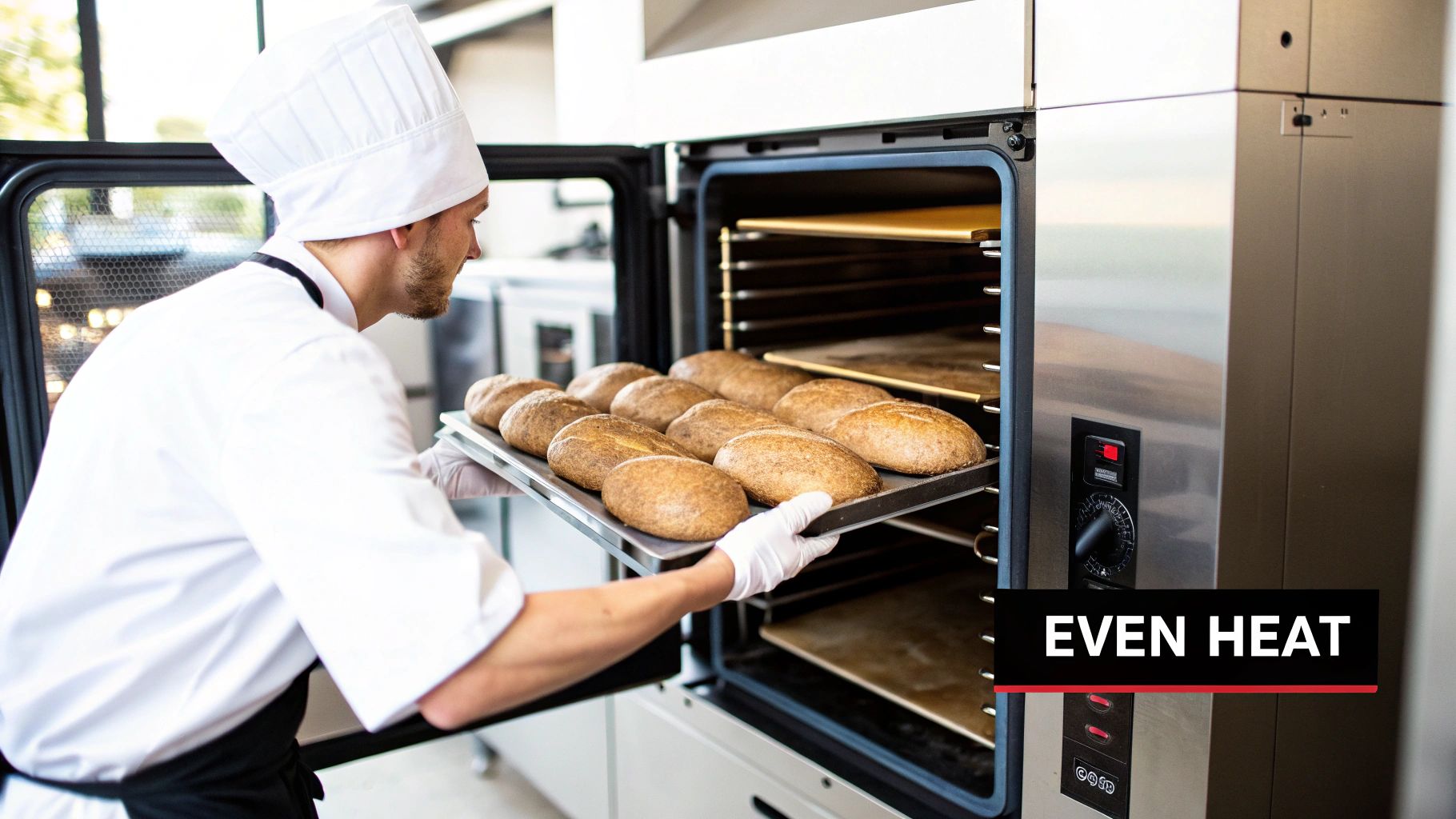
Step into almost any successful restaurant in Los Angeles, and you'll find a commercial convection oven holding down the line. The secret weapon is that fan. It’s not just blowing hot air around; it’s fundamentally changing the way food cooks.
Think about the difference between letting your hair air-dry and using a hairdryer. The hairdryer’s focused airflow gets the job done much faster and more evenly. A convection oven operates on the exact same principle. The fan creates a constantly moving current of hot air that wraps around the food, cooking it from all sides at once.
Eliminating Hot Spots for Perfect Consistency
Traditional ovens cook with radiant heat from stationary elements, which almost always creates "hot spots"—areas in the oven that are hotter than others. This is why you get a tray of roasted vegetables with some pieces burnt to a crisp while others are still half-raw. It's a frustratingly common problem.
The constant air movement in a commercial convection oven wipes out those hot spots completely.
This circulating heat makes sure every single item, whether it's on the top rack, bottom rack, or tucked in a corner, gets hit with the same consistent temperature. For a high-volume Mexican Food restaurant in LA, that means every batch of carnitas comes out perfectly crisped. For one of the many Los Angeles Food Trucks cranking out baked goods, it guarantees every pastry is golden-brown from edge to edge.
By actively moving heat, a commercial convection oven transforms the cooking environment from a static chamber into a dynamic, high-efficiency system. This directly translates to better food quality and a more predictable workflow.
The market definitely reflects this need for efficiency. The global commercial convection oven market was valued at $392.41 million in 2021 and is projected to hit $450.3 million by 2025. That growth is being driven by kitchens that need equipment that can slash cooking times by up to 25-30% compared to traditional models—a massive advantage in the fast-paced food world. You can dig into more of this market trend over at cognitivemarketresearch.com.
The Real-World Benefits in Your Kitchen
This isn't just a technical upgrade; it's a real competitive edge. The benefits of making the switch to a commercial convection oven show up immediately, especially for a busy Southern California restaurant.
Here’s what that actually looks like in your day-to-day operations:
- Faster Cooking Times: Getting food out of the oven and onto the plate quicker means you can serve more customers during peak hours. That’s more table turnover and more revenue.
- Superior Browning and Crisping: The moving air is great at wicking moisture away from the surface of foods. The result? Crispier chicken skin, beautifully caramelized vegetables, and perfectly golden crusts for any Los Angeles Pizza spot.
- Increased Yield: Even cooking helps reduce shrinkage when you’re roasting meats, which means you get more sellable product out of the same starting weight.
- Energy Savings: Shorter cooking times mean the oven is running for less time. That directly adds up to lower utility bills, which is a huge deal for any restaurant's bottom line.
At the end of the day, a commercial convection oven is so much more than just another piece of restaurant equipment. It’s a powerful tool for achieving consistency, boosting your kitchen's efficiency, and putting out the kind of high-quality dishes that keep your customers coming back for more.
Matching an Oven to Your Kitchen's Reality
Picking the right commercial convection oven isn't just about the brand on the door. It's about getting real about the space you have, how you cook, and what your kitchen can handle. Make the wrong call here, and you're not just out the initial cost—you're stuck with a piece of equipment that clogs up your workflow and frustrates your team instead of helping them succeed.
The first, most concrete thing to consider is size. In a market like Los Angeles, where every square foot is precious, you can't afford to get this wrong. You need an oven that can keep up with your orders without turning your kitchen into an obstacle course.
Finding the Right Fit for Your Footprint
The physical size of your oven is directly tied to how much food you can push out. A high-volume wholesale bakery has wildly different needs than a cozy café or one of the many Los Angeles Food Trucks hustling on a street corner.
Let's break down the common sizes you'll see:
- Full-Size Ovens: These are the undisputed heavyweights. Built for serious volume, they’re the go-to for large bakeries, busy pizzerias, and hotel kitchens. They easily swallow multiple full-size sheet pans, letting you roast or bake huge batches all at once.
- Half-Size Ovens: A bit more nimble, half-size models are a perfect match for restaurants with varied menus that don't need the massive output of a full-size unit. They're fantastic for smaller batches, reheating dishes, or acting as a trusty backup oven when the kitchen is slammed.
- Countertop Ovens: When space is tight, these compact powerhouses save the day. For a packed L.A. food truck, a coffee shop with a small pastry program, or a bar that needs to quickly heat up appetizers, a countertop convection oven delivers serious performance without eating up your workspace.
Thinking through your available space is step one. For a deeper dive into making every inch count, check out our guide on commercial kitchen layout and design. It's packed with practical tips to help you make smarter equipment choices.
Gas vs Electric: The Great Power Debate
Once you've sized up your space, the next big question is the power source: gas or electric? This choice echoes through your installation costs, monthly utility bills, and even how your food cooks. There’s no single "right" answer—it all comes down to your kitchen's existing setup and your menu.
A gas commercial convection oven is often the chef's choice for its raw power. It preheats in a flash and recovers its temperature quickly after the door has been opened. During a hectic dinner service, that speed is a game-changer. Plus, in areas where natural gas is affordable, they can be cheaper to run month after month.
But electric models have their own strong arguments. They're known for providing incredibly consistent, even heat—something that’s non-negotiable for delicate items like macarons, soufflés, and cakes. Installation is also a breeze if you don't have a gas line, making them a popular pick for new kitchens or spots where running a new gas line just isn't practical.
The gas vs. electric decision is pure strategy. Look at your local utility rates, see what hookups you already have, and ask yourself what your menu needs most: the brute force of gas or the delicate precision of electric.
Here’s a quick rundown to help you decide:
| Power Source | Pros | Cons |
|---|---|---|
| Gas | - Heats up and recovers temperature fast - Often cheaper to operate - Hits high temps quickly |
- Requires a professional gas line installation - Can have less even heat distribution - Needs proper ventilation for fumes |
| Electric | - Incredibly precise and even heat - Simpler, often cheaper installation - Ideal for delicate baking |
- Slower to preheat and recover - Can lead to higher utility bills - May require special high-voltage wiring |
By carefully weighing these real-world factors—size, space, and power—you can land on a commercial convection oven that’s a true partner in your kitchen, setting you up for a smooth, efficient operation from day one.
Translating Tech Specs Into Kitchen Performance
Staring at a spec sheet for a commercial convection oven can feel a bit like trying to read a foreign language. All those numbers and acronyms might seem like technical fluff, but they’re actually the blueprint for your kitchen's entire workflow, its efficiency, and the quality of every single dish that leaves the pass. Learning to speak this language is the key to picking an oven that works for you, not against you.
Think of it like buying a vehicle for your business. You wouldn't choose a small hatchback to haul construction supplies, and you wouldn't use a massive semi-truck for downtown food delivery. The specs tell you exactly what that oven is built to do, ensuring you match its power and features to what your kitchen truly needs.
This simple breakdown shows the main forks in the road you'll encounter when choosing an oven, starting with size and then moving to the power source.
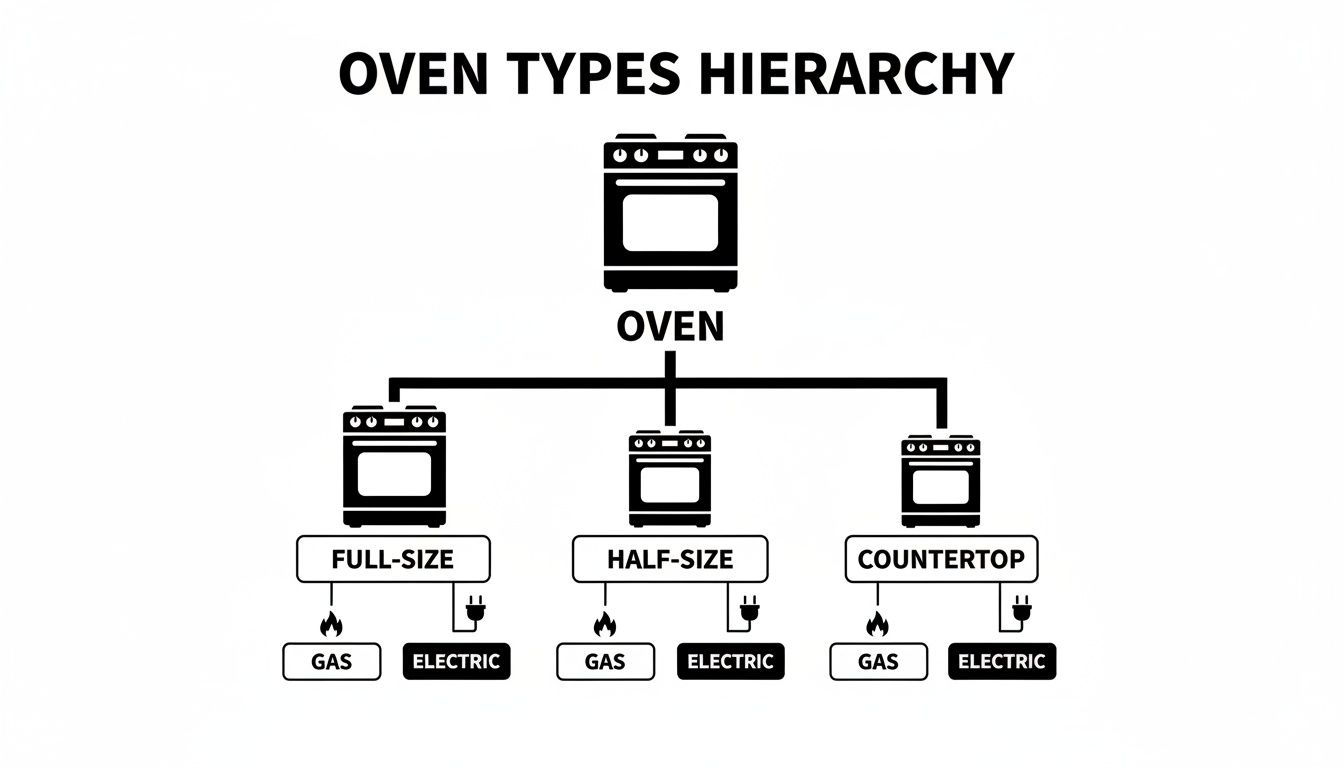
As you can see, the first big decision is size—Full, Half, or Countertop—and from there, you’ll choose between a Gas or Electric model for each.
Decoding Heating Power: BTUs and kW
The first numbers you’ll probably notice are for heating power, measured in BTUs (British Thermal Units) for gas ovens and kilowatts (kW) for electric ones. These figures are a direct measure of how fast your oven heats up and—just as critically—how quickly it gets back to temperature after the door has been opened.
A higher BTU or kW rating means you’re getting faster preheating and lightning-fast recovery time. For a busy Los Angeles Pizza joint constantly swinging the door open during the dinner rush, a high-BTU gas oven is non-negotiable for keeping those cook times consistent. On the other hand, an electric oven with a solid kW rating delivers that steady, even heat you need for perfectly uniform results, batch after batch.
Think of heat recovery speed as your oven's "stamina." A high-powered oven won’t get gassed out during a crazy service, ensuring the last tray of roasted veggies is just as perfect as the first.
Understanding Fan Speeds and Airflow
Not all convection fans are built the same. That fan is the heart of the whole operation, and its features can make or break certain recipes. Many modern ovens offer multiple fan speeds, giving you precise control over the cooking environment.
- Two-Speed Fans: These are the jacks-of-all-trades. The high-speed setting is your go-to for roasting meats and vegetables, giving them that beautiful, crispy finish. But the low-speed setting is a lifesaver for delicate items like meringues, soufflés, or light cakes that would get blown around or collapse under a powerful blast of air.
- Single-Speed Fans: These are the rugged workhorses. They're perfect for kitchens that are all about heavy-duty roasting and general baking. They provide consistent, powerful airflow that’s ideal for high-volume cooking where you don't need to worry about delicate pastries.
A Southern California bakery that specializes in artisan bread would absolutely need that gentle, low-speed fan setting. Meanwhile, one of the many Los Angeles Food Trucks focused on perfectly roasted chickens would do just fine with a powerful, no-fuss single-speed unit.
To help you connect these features to your specific needs, here’s a quick comparison table breaking down what really matters.
Commercial Convection Oven Feature Comparison
A comparison of essential features to consider when selecting a commercial convection oven, helping you match specifications to your kitchen's needs.
| Feature | What It Means for Your Kitchen | Best For |
|---|---|---|
| High BTU/kW Rating | Faster preheating and quick temperature recovery after opening the door. | High-volume kitchens, pizza shops, operations with constant door openings. |
| Two-Speed Fan | Offers versatility—high speed for roasting and browning, low speed for delicate baking. | Bakeries, fine dining restaurants, kitchens with diverse menus. |
| Single-Speed Fan | Provides powerful, consistent airflow for general-purpose cooking and roasting. | Roasting-focused operations, food trucks, high-output institutional kitchens. |
| Cook and Hold Feature | Automatically shifts from cooking to a safe holding temperature, preventing overcooking. | Catering businesses, banquet halls, restaurants needing to prep large roasts ahead of service. |
Choosing the right combination of these specs ensures you get a piece of restaurant equipment that truly fits your operational style and menu.
Leveraging Smart Features Like Cook and Hold
Beyond raw power, today's convection ovens are packed with smart features designed to make life in the kitchen easier and more consistent. One of the most useful is the ‘cook and hold’ function. This lets the oven automatically switch from its cooking temperature to a lower holding temperature once a cooking cycle finishes.
This is a complete game-changer for managing a hectic service. You can cook a prime rib to a perfect medium-rare, and the oven will hold it at a safe, ideal temperature for hours without a hint of overcooking. Every slice you serve will be juicy and warm, and your crew is freed up to focus on plating and other tasks instead of babysitting the oven. It's a simple-sounding feature that has a huge impact on food quality, waste reduction, and the overall rhythm of your kitchen.
How the Right Oven Can Lower Your Utility Bills
In the competitive Los Angeles restaurant world, profit isn't just about what's on the plate—it's about smart spending. Your monthly utility bills are a huge piece of that puzzle, and they can eat into your bottom line if you're not careful. Choosing an energy-efficient commercial convection oven is one of the smartest financial moves you can make, turning a kitchen workhorse into an asset that actually saves you money.
This isn't about some vague, eco-friendly gesture. It’s a direct business decision to cut your overhead costs. Modern convection ovens are engineered to trap heat and squeeze every last bit of performance out of the energy they use. That clever design means real, tangible savings on your utility bills, month after month.
The Engineering Behind the Savings
So, how does an oven actually trim your energy costs? It all comes down to a few key design elements that work together to keep the heat where it belongs: inside the oven. This means the oven works smarter, not harder, to stay at temperature.
When you're comparing models, keep an eye out for these critical features:
- Double-Pane Thermal Glass Doors: Ever stand next to a cheap oven and feel the heat radiating off the door? That's wasted energy. A double-pane door acts just like modern insulated windows in a house, creating a barrier that locks the heat inside.
- Superior Insulation: It’s what’s on the inside that counts. High-quality, dense insulation packed into the oven’s walls and door is a must. It stops heat from bleeding into your kitchen, meaning the heating elements kick on far less often to maintain the right temperature.
- ENERGY STAR Certification: This is your cheat sheet for efficiency. An ENERGY STAR certified commercial convection oven has been independently tested to meet strict performance standards set by the U.S. Environmental Protection Agency. These machines are proven to cook faster while using way less energy.
The Real-World Financial Impact
The savings aren't just pocket change. A truly efficient oven can use 20-30% less energy than older models. That’s a massive win when you realize that in most restaurants, the kitchen is responsible for a staggering 18% of the total energy bill. The global demand for these ovens is exploding for this very reason, with the market projected to grow from $1.66 billion in 2024 to $2.59 billion by 2035. It's a clear trend: operators are tired of high utility costs and are demanding smarter equipment. You can dig deeper into these market trends over at Market Research Future.
Choosing an energy-efficient oven is a direct investment in your restaurant's profitability. The monthly savings on your utility bill can quickly add up, often helping the equipment pay for itself over its lifespan.
But the savings don't stop with your utility bill. There’s another huge financial benefit: labor. A commercial convection oven can cook food up to 25% faster than a conventional one. You’re not just saving on gas or electricity; you're saving on the time your team spends on each dish.
Faster cook times mean your kitchen can push out more orders. For a busy Los Angeles Pizza spot on a Friday night or a food truck with a long line, that extra throughput means more sales and a healthier bottom line. Every minute saved is a dollar earned.
Protecting Your Investment with Proper Care
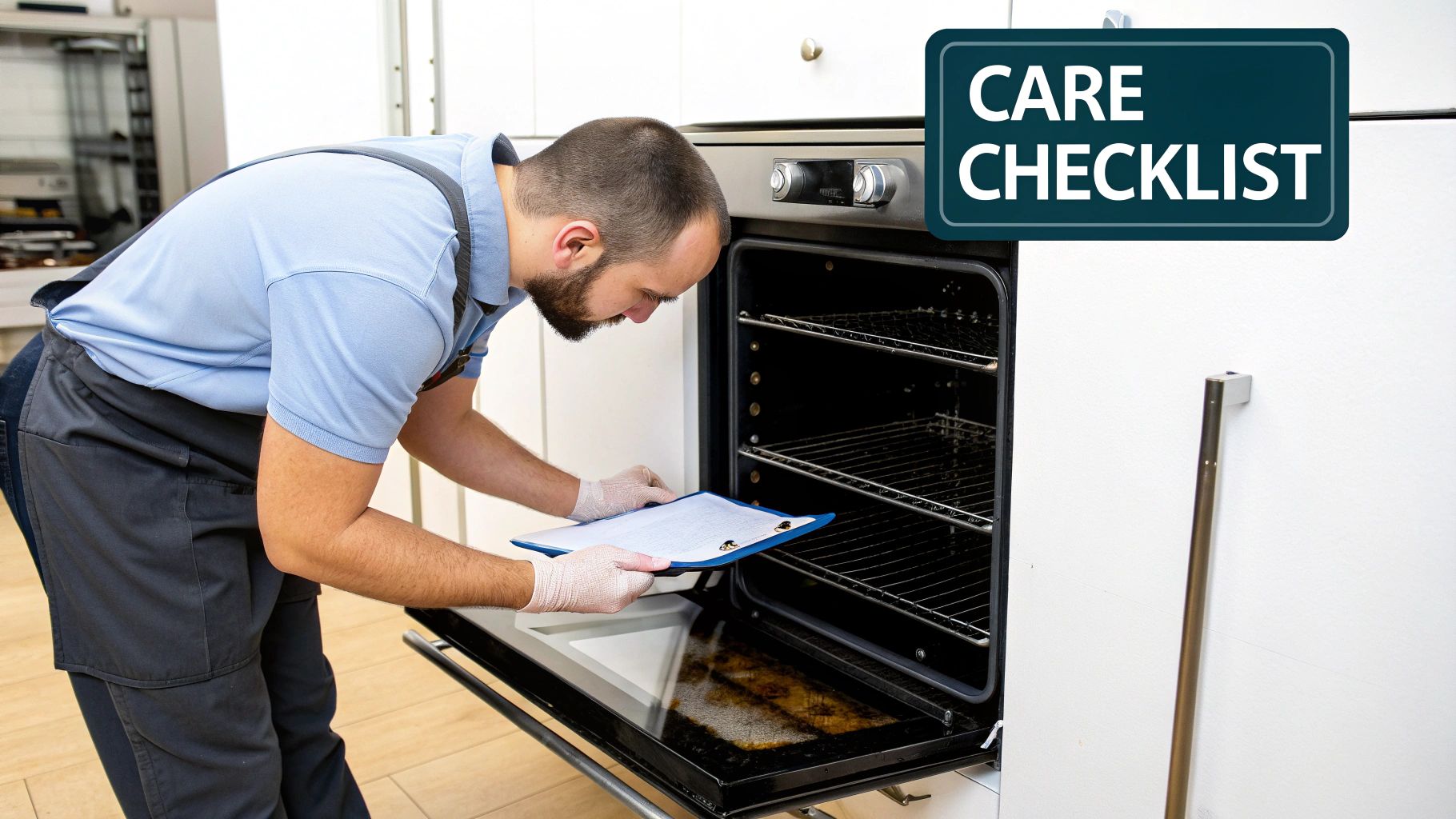
A commercial convection oven is a serious investment and, for many kitchens, the absolute cornerstone of productivity. Just like any high-performance machine, its lifespan and day-to-day reliability depend entirely on how you treat it.
By getting it set up correctly from day one and sticking to a simple care routine, you can ensure it runs safely, efficiently, and without those costly, service-call-inducing interruptions for years to come. This is about more than just cleaning; it's about protecting the heart of your operation.
Setting Up for Success: Professional Installation
Proper installation is the foundation of your oven's long-term health. This is not the place to cut corners. While handling setup in-house might seem tempting, getting a professional to do it is critical for both safety and performance.
An experienced technician will make sure every gas or electrical connection is secure and up to local Los Angeles codes—vital for preventing dangerous leaks or electrical faults. They’ll also guarantee the unit is perfectly level, a small detail that’s essential for even baking and preventing long-term damage to the door hinges.
But it’s not just about the hookups. Pros know that airflow is everything.
- Adequate Clearance: Ovens need to breathe. A technician will ensure there’s enough space around the unit for proper air intake and to keep intense heat from damaging nearby walls or equipment.
- Proper Ventilation: For gas models, a professionally installed ventilation hood is non-negotiable. It pulls dangerous combustion byproducts like carbon monoxide safely out of your kitchen. Don’t forget, even some electric models may require a hood depending on what you’re cooking and local regulations.
Building a Simple Maintenance Schedule
Once your oven is installed and running, a routine maintenance schedule is your best defense against wear and tear. A little bit of daily attention, combined with more thorough weekly and monthly checks, can literally add years to your equipment's life.
Think of it as a simple checklist that keeps your kitchen's engine running smoothly. For a deeper dive into maintaining all your gear, check out our complete guide to commercial kitchen equipment maintenance.
A consistent maintenance habit is the difference between an oven that lasts five years and one that powers your kitchen for over a decade. It’s the most cost-effective insurance policy you can have for your equipment.
This schedule doesn't need to be complicated. By breaking tasks down into daily, weekly, and monthly actions, it just becomes part of the kitchen's natural workflow.
Daily, Weekly, and Monthly Care Checklist
A proactive approach is what keeps your convection oven in prime condition. Here’s a simple, actionable checklist you can start using today to protect your investment and guarantee consistent results.
Daily Tasks (5–10 Minutes):
- Wipe Down the Interior: After service, once the oven has cooled, give the inside a quick wipe with a damp cloth. This gets rid of spills before they burn on, which can cause smoke and affect the flavor of your food.
- Clean the Exterior: A quick wipe-down of the doors and control panel with a soft cloth and stainless steel cleaner keeps the unit looking professional.
Weekly Tasks (15–20 Minutes):
- Deep Clean Racks and Guides: Pull the oven racks and their guides out. Let them soak in a good degreasing solution and give them a thorough scrub to get rid of that baked-on grime.
- Inspect Door Gaskets: Take a close look at the rubber or silicone seals around the door. You’re looking for cracks, tears, or any signs of brittleness. A bad seal leaks heat, wastes energy, and ruins cooking consistency.
Monthly Tasks (20–30 Minutes):
- Calibrate the Thermostat: Grab an oven thermometer and see if the oven's actual temperature matches what the dial says. If it's off by more than 10-15°F, your food isn’t cooking right, and it might be time for a professional recalibration.
- Check the Fan: Turn the fan on and just listen. Any unusual rattling or grinding noises are a red flag. Make sure it spins freely and isn't getting blocked by any built-up debris.
The Advantage of a Local Equipment Partner
For restaurant owners here in Southern California, picking where you buy your commercial convection oven is just as important as picking the oven itself. You might see deals from huge online retailers, but partnering with a local Los Angeles supplier brings real-world advantages that you'll feel in your daily operations and on your bottom line. It’s the difference between just another transaction and building a relationship with someone who has your back.
A local partner gets it. They understand the crazy pace of the LA market. Instead of getting lost in a national company's phone tree, you can get real advice from people who know what works in kitchens from Santa Monica all the way to the Inland Empire.
Faster Service and Lower Shipping Costs
Picture this: it's the middle of a dinner rush, and your oven dies. You can't afford to wait days for a part to ship from across the country. This is where a local supplier really shines.
With warehouses right here in Southern California, we can often get new equipment or critical replacement parts to your door in just one to two business days. That kind of speed cuts down on downtime that bleeds money. Plus, shipping within the state is almost always cheaper—or even free—saving you hundreds of dollars that national chains tack on for freight.
A local equipment partner is like an extension of your team, giving you the speed and access you need to keep your kitchen humming without those gut-wrenching, costly delays.
Immediate Access to Certified Technicians
A commercial convection oven is a serious investment, and it needs professional care to keep it running right. A local supplier gives you a massive leg up by connecting you with a network of certified technicians for installation, routine maintenance, and those inevitable emergency repairs.
Forget spending hours scrolling online for a random technician who may or may not know your equipment. When you work with a local partner, you have a direct line to trusted pros who are already familiar with your exact model. This guarantees your oven is installed correctly and meets local codes, and if something goes wrong, it gets fixed fast by someone who knows what they're doing. For a closer look at trusted local suppliers, check out our guide on commercial kitchen equipment suppliers.
Having that local support system is pure peace of mind. You know that expert help is just one phone call away, protecting your investment and keeping your kitchen productive.
Got Questions About Convection Ovens? We’ve Got Answers.
Jumping into the world of commercial convection ovens always brings up a few questions. How do you adapt your old recipes? What kind of pans work best? Getting a handle on the details early on is the best way to get the most out of your new equipment. We’ve put together some quick, straightforward answers to the most common questions we hear from chefs and restaurant owners.
Think of this as your go-to cheat sheet for cooking with confidence.
How Do I Adapt My Recipes for a Convection Oven?
This is the big one. When you switch from a conventional oven to convection, you’re dealing with a much more efficient cooking environment. That fan-circulated air cooks food a whole lot faster, which means you can’t just use the same old times and temps without burning things.
Here’s the standard rule of thumb to get you started:
- **Reduce the cooking temperature by 25°F.
- **Or, cut the total cooking time by about 25%.
Let's say a recipe for your Los Angeles Food Truck says to bake at 375°F for 40 minutes. You could try setting your convection oven to 350°F for the full 40 minutes, or keep it at 375°F and check it around the 30-minute mark. Always keep a close eye on your food the first few times you try a new recipe—it’s the best way to learn how your specific oven behaves.
Can I Use My Standard Baking Pans?
Yes, absolutely. You can use your existing baking pans, but the type of pan you choose definitely makes a difference in the final product. For the best results, you want to use pans that let that powerful airflow do its job.
The real magic of convection cooking happens when that hot, moving air can wrap around the food from all sides. Low-sided baking sheets and half-sheet pans are your best friends here because they don’t put up a wall, giving you that perfectly even browning and crisping you're after.
If you use high-sided roasting pans, they can sometimes block the circulating air and reduce the convection effect a bit. One more pro tip: watch out for really lightweight parchment paper. That fan is strong enough to blow it right off the pan!
What’s the Difference Between a Convection and a Combi Oven?
This is a really important distinction, and the right answer depends entirely on your kitchen’s menu and goals. A commercial convection oven is a master of dry heat. It uses a fan to move hot air around, making it the undisputed champion for anything that needs browning or crisping—think roasting meats, baking flaky pastries, or getting that perfect finish on a pizza. This makes it essential restaurant equipment for a Los Angeles Pizza shop or a Mexican Food restaurant focused on roasted meats.
A combi oven, on the other hand, is a versatile, all-in-one powerhouse. It combines three different cooking modes into a single machine: convection (dry heat), steam (moist heat), and a combination of both. This means it can roast, bake, steam, poach, and even proof bread. While a combi oven gives a high-end LA restaurant incredible menu flexibility, it's also a more complex and pricier piece of equipment than a dedicated convection oven.
Ready to boost your kitchen's efficiency with the right equipment? At LA Restaurant Equipment, we offer a wide selection of top-quality commercial convection ovens backed by full warranties. Explore our inventory today at https://larestaurantequipment.com and get the performance your restaurant deserves.