

Think of your food truck’s kitchen as the engine room of your entire operation. It’s where the magic happens, but only if every piece of equipment works in perfect harmony to crank out orders with speed and quality. Choosing the right appliances isn't just about cooking; it's a strategic investment that directly fuels your profitability on the streets of Los Angeles.
Building Your Food Truck's Culinary Engine Room
Picture a high-performance pit crew during a race. Every member has a job, and every tool is chosen for pure efficiency. That’s exactly how you need to think about your food truck's kitchen. The cooking equipment you install isn't just a random collection of steel; it's a hand-picked team designed to execute your menu flawlessly, especially when the line is 20 people deep.
This "culinary engine room" is where your concept truly comes to life. Whether you're slinging authentic Mexican food with sizzling carne asada, serving up slices from a Los Angeles pizza truck, or crafting classic L.A. street fare like gourmet burgers, the right gear is everything. A powerful charbroiler gets you that perfect smoky sear, while a reliable convection oven ensures every last baked good comes out consistently golden.
The Core Components of Your Mobile Kitchen
While every menu is different, a few core pieces of restaurant equipment form the foundation for nearly every successful Los Angeles food truck. These are the versatile workhorses that handle the bulk of the cooking, ensuring you can keep up with the demands of a hectic lunch rush. Getting to know their specific roles is the first step toward building an efficient mobile kitchen.
You really can't overstate how vital these core appliances are. In the fast-paced world of Los Angeles food trucks, cooking equipment is the beating heart of the business, accounting for a massive 32.7% revenue share in the global food service equipment market back in 2025, according to industry reports. That's no surprise when you realize fryers, griddles, and ranges are behind everything from street tacos to gourmet burgers.
These are the primary pieces of cooking equipment for a food truck that will be your mainstays:
-
Commercial Griddles: The flat-top griddle is arguably the most versatile player on your team. It’s perfect for cooking multiple items at once—think pancakes and eggs for a breakfast truck or searing burger patties and toasting buns for a lunch spot.
-
Commercial Fryers: If your menu features anything crispy and delicious like fries or onion rings, a commercial fryer is completely non-negotiable. Countertop models are a popular choice because they save space and heat up quickly.
-
Commercial Ranges: A range is a space-saving powerhouse, combining burners on top with an oven below. This single unit lets you simmer sauces, boil pasta, and bake, making it invaluable for trucks with diverse menus.
To help you visualize the essentials, here’s a quick-reference table that breaks down the most critical cooking equipment.
Essential Food Truck Cooking Equipment At a Glance
| Equipment Type | Primary Function | Best For (Menu Items) |
|---|---|---|
| Commercial Griddle | Flat-surface cooking and searing | Burgers, pancakes, cheesesteaks, quesadillas, eggs |
| Commercial Fryer | Deep-frying foods to a crispy finish | French fries, onion rings, chicken wings, donuts |
| Commercial Range | Sautéing, boiling, simmering, and baking | Soups, sauces, pasta, small baked goods |
| Charbroiler | Grilling with direct, high heat for sear marks | Steaks, chicken, burgers, grilled vegetables |
| Convection Oven | Even, fast baking and roasting with circulated air | Pastries, pizzas, roasted meats, baked potatoes |
| Food Warmer/Holding | Keeping cooked food at safe, ready-to-serve temps | Prepped proteins, sauces, side dishes |
This table covers the heavy hitters, but remember that your specific menu will always be the ultimate guide.
Beyond the Basics: Specialized Equipment
While griddles and fryers are the foundation, specialized restaurant equipment is what can really elevate your menu and set your truck apart from the competition. These pieces are chosen to perfect a specific dish or cooking style, acting as the specialists on your culinary team. This is where you get to tailor the kitchen to your unique brand.
For instance, a Mexican food truck focused on al pastor will need a vertical broiler. A Los Angeles pizza truck? It needs a dedicated pizza oven. It all comes down to matching the tool to the task.
Your equipment choices should be a direct reflection of your menu. Don't invest in a charbroiler if you're only selling smoothies. Every appliance must earn its valuable, limited space by contributing directly to your core offerings and profitability.
When you're building out this engine room, don't forget the smaller gear and specialized tools. Things like panini presses, blenders, and food warmers fill in the gaps and support your main appliances. For a deeper dive, exploring a guide on commercial kitchen accessories can spark some great ideas for outfitting your space with these crucial support items. Making a complete list of every single tool you'll need is a smart move; check out our guide on creating a commercial kitchen equipment checklist to make sure you don't miss a thing.
Designing a High-Efficiency Mobile Kitchen
In a food truck, every single square inch is prime real estate. The way you lay out your mobile kitchen can genuinely make or break your entire operation. Unlike a brick-and-mortar restaurant with room to spread out, a truck demands a smart, thoughtful design where every piece of cooking equipment for a food truck has its place and works together seamlessly.
The real goal is to build an ergonomic, step-saving workflow. You want your team moving with purpose, especially when you’re slammed during a chaotic lunch rush in a place like Los Angeles. Think of it like choreographing a dance in a phone booth—every movement has to be planned, from the moment an order ticket prints to the second that food is handed out the window. A killer layout cuts down on wasted steps, keeps your crew from bumping into each other, and puts the most-used gear right at their fingertips. This isn't just about comfort; it's about speed and safety, which translates directly into more orders served and much happier customers.
Maximizing Your Limited Footprint
The first puzzle every new food truck owner tries to solve is how to cram a high-powered commercial kitchen into a tiny vehicle. This is where multi-functional units and getting creative with vertical space become your absolute best friends.
A commercial range, for instance, gives you burners on top and an oven down below, knocking out two essential functions in one footprint. In the same way, a refrigerated chef base that slides right under your griddle keeps your burger patties and cheese cold and exactly where you need them, saving you constant trips back and forth to a separate fridge.
Space is gold. Mid-range trucks, typically 16 to 25 feet long, really hit the sweet spot. They dominate the U.S. market, holding a 50.25% share in 2025 because they’re big enough for a full kitchen—undercounter fridges, chef bases, prep tables—but still nimble enough to navigate LA’s tight streets. The trick is to pick equipment that pulls double duty, giving you maximum capability without cluttering up your precious workspace.
Proven Layout Strategies for Workflow
There are a few tried-and-true layout strategies that work perfectly for the long, narrow space inside a food truck. By far, the most common and effective is the assembly line layout. This setup arranges your kitchen stations in a logical order that mirrors how your food is actually made.
Here’s how it usually flows:
- Cold Prep & Storage: This is where ingredients live and get prepped, built around undercounter refrigerators and prep tables. You’ll usually find this at one end of the truck.
- Hot Cooking Line: Next up is the heart of the kitchen—the griddles, fryers, and ranges. This is where the magic happens, and it should be right in the middle for easy access.
- Finishing & Plating: This spot is for adding sauces, assembling the final dish, and getting it ready to go. It needs to be right next to the service window.
- Service Window: The final stop. This is where you take payments and hand out the food.
This logical path prevents traffic jams inside the truck and creates a smooth, efficient journey from raw ingredients to a happy customer. For a deeper dive into visual concepts and layout ideas, check out our comprehensive guide on essential food truck design principles.
The ultimate test of any food truck layout is how it holds up under pressure. A design that feels roomy when it's empty can quickly turn into a cramped nightmare during a rush. Always walk through your cooking process in your head, step-by-step, to make sure your layout is built for speed when it counts.
Beyond the big cooking equipment, don't forget about the tech. Integrating reliable mobile POS systems is absolutely crucial for keeping orders and payments flying. A great point-of-sale system is the final piece of the puzzle, ensuring your perfectly designed kitchen can keep up with the fast pace of customer transactions. When you combine a smart layout with the right tech, you transform your truck into a finely tuned machine.
Choosing Your Power Source: Propane Vs. Electric
Figuring out your power source is one of the most fundamental decisions you'll make. It’s the lifeblood of your mobile kitchen, dictating the cooking equipment for a food truck you can run, how your team operates, and even where you’re legally allowed to park and serve. This isn't just a technical detail—it's a core strategic choice that shapes your entire business.
The two main contenders are propane and electricity. Each has its own distinct personality. Propane brings the raw, high-heat muscle that’s perfect for searing and frying. Electricity, on the other hand, offers clean, consistent energy that’s ideal for refrigeration and precision cooking. It’s no surprise that many of the sharpest food truck operators in Los Angeles run a hybrid system, getting the best of both worlds.
The Case For Propane Power
Propane is the old-school workhorse of the food truck world, and for good reason. It delivers the kind of intense, on-demand heat that commercial griddles, charbroilers, and deep fryers need to keep up with a long line of hungry customers. Think of it as the fuel for your primary "hot line" weapons.
Its biggest selling point is independence. With propane, you can pull up to a curb and start cooking immediately, no need to hunt for an outlet or fire up a noisy generator. For trucks that thrive on hitting different spots every day, that freedom is huge.
Of course, propane comes with its own set of rules. You'll need secure, properly ventilated storage for your tanks and a rock-solid plan for refills. Running out of gas mid-service is a rookie mistake you don't want to make, which is why veterans always keep backup tanks on hand. Safety is also non-negotiable; regular inspections of your lines and connections are an absolute must to prevent leaks.
The Rise Of Electric Equipment
Electric food truck equipment brings a quiet, clean, and often simpler alternative to the table. Electric appliances give you incredibly precise temperature control, which is a game-changer for delicate items or holding food perfectly for hours. That's why you see so many electric food warmers, induction cooktops, and modern refrigeration units out there.
The big hurdle has always been where to get the juice. Relying solely on a generator can be loud, smelly, and means another engine you have to keep fueled. Shore power—plugging into an external source—is great when you can get it at a commissary or a planned event, but it definitely ties you down.
A major force pushing the industry toward electric is sustainability. The market for electric and alternative-fuel food trucks is booming, growing at an incredible 22.3% CAGR through 2034. It's all part of a larger trend that's expected to push the global market from USD 2.88 billion in 2026 to USD 4.17 billion. Operators and event organizers are increasingly looking for zero-emission, quieter trucks. You can dive deeper into the numbers with this market analysis from Fortune Business Insights.
This decision tree gives you a great visual of how your power and equipment choices ripple out to affect your entire truck layout.
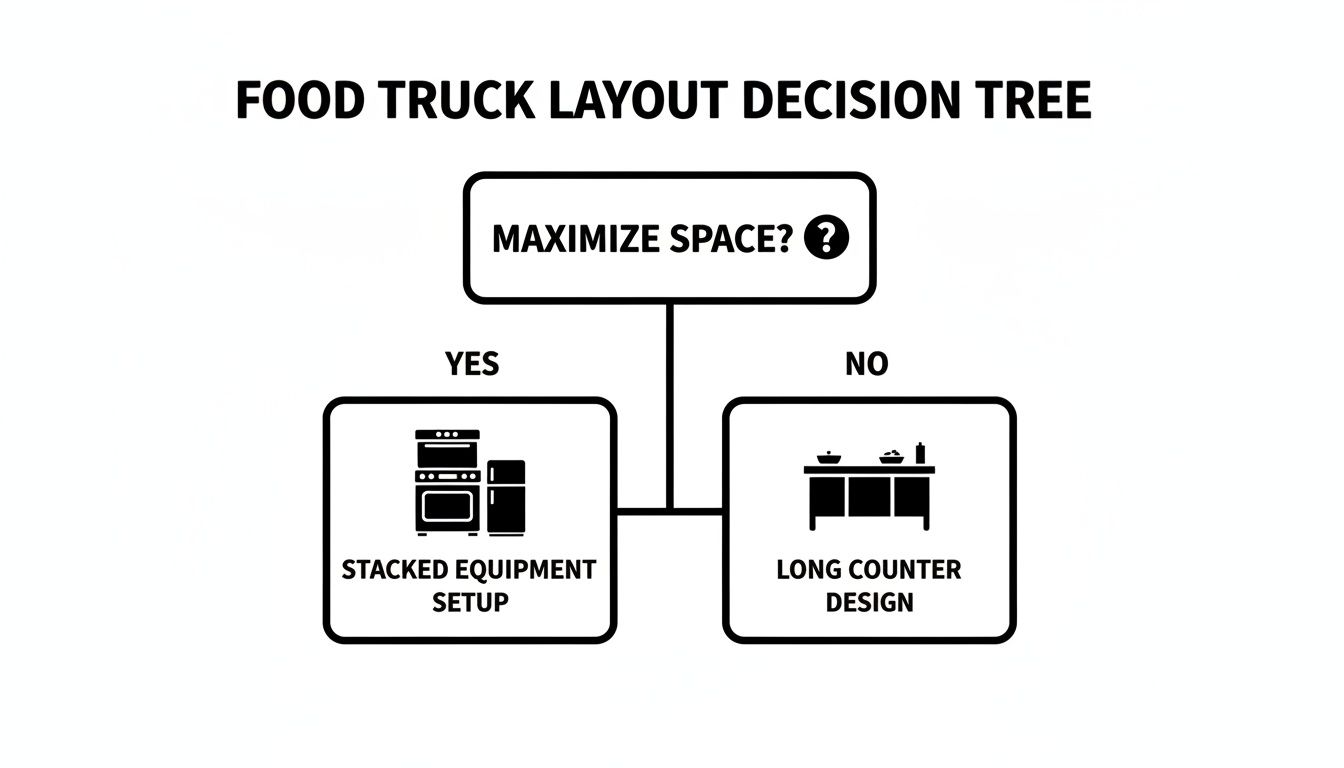
As you can see, a chef focused on maximizing cooking space might lean towards stacked equipment, while someone prioritizing a smooth workflow might design a longer, more linear setup.
Food Truck Power Source Comparison Propane vs Electric
Deciding between propane and electric isn't always straightforward. Each power source has distinct pros and cons that directly affect your daily operations, from cooking performance to where you can legally operate. This table breaks down the key differences to help you think through what's best for your specific concept.
| Factor | Propane (Gas) | Electric (Generator/Shore Power) |
|---|---|---|
| Best For | High-heat cooking (grills, fryers, ranges) | Refrigeration, lighting, POS, precision cooking |
| Power Output | High, consistent heat perfect for searing | Stable, precise temperature control |
| Mobility | High (self-contained tanks) | Limited by generator fuel or cord length |
| Noise & Fumes | Quiet operation, but potential for gas fumes | Generators can be very loud and produce exhaust |
| Upfront Cost | Equipment is often less expensive | Can be higher, especially for high-capacity generators |
| Operating Cost | Varies with propane prices; refills needed | Generator fuel or electricity costs |
| Regulations | Strict safety/storage codes; some areas have restrictions | Generator noise/emission rules; shore power access is limited |
Ultimately, the right choice balances power with practicality. A hybrid approach often gives operators the most flexibility to handle any situation.
Making The Right Choice For Your Truck
So, which one wins? For most trucks, the smartest answer is: both. A hybrid setup is the gold standard for a reason. You use propane to power the heavy-hitting cooking gear that needs serious BTUs—your griddle, your fryers. At the same time, a generator or battery system handles the electricity for your refrigeration, lights, POS system, and any specialty appliances.
The best power setup is one that's tailored to your menu. A burger truck will lean heavily on propane for its grill, while a smoothie truck might be able to run entirely on a battery and inverter system. Let your food be your guide.
Balancing these two power sources creates a versatile and bulletproof mobile kitchen. You get the raw cooking power needed to crank out orders quickly, plus the steady, clean electricity that keeps your support systems and food-safe. This hybrid strategy makes sure you're ready for anything, whether you’re on a busy downtown corner or at a catered event with full shore power access.
The Unsung Heroes: Refrigeration And Prep Stations
Let's talk about the real engine of your food truck. While the sizzle of the griddle and the bubbling of the fryer get all the attention, the true secret to a fast, safe, and profitable operation is what happens behind the scenes. We're talking about the unsung heroes of your mobile kitchen: refrigeration and prep stations.
These aren't just boxes to keep food cold or tables to chop on. They are the heart of your entire workflow. Get this part right, and you're set up for success. A well-thought-out cold line and prep area are the foundation for speed and consistency, making sure every order flies out of the window correctly, even when you're slammed during a downtown L.A. lunch rush.
Reliable Refrigeration: Your First Line Of Defense
Inside the tight, often blazing-hot confines of a food truck, good refrigeration isn't a luxury—it's your most critical tool for food safety and efficiency. A quality undercounter refrigerator or chef base is more than just a cold box; it's a direct investment in your product quality. These units are built to hold their temperature when the heat is on, literally, protecting your expensive inventory from spoiling.
Think of your refrigeration as a partner in your workflow. A chef base sliding neatly under your griddle means burger patties, cheese, and prepped veggies are right where the cook needs them. This simple setup cuts out wasted steps, shaves seconds off every single order, and keeps your team focused on cooking. The same goes for a sandwich prep table; having every topping chilled and within arm's reach turns a chaotic scramble into a smooth, efficient assembly line.
Your refrigeration system is the silent guardian of both your inventory and your reputation. If a unit gives out during a Southern California heatwave, you're not just losing ingredients. You could be shut down for the day and risk your health permit.
Choosing the right unit is a balancing act between size, accessibility, and power draw. Undercounter models are fantastic for making every square inch count. Worktop refrigerators pull double duty, giving you cold storage below and a durable stainless steel prep surface on top. To really dial in your choice, it's worth learning more about energy-efficient commercial refrigerators, which is absolutely essential for managing a food truck's limited power supply.
Strategic Prep Stations: The Assembly Line Hub
If refrigeration is your defense, then your prep stations are the command centers where your menu truly comes to life. A smart prep area is the central hub for meal assembly, ensuring every dish is built with precision and speed. Stainless steel work tables are the industry standard for a reason—they’re tough, easy to sanitize, and give you a reliable surface for everything from dicing onions to plating the final product.
For certain menus, specialized prep tables are absolute game-changers.
- Sandwich and Salad Prep Tables: These units are brilliant, combining refrigerated ingredient wells up top with cold storage cabinets below. It creates a self-contained station where one person can build orders incredibly fast.
- Pizza Prep Tables: If you're a Los Angeles pizza truck, you need one of these. They have a wide, refrigerated rail for all your toppings and a large cutting board surface, keeping cheese, sauce, and pepperoni perfectly chilled and organized.
The layout is everything. You want to create a logical flow—from the fridge to the prep surface to the hot line—that minimizes movement and keeps your team from tripping over each other. It’s a classic assembly-line approach, and it’s the only way to handle high-volume service without quality taking a nosedive. Don't overlook this gear; investing in dependable, space-saving support equipment is just as critical as your fryer or griddle for keeping the momentum going during your busiest hours.
Passing Your Los Angeles Health Department Inspection
Buying the right cooking equipment for a food truck is a huge step, but the real test comes when you have to get it approved. In Southern California, your health permit is literally your license to operate. Without it, your truck stays parked and your service window stays shut.
Wading through the Los Angeles and Orange County health codes can feel like a nightmare, but it really boils down to just a few core ideas about safety and cleanliness.
Think of the health inspector less like a critic and more like a co-pilot. They're not there to fail you; they're there to make sure your mobile kitchen is safe for your team and your future customers. Their checklist is your roadmap to opening day, and every single item on it is a non-negotiable part of building a legitimate, professional food truck.
The Absolute Must-Haves for Health Code Compliance
When an inspector hops on your truck, their first glance will be at the big-ticket systems that prevent foodborne illness and keep things sanitary. These are the foundational pieces that have to be installed correctly and work perfectly from day one. There’s absolutely no wiggle room on these.
Here’s what they’ll check immediately:
- Three-Compartment Sink: This is mandatory. You need it for the classic wash, rinse, and sanitize process for all your pots, pans, and tools. Each sink basin has to be big enough to completely submerge your largest piece of cookware.
- Dedicated Hand-Washing Station: This must be totally separate from your main sink. It needs hot and cold running water, soap, and paper towels right there. It’s the single most important defense against cross-contamination.
- Proper Ventilation: That big exhaust hood isn't just to keep things from getting steamy. It’s a serious safety system that pulls grease-filled vapor out of the air, which drastically reduces fire risk. It has to extend over every piece of equipment that produces heat.
- Fire Suppression System: This is the one you can’t skip. Commercial cooking creates flammable grease, plain and simple. A professionally installed and certified fire suppression system is your first line of defense if things go wrong.
Why That Little "NSF" Logo Matters So Much
As the inspector moves through your truck, they’ll be looking for a small but crucial detail on your equipment: the NSF (National Sanitation Foundation) certification. That little blue logo is your proof that the gear you bought meets strict public health standards. It tells the inspector that the equipment is made from safe materials, is designed to be easily cleaned, and won’t harbor bacteria.
Trying to get by with residential, home-use equipment is one of the quickest ways to fail an inspection. Inspectors can spot it a mile away and know it wasn’t built for the intensity of a commercial kitchen. They will not approve it.
Investing in NSF-certified commercial equipment isn't just a good idea—it’s a flat-out requirement.
Inspectors will look for the data plates on your griddles, refrigerators, and prep tables to find that NSF mark. Seeing it assures them you’ve invested in professional, safe gear and are serious about running a clean operation. If you design your kitchen around these mandatory, certified components from the very beginning, you’ll be on the fast track to passing your inspection the first time and avoiding expensive delays.
Got Questions About Food Truck Gear? We've Got Answers.
Jumping into the Los Angeles food truck scene is exciting, but it comes with a ton of questions. Forget the menu for a second—the choices you make on your cooking equipment for a food truck will make or break your budget, your workflow, and your sanity. We hear the same questions from new truck owners all the time, so we’ve put together some straight, no-nonsense answers to help you invest wisely.
These are the big ones. Get these right from day one, and you’ll save yourself a world of headaches and cash down the line.
Should I Buy New or Used Cooking Equipment for My Food Truck?
It's always tempting to scope out used equipment to save a buck. I get it. But that shortcut can be a minefield of hidden problems. A used fryer that looks like a deal might save you a few hundred dollars upfront, but what happens when it breaks down mid-service? It likely has no warranty, might not be up to current Los Angeles health codes, and could get you a failed inspection right when you’re trying to launch.
Honestly, new equipment is the smarter play for your business in the long run. When you buy new from a solid supplier, you’re not just buying a machine; you’re buying peace of mind. You get a full manufacturer's warranty, a guarantee it's NSF-certified for the health department, and you're getting the most energy-efficient tech. That means you’re protected from surprise repair bills and you’ll save money on utilities every single day.
How Can I Finance My Food Truck Equipment?
Let's be real: outfitting a mobile kitchen is a huge upfront cost. A full setup of brand-new, reliable gear can feel like a mountain to climb, but it doesn’t have to stop you from getting started. This is exactly why financing has become a go-to strategy for smart food truck owners.
Don't think of financing as just taking on debt. Think of it as a tool for protecting your cash flow. Spreading out the cost of your equipment means you keep your cash free for all the other things that keep your truck rolling—inventory, gas, permits, and marketing.
Good equipment suppliers work with financing partners that get the small business grind. They can set you up with manageable payment plans that make sense. This lets you get the high-quality, dependable gear you need to hit the ground running without emptying your bank account on day one.
How Fast Can I Get Equipment Delivered in Los Angeles?
In the food world, time is money. Period. When your main griddle dies during a lunch rush, every minute it's down costs you. The same goes for your initial build-out—waiting around for weeks on a delivery can throw your entire launch schedule off track.
This is where a local supplier with a Southern California warehouse is an absolute game-changer. You want to find a company that actually stocks their gear right here in LA. These guys can often get your equipment to you in just one to two business days. That kind of speed is a massive advantage, whether you're in a panic replacing a broken fridge or just trying to get your truck finished and inspected.
What Is The Most Important Maintenance for My Equipment?
The best way to avoid a costly, service-killing breakdown is just good old-fashioned cleaning and upkeep. You don’t need to be a mechanic, you just need to be consistent. A few simple tasks each day and week can add years to the life of your equipment and keep it cooking perfectly.
Here’s what you absolutely have to stay on top of:
- Daily Cleaning: At the end of every single shift, get in there and clean your cooking surfaces. Scrape the griddle, boil out the fryer, and wipe down every inch of stainless steel. Grease buildup isn't just gross—it’s a fire hazard and it makes your food taste bad.
- Weekly Filter Checks: The filters in your ventilation hood are your first line of defense against grease. Pull them out and clean them at least once a week. This keeps the air moving, keeps your truck safe, and keeps the whole system from working too hard.
- Refrigeration Coil Care: Think of the coils on your fridges and freezers like the radiator in a car. They need to breathe. Once a month, take a brush and gently clean off any dust and gunk so they can release heat properly. Your units will stay colder and use less electricity.
A simple cleaning schedule is the number one thing you can do to protect your investment and make sure your kitchen is always ready to crush a busy service.
Ready to equip your food truck with reliable, warranty-backed gear? LA Restaurant Equipment offers warehouse-direct pricing on a full line of NSF-certified cooking and refrigeration equipment, with fast, free shipping across Southern California. Explore our inventory and get your mobile kitchen started today.