

When you're trying to outfit a commercial kitchen in Los Angeles, every inch counts. This is especially true for undercounter refrigerators, which are designed to tuck neatly under standard countertops, maximizing your workspace. Whether you're running a bustling pizza place, a compact food truck, or a classic Mexican restaurant, getting the dimensions right is crucial.
Generally, you'll find that commercial undercounter fridges have a height between 32 to 34.5 inches, a width anywhere from 24 to 60 inches, and a depth that hovers right around 24 inches. These dimensions aren't random; they're specifically engineered to slide right under standard 36-inch commercial countertops.
What Are the Standard Dimensions for an Undercounter Fridge?
Whether you're running a bustling Los Angeles pizza joint, a high-traffic food truck, or a popular Mexican food spot, choosing the right restaurant equipment starts with knowing its footprint. The beauty of standardized undercounter fridge dimensions is that they simplify kitchen design and make upgrades a breeze. You can usually swap out an old unit for a new one without having to tear apart your entire prep line.
This consistency is a lifesaver. For a deeper dive into how kitchen layouts are planned, a guide to standard kitchen cabinet sizes can be a huge help. These coolers are built to match common cabinet depths, giving you that clean, built-in look that's crucial for an efficient and professional kitchen.
The Three Core Measurements
Let's break down the three key dimensions you need to know: width, height, and depth. The diagram below gives you a quick visual.
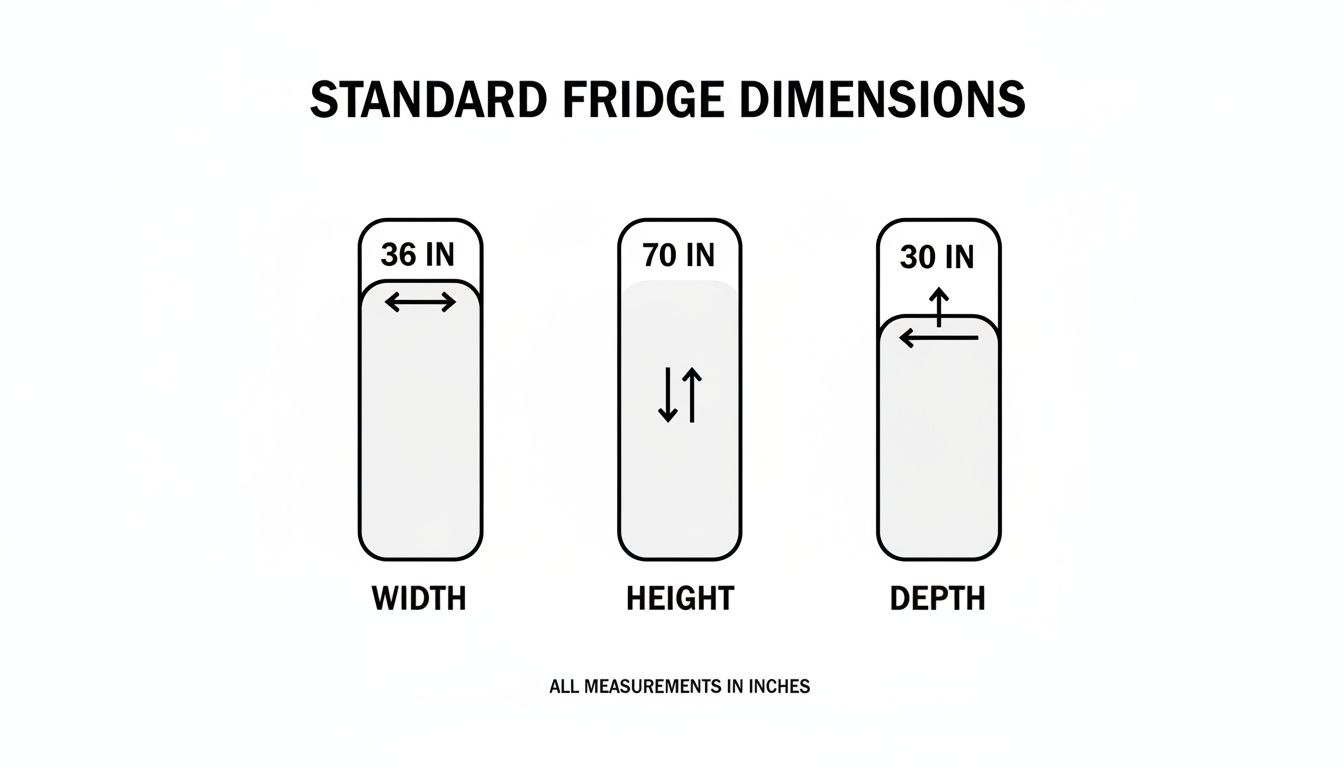
As you can see, the height is dictated by those standard countertops, the depth aligns with your cabinetry for a flush fit, and the width varies based on the unit’s capacity and how many doors it has. These three numbers are your starting point for any installation. Get them right, and the unit will slot perfectly into your kitchen's workflow.
To make things even clearer, here's a quick reference table that breaks down the typical dimensions you'll see on the market for single, double, and even triple-door models.
Typical Commercial Undercounter Fridge Dimensions
This table summarizes common exterior dimensions and capacity ranges for single, double, and triple-door commercial undercounter refrigerators, helping you quickly identify the right fit.
| Unit Type | Common Widths (Inches) | Standard Height Range (Inches) | Standard Depth Range (Inches) | Typical Capacity (Cu. Ft.) |
|---|---|---|---|---|
| Single-Door | 24 - 32 | 32 - 34.5 | 24 - 32 | 6 - 10 |
| Double-Door | 48 - 60 | 32 - 34.5 | 24 - 32 | 12 - 18 |
| Triple-Door | 60 - 72+ | 32 - 34.5 | 24 - 32 | 19 - 25 |
This table should give you a solid baseline for what to expect as you start shopping. Keep these numbers in your back pocket, and you'll be well on your way to finding the perfect restaurant equipment for your space.
Why Precise Dimensions Are Critical for Kitchen Workflow
Choosing the right undercounter fridge isn't just about plugging a hole in your prep line. Getting the dimensions right directly impacts your kitchen's entire flow, safety, and even your bottom line. An ill-fitting refrigerator can create instant bottlenecks, block walkways, and cause expensive installation headaches that bring your operation to a halt.
Think of it this way: in a fast-paced Los Angeles pizza joint, the line between profit and loss is paper-thin. A chef base that’s even a few inches off might force a cook to take an extra step for every single order. That adds up to minutes of lost time per hour, which over a year, translates to real money in labor costs and slower ticket times.
Financial and Operational Impacts of Sizing
Nailing the measurements from day one prevents a whole cascade of problems down the road. A unit that’s just a half-inch too wide won't fit, period. That means return fees, project delays, and a lot of frustration. On the flip side, a unit that’s too small creates those awkward, grimy gaps that are impossible to clean and become a magnet for sanitation issues.
In a commercial kitchen, space is money. Every square foot must be optimized for performance. Accurate undercounter fridge dimensions ensure that equipment not only fits but actively contributes to a smoother, faster, and more ergonomic workflow.
Proper sizing is also crucial for giving the unit enough ventilation space. Without that clearance, the refrigerator’s compressor has to work overtime, jacking up your energy bills and leading to premature burnout. This is exactly why solid planning is non-negotiable. To really map things out and guarantee your dimensions are spot-on, you might want to look into specialized kitchen design software.
Workflow Optimization in Practice
The right dimensions can completely transform how a space operates. Just look at these examples from Los Angeles restaurants:
- LA Food Trucks: In the tight quarters of a food truck, a perfectly sized undercounter unit means maximum cold storage without eating into precious prep space. Ingredients are always within arm's reach.
- Mexican Restaurants: A well-placed prep table refrigerator with the right footprint can streamline the assembly line for tacos and burritos, dramatically boosting output during the lunch rush.
- Pizza Restaurants: A low-profile chef base under the pizza oven keeps cheese and toppings chilled and accessible, shaving seconds off every order.
At the end of the day, precise measurements are the foundation of a successful kitchen. To dive deeper into this, you can learn more about crafting an effective commercial kitchen layout design in our detailed guide.
How to Accurately Measure Your Space
Before you click "buy" on any piece of restaurant equipment, grabbing a tape measure is your single best defense against a massive, costly headache. I've seen it happen time and again: a new undercounter fridge shows up, and it’s off by a mere fraction of an inch, leading to huge installation delays and a lot of frustration.
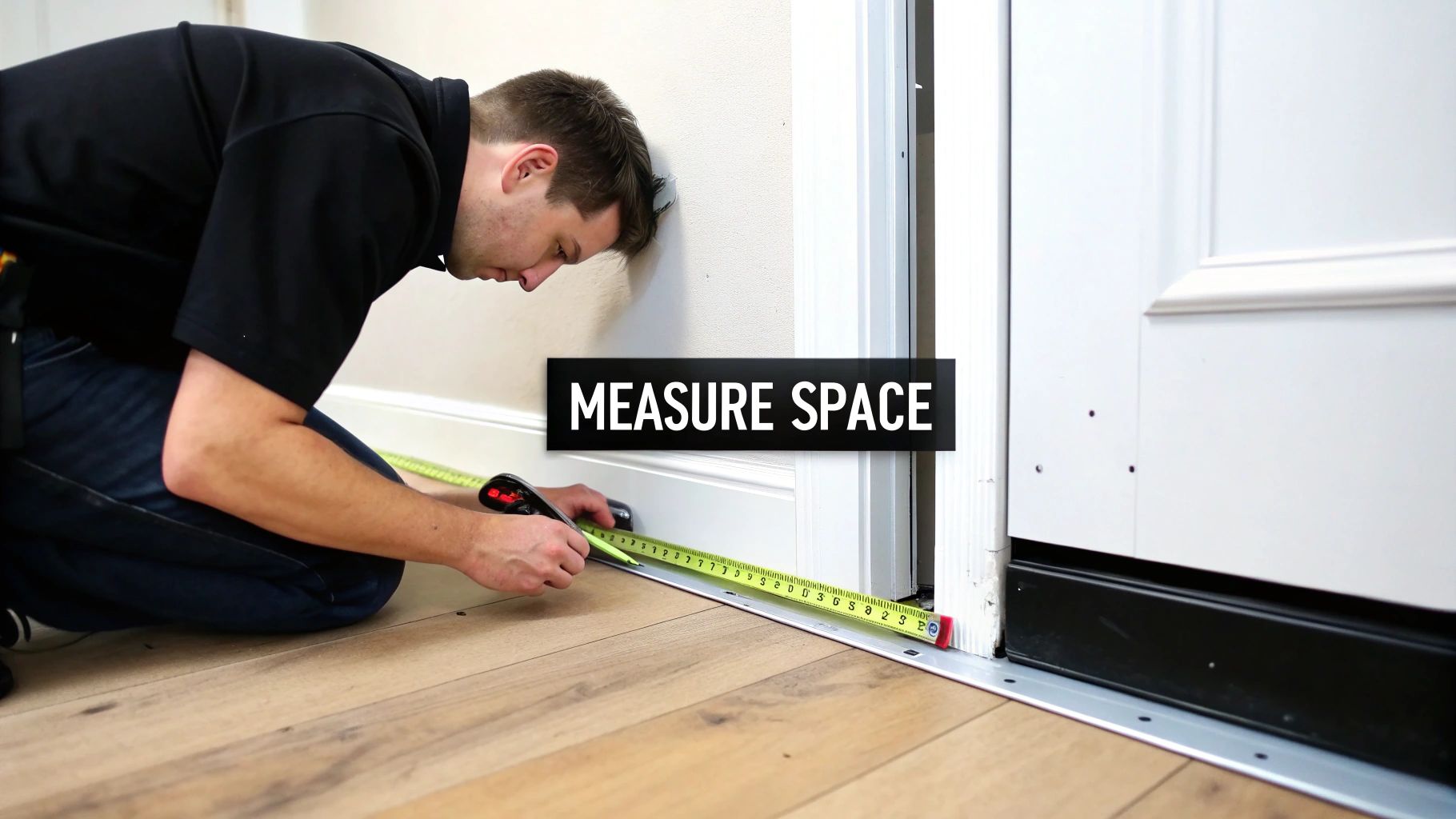
Let's walk through the right way to do this so you can order with total confidence. The goal here isn’t just to see if the unit will slide in, but to make sure it has the room it needs to run efficiently for years to come. So, grab a reliable tape measure, a notepad, and let’s get it right the first time. No rounding numbers—accuracy is everything.
Taking the Three Core Measurements
Here’s a fact of life in commercial kitchens: floors and walls are almost never perfectly level or straight. Because of this, you absolutely must measure the height, width, and depth at multiple points to find the true minimum dimension you're working with.
- Measure the Height: Take three separate height measurements for the opening—one on the far left, one smack in the middle, and one on the far right. Write down the smallest of the three. That's your absolute maximum height.
- Measure the Width: Do the same thing for the width. Measure across the top of the space, the middle, and the bottom. Again, the narrowest measurement is the only one that matters. This ensures the unit will slide in without a fight.
- Measure the Depth: Run your tape from the back wall to the front edge of the counter or adjacent cabinets. Don't forget to look for any obstructions back there—things like plumbing pipes or electrical outlets can sneak up on you and steal valuable inches.
Accounting for Essential Clearances
This is non-negotiable. Your undercounter fridge needs room to breathe. Without proper ventilation, the compressor works overtime, your energy bills shoot up, and the lifespan of the unit takes a nosedive.
Pro Tip for LA Businesses: Before you even think about finalizing an order, measure every single doorway, hallway, and elevator on the delivery path. A fridge that fits perfectly under your counter but can't get through the front door of your Los Angeles restaurant is a logistical nightmare you don’t need.
Most commercial, front-venting models will need at least 1-2 inches of clearance at the back and about 1 inch on the sides and top. But always double-check the manufacturer's spec sheet for the exact model you want. That small buffer is absolutely critical for letting heat escape.
Finally, think about your daily workflow. Stand in the spot and pretend to open the fridge door. Is it going to block a high-traffic walkway in your LA food truck? Will it bang into the oven next to it? Planning for door swing is a simple step that saves you from a thousand tiny annoyances every single day.
Matching Undercounter Configurations to Your Needs
Let's be clear: not all undercounter refrigerators are the same. The right restaurant equipment for a cramped Los Angeles food truck is worlds apart from what a high-volume Mexican restaurant or a chic pizza spot needs. Getting to know the main players—single-door, multi-door, drawer units, and chef bases—is the only way to pick a model that actually helps your workflow instead of getting in the way.
Each design is a trade-off between footprint, capacity, and how you access what's inside. A compact single-door unit might be the perfect fit for a small coffee shop's milk station, while a sprawling triple-door model is what a busy prep line in a Mexican restaurant needs to stay stocked. The goal is always to match the undercounter fridge dimensions and features to the job it needs to do.
Single and Double-Door Refrigerators
Single-door units are the unsung heroes of smaller kitchens and bars. They usually measure between 24 to 32 inches in width, which makes them a lifesaver in tight spots. Think about stashing one under a bar for garnishes or tucking it into a food truck to hold prepped ingredients. They offer simple, reliable cooling where every inch counts.
When you need more storage, double-door models are the next step up. Spanning 48 to 60 inches wide, these are a staple in most restaurant prep stations. They give you enough room to keep different food categories separate, which helps cut down on cross-contamination and lets chefs in a busy pizza kitchen grab what they need without a frantic search during a dinner rush. The glass door versions are especially great for front-of-house, showing off bottled drinks and desserts to tempt customers.
Fun fact: the 24-inch wide undercounter fridge is the most popular size out there, grabbing over 40% of the global market share. These units are often around 24 inches deep, so they can sit flush with standard cabinets, giving you that clean, built-in look so many upscale LA spots go for.
Drawer Units and Chef Bases
Drawer models are all about speed and saving your back. Instead of swinging a door open and bending down to dig through shelves, your cooks can just pull out a drawer for instant, top-down access to ingredients. Ranging from 27 to 72 inches wide, these are an absolute game-changer for fast-paced kitchens like a busy sandwich shop or a pizza station where every second is precious. Better organization means faster ticket times.
Finally, you have chef bases, which are the ultimate combination of cooking and cooling. These are low-profile, super-sturdy units built to have heavy equipment like griddles or charbroilers placed right on top. Their dimensions usually run from 36 to 84 inches wide with a height around 26 inches, keeping proteins and other key ingredients perfectly chilled right where the cooking happens. This kind of setup is a must-have in many Los Angeles kitchens, from Mexican restaurants to high-end diners, as it saves chefs countless trips back and forth to a separate fridge.
To browse a huge selection of models and find the one that's just right for your space, check out our guide on various undercounter refrigerator options.
A Deep Dive into Dimensions and Capacity
When you're looking at undercounter fridge dimensions, you're figuring out if a unit will physically fit in your space. But the real game-changer is its internal capacity, measured in cubic feet (cu. ft.), which tells you how much product it can actually hold. For any Los Angeles restaurant owner, whether you're running a high-volume pizza spot or a tiny food truck, that space is gold.
Getting this right is the difference between a smooth service and constantly running to the walk-in. A unit’s outside measurements don't always tell the whole story. The compressor's location, how thick the insulation is, and the interior layout all eat into the usable space. For example, a slim 24-inch single-door model might look compact, but it can still offer a respectable 5 to 7 cubic feet of storage. That's often the perfect size for keeping daily essentials right at hand in a bar or coffee shop.
Translating Width into Storage
As you'd expect, as the unit gets wider, the capacity grows—but it's not always a direct one-to-one increase. Smart design makes a huge difference. Jumping up to a standard 48-inch double-door refrigerator gives you a significant boost to around 12 to 15 cubic feet. This is the sweet spot for a busy Mexican food prep line that needs to hold a variety of fresh ingredients.
Go even bigger, and a 60-inch model can easily push past 15 cubic feet, while the large 72-inch triple-door units can top 19 cubic feet. All that extra room means better organization, less food waste, and chefs who can grab what they need in seconds. Balancing the footprint with the internal storage you need is a core operational decision for any Los Angeles restaurant.
A common mistake is focusing solely on the external footprint without considering the internal layout. A well-designed 48-inch model with adjustable shelving can often be more functional than a poorly organized 60-inch unit.
Market Trends and Capacity Insights
The global demand for this restaurant equipment shows just how vital it is in any modern kitchen. The undercounter refrigerator market hit a massive USD 3.42 billion in 2024 and is expected to climb to USD 6.27 billion by 2033. Here in North America, these units are a lifeline for space-crunched businesses like LA's food trucks.
The ever-popular 24-inch models, which provide that handy 5 to 7 cubic feet of space, make up over 40% of global sales because they slide perfectly under standard 36-inch countertops. For our customers, that means an Atosa unit can fit seamlessly into just about any prep station. In fact, models with a 5-10 cu. ft. capacity command over 50% of the revenue share worldwide, hitting that perfect middle ground for bars and cafes. You can dig into more stats about the growing undercounter refrigerator market on dataintelo.com.
Choosing the right capacity also plays a big part in your utility bills. To learn more, take a look at our guide on selecting energy-efficient commercial refrigerators.
What About Specialty Undercounter Units?
While your standard undercounter fridge covers a lot of ground, Los Angeles's incredibly diverse food scene often calls for something a bit more specialized. Equipment like kegerators, chef bases, and pizza prep tables aren't just novelties; they're essential tools with unique dimensions built for a specific job, making them indispensable in breweries, pizzerias, and high-volume Mexican restaurants across Southern California.
Think about beverage service. Kegerators and back bar coolers are designed specifically for this. A simple single-tap kegerator usually comes in at 24 inches wide, a perfect fit for a small bar or even a food truck. But for a bustling brewery or a busy bar, you'll see multi-tap systems that stretch to 48, 60, or even 96 inches wide to hold several kegs. They all stick to that standard counter height of around 36 inches so they line up neatly with the rest of your bar.
Chef Bases and Pizza Prep Tables
Chef bases are the unsung heroes of the hot line. These are low-slung, powerful refrigerated drawers built tough enough to hold heavy cooking equipment like griddles or charbroilers right on top. Because of this, they’re shorter, usually around 20 to 26 inches high, but can range in width from 36 to over 100 inches. This clever design keeps your key ingredients perfectly chilled right where the cooking happens—a huge advantage in any fast-paced LA kitchen.
For any Los Angeles pizza restaurant worth its salt, a dedicated prep table is non-negotiable. These units brilliantly combine a refrigerated base for storage with a raised, refrigerated rail on top to hold all your ingredient pans. You’ll typically see them in 48, 60, or 72-inch widths. The key dimension to watch here is the depth; they are often much deeper than standard units, usually between 32 to 36 inches, giving your staff plenty of workspace in front of the ingredients.
The market for commercial undercounter refrigeration, valued at a staggering USD 11.4 billion in 2024, is expected to climb to USD 15 billion by 2033, which really underscores just how vital these units are. For LA’s independent restaurant owners, the 24-inch wide by 24-inch deep models are consistent best-sellers, while 48-inch prep tables grab 45% of the commercial market share.
This market data just confirms what chefs already know: these specialized units are efficiency machines. From ghost kitchens squeezing in narrow 18-inch models to sandwich shops that live and die by their 5-10 cu. ft. units, getting the dimensions right drives your whole operation. You can dig into more data on the commercial refrigeration market's growth and trends on credenceresearch.com. Ultimately, picking the right specialty unit means your equipment is built to support your unique menu and workflow, not fight against it.
Common Installation Mistakes to Avoid
Even if you’ve nailed the undercounter fridge dimensions, a few common installation slip-ups can turn your shiny new investment into a major headache. We're talking poor performance, sky-high energy bills, and even premature equipment failure. Getting the setup right from day one is absolutely crucial, especially in a busy Los Angeles restaurant where you can't afford any downtime.
One of the biggest blunders we see is ignoring the manufacturer's ventilation specs. It’s tempting to shove a unit right up against the wall to save space, but blocking the vents traps heat and forces the compressor to work overtime. Before you know it, you're dealing with a burnt-out motor. Always, always leave the specified clearance—it's usually just one to two inches at the back and sides, but it makes all the difference.

Overlooking Site and Utility Prep
Another frequent oversight is just not prepping the installation site properly. Kitchen floors are almost never perfectly level. If you don't take a minute to adjust the unit’s feet, the door won't seal correctly, leading to constant temperature fluctuations and wasted energy.
A seamless installation starts long before the delivery truck arrives. Verifying your space, from floor levelness to electrical capacity, prevents a simple restaurant equipment drop-off from turning into a costly project delay.
Here are a few other critical mistakes that can trip you up:
- Forgetting Obstructions: It happens all the time. You measure the open space but forget about the baseboards, plumbing lines, or electrical outlets that steal precious inches of depth you were counting on.
- Misjudging Door Swing: Make sure you map out the door swing. A door that opens into a busy walkway or constantly bangs into other equipment is more than an annoyance—it's a workflow killer.
- Ignoring Electrical Needs: Assuming any old outlet will do is a risky game. Commercial refrigerators are power-hungry and often require a dedicated circuit to handle their draw without constantly tripping the breaker.
Your Top Questions About Undercounter Fridge Dimensions
When you're zeroing in on the right undercounter fridge, a few final questions always seem to pop up. It’s totally normal. Getting these details right is what separates a smooth installation from a headache, whether you're outfitting a high-volume Los Angeles pizza restaurant, a cozy food truck, or a busy Mexican restaurant.
Let's walk through the most common questions we get from chefs and owners. Clearing these up will help you buy with confidence, knowing your new unit will fit and perform perfectly from day one.
What Is the Standard Height of a Commercial Undercounter Fridge?
You’ll find that most commercial undercounter refrigerators stand between 34 and 36 inches tall. This isn't an accident—it’s designed specifically so the unit can slide right under a standard 36-inch high commercial countertop. The goal is a clean, built-in look that maximizes your workspace.
To deal with the reality of older, uneven kitchen floors, most models also come with adjustable legs or casters. This little feature is a lifesaver, allowing you to tweak the height for a perfectly level and stable setup.
How Much Clearance Space Does an Undercounter Fridge Need?
This is a big one. Proper airflow is non-negotiable for the health and efficiency of your fridge. As a rule of thumb, most manufacturers will tell you to leave at least 1-2 inches of open space at the back and on both sides. This gives the condenser coils room to breathe and dissipate heat effectively.
Now, some "front-breathing" models are engineered to be installed flush against side cabinets, which is great for tight spaces. But you absolutely must check the manufacturer's spec sheet for your specific model. Skimping on clearance is the fastest way to an overheated compressor, higher energy bills, and a unit that dies long before its time.
Can I Use a Residential Undercounter Fridge in My Restaurant?
Putting a residential fridge in a commercial kitchen is a classic, costly mistake. We strongly advise against it. Commercial-grade refrigerators are built differently from the ground up, with powerful cooling systems and rugged components designed to handle the relentless pace and high heat of a professional kitchen.
A residential unit simply can’t keep up. It will almost certainly fail under the strain, and the manufacturer will immediately void your warranty. Even more critical, it likely won’t meet local health codes, which could get you in hot water during an inspection. Investing in proper commercial restaurant equipment isn't just a good idea—it's essential for safety, reliability, and peace of mind.
Ready to find the perfect fit for your professional kitchen? At LA Restaurant Equipment, we specialize in new, warranty-backed commercial refrigeration at warehouse-direct prices. Explore our extensive selection and enjoy fast, free shipping across Southern California by visiting us at https://larestaurantequipment.com.