

Picking the right commercial refrigerator ice maker is one of those make-or-break equipment decisions for any restaurant owner in Los Angeles. It’s not just another appliance; it’s a workhorse that impacts everything from the quality of your drinks to the efficiency of your kitchen. Whether you're slinging pizzas, running a bustling food truck, or serving authentic Mexican food, your ice machine is a core asset that fuels your service.
Finding the Right Ice Maker for Your Restaurant
In the non-stop Southern California food scene, you simply can't afford to run out of ice. From chilling horchata at a taco spot to building craft cocktails at a high-end bar, the demand is relentless. It's no surprise the global market for ice makers has been booming—these machines are vital. In fact, North America alone accounts for a whopping 36.91% of the global market share, and you can bet a huge chunk of that demand comes from places like L.A.
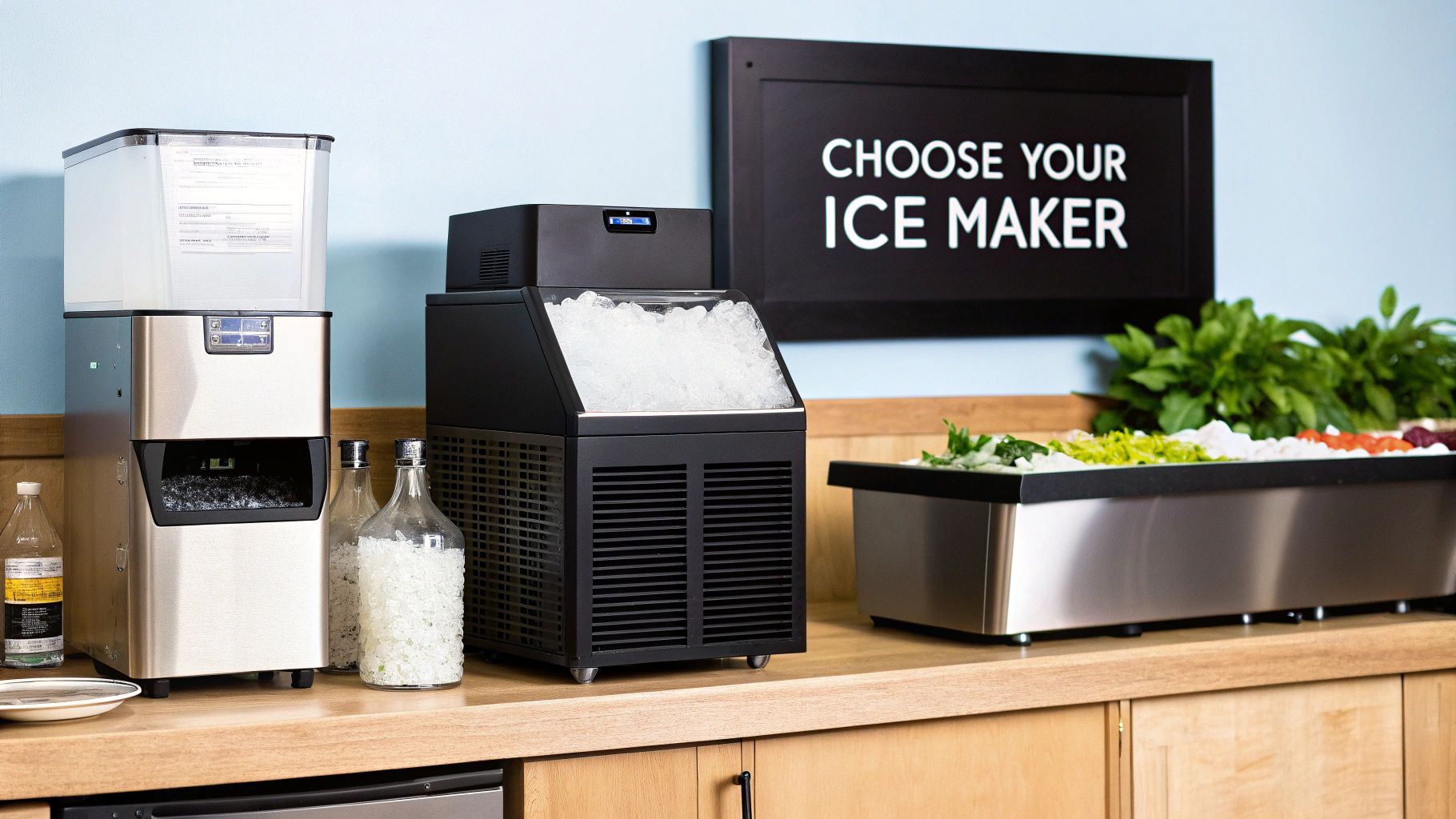
This guide is here to cut through the noise and help you make a smart investment in your restaurant equipment. Let's start by breaking down the three main types of ice solutions you'll come across.
Your Three Main Options
Think of choosing an ice maker like picking a vehicle for your business—each one is built for a different job.
- Undercounter Units: These are the compact city cars of the ice world. They slide right under a bar or prep counter, making them perfect for tight spaces where you need ice immediately on hand.
- Integrated Models: Consider these the versatile SUVs. You'll often find them built into a larger refrigerated prep table, keeping ice within arm's reach for a busy line cook.
- Standalone Machines: These are the heavy-duty pickup trucks. Built for pure, high-volume production, they are the powerhouses for large restaurants, bars, and event spaces that can never, ever run out of ice.
A bustling Los Angeles pizza joint has completely different needs than a nimble food truck serving up tacos. Even different types of Mexican food restaurants have unique demands based on their menu. Once you understand these core types of restaurant equipment, you can start to see which one fits your operation.
It all comes down to balancing how much ice you need with the space and budget you have. You can also explore our full collection of Los Angeles ice makers to see these different models in action. Getting this foundation right will point you toward the perfect machine for your business.
Comparing Commercial Ice Maker Types
Trying to figure out the world of commercial ice equipment can feel like a lot, but it really just comes down to three main designs. Every type of refrigerator ice maker is built for a specific kitchen, workflow, and how much ice you need. Getting a handle on what makes each one tick is the first real step to picking a machine that doesn't just make ice, but actually helps your restaurant run smoother.
Think about it: a trendy Los Angeles pizza parlor in Silver Lake has totally different needs than a huge, bustling Mexican food restaurant in East LA. One needs ice right at the bartender's fingertips, while the other needs a mountain of it, 24/7. Let’s dig into the roles each of these machines play in the LA food scene.
Undercounter Ice Makers
The undercounter refrigerator ice maker is the king of saving space. Just like the name says, these all-in-one units are made to slide right under a standard 34-inch high counter. They pack the ice-making parts and a small storage bin into one compact machine, making them the perfect choice for your front-of-house crew.
Picture a busy Pasadena sandwich shop during the lunch rush. The staff needs to scoop ice for fountain drinks without walking to the back. An undercounter unit tucked right next to the soda machine gives them that instant access, which keeps the line moving and the customers happy. Their smaller size means they produce less ice, usually somewhere between 50 to 300 pounds a day, but for those specific, on-the-spot needs, you can't beat their efficiency.
Integrated Ice and Water Dispensers
You've definitely seen these before. Integrated models, the kind you often find in hotel hallways or as part of a big beverage dispenser, are the go-to for any self-service situation. They handle everything—making ice, storing it, and dropping it right into a cup—all in one piece of equipment. They're a staple in fast-casual spots, cafeterias, and break rooms where people are grabbing their own drinks.
These systems are built for convenience and, just as importantly, hygiene. The ice is dispensed straight into the cup, so no one's hands are touching a scoop. That seriously cuts down on the risk of cross-contamination, which is a massive deal in any food business, including Los Angeles food trucks. Their production is usually moderate, but they’re perfect for handling a steady, predictable flow of customers all day long.
Standalone and Modular Ice Machines
When you just need sheer volume, standalone and modular ice machines are the champs, no question. These are the heavy-duty workhorses of the kitchen, cranking out anywhere from 400 to over 2,000 pounds of ice every single day. A standalone unit, also called an "ice machine head," only makes the ice; you have to pair it with a separate storage bin.
This modular setup gives you incredible flexibility. Let's say a Los Angeles pizza restaurant is just getting started. They might begin with a 500-pound ice machine head on top of a matching bin. As they get more popular, they can just swap out the head for a 1,000-pound model without having to replace the whole setup. That kind of scalability makes these units a smart long-term restaurant equipment investment for any business with big or changing ice demands. They are the backbone of large restaurants and busy bars—any place where running out of ice just isn't an option.
Here's the key takeaway for any restaurant owner: match the machine's design to how your staff actually works. Putting the right machine in the right place—like an undercounter at the bar and a big modular unit in the back—can make a huge difference in your team's efficiency and how fast you can serve customers.
To make it easier to see the differences, here’s a quick side-by-side of the three main types of commercial ice makers.
Commercial Ice Maker Comparison
This table breaks down the three main types of commercial ice makers, showing you where each one shines and what to watch out for.
| Ice Maker Type | Best For | Key Advantages | Potential Drawbacks |
|---|---|---|---|
| Undercounter | Bars, cafes, small restaurants, service stations | Compact footprint; convenient front-of-house access; all-in-one design. | Lower ice production and storage capacity; not ideal for high-volume needs. |
| Integrated | Fast-casual, self-service beverage stations, hotels | Hygienic dispensing; user-friendly operation; combines ice and water. | Moderate capacity; less flexibility than modular systems. |
| Standalone/Modular | High-volume restaurants, large bars, event venues | Maximum ice production; scalable design; flexible bin options. | Requires significant space; higher initial investment; separate bin needed. |
Choosing the right one really comes down to knowing your space, your daily volume, and how your team operates.
Calculating Your Restaurant's Daily Ice Needs
Picking the right type of refrigerator ice maker is a great first step, but sizing it correctly is what really makes or breaks the decision. Go too small, and you'll be making frantic ice runs during a dinner rush. Go too big, and you're just wasting energy and money. Let's get past the guesswork and figure out what your restaurant actually needs every day.
This isn't just about counting heads; it's about understanding how your specific operation uses ice. A Los Angeles pizza restaurant, a busy food truck, and a high-end Mexican food spot all have completely different ice demands. The trick is to break it all down, piece by piece.
Start with a Simple Formula
To get a solid baseline, you can lean on a simple industry formula. This gives you a starting point before you start tweaking it for your unique menu and service style.
- For Drinks: Plan on needing about 1.5 pounds of ice per customer. This covers the average use for fountain drinks, iced tea, and water.
- For Food Prep: Toss in another 0.5 pounds of ice per customer if you use ice in your kitchen for things like salad bars, seafood displays, or chilling down ingredients.
So, a restaurant seeing 100 customers would need roughly 200 pounds of ice a day (150 lbs for drinks + 50 lbs for food). A Los Angeles food truck with a simple menu might stick closer to the 1.5 lbs per customer, while a seafood joint will need way more.
Adjusting for Your Menu and Service
Now, let's sharpen that estimate. A full-service restaurant with a hopping bar is going to burn through a lot more ice than a quick-service cafe.
Think of it this way: your production rate is your daily income, and your bin capacity is your savings account. You need enough daily cash flow (production) to handle normal business, and a healthy savings account (bin) for those unexpected surges.
You’ll want to consider a few other things:
- Bar Service: A cocktail-heavy bar can easily double its ice consumption. Blended drinks, in particular, are absolute ice hogs. A good rule of thumb is to add 3 pounds of ice per seat in your bar area to your daily total.
- Back-of-House Needs: Got a salad bar or a fresh fish display? Those need a serious amount of ice to stay fresh and look appealing. You'll need to factor in the volume of your display bins.
- Peak Hours: Always plan for your busiest crush. Your machine needs to produce enough ice to get you through the peak without running the bin dry. A good target is to have your bin no more than 75% depleted after your busiest rush.
This chart lays out the general selection process, which really kicks in after you've nailed down your numbers.
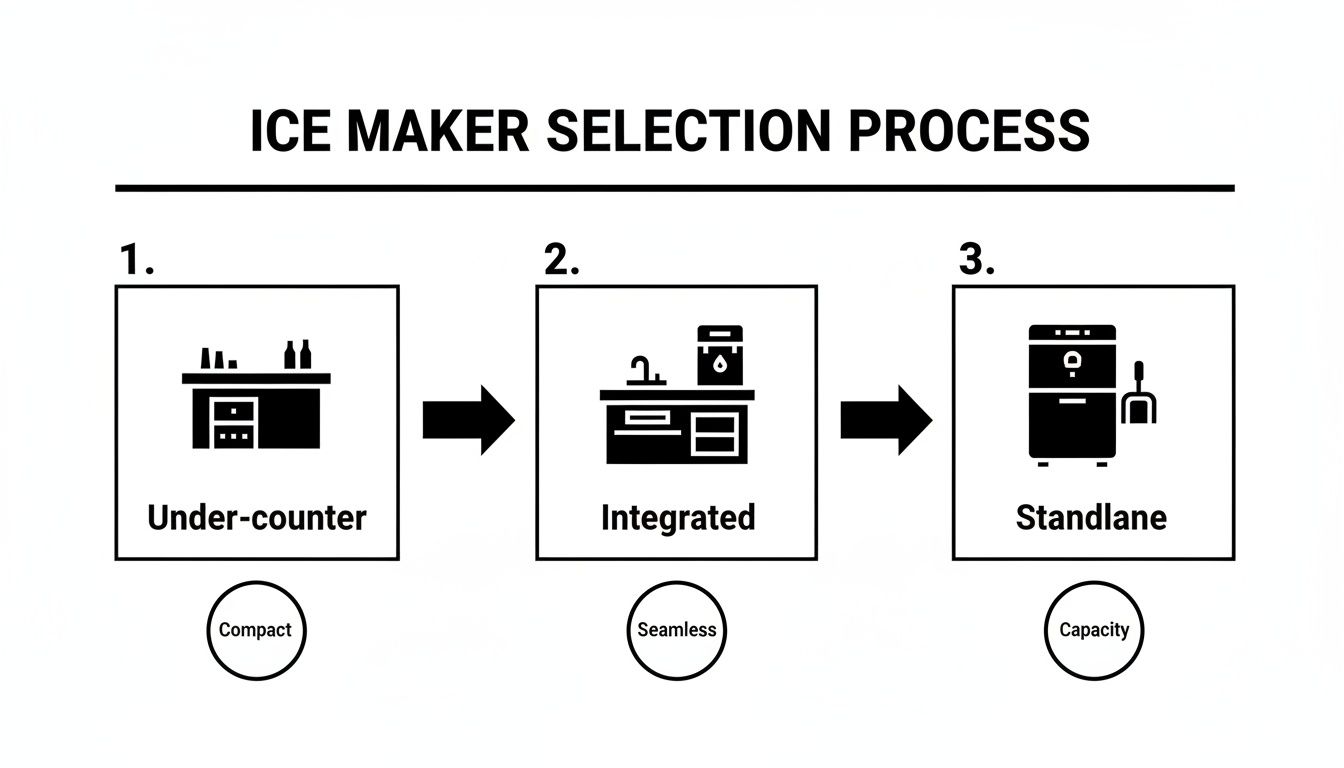
You can see how the solutions scale up—from a compact undercounter unit to a standalone beast—as your ice needs grow.
Real-World Los Angeles Examples
Let’s put this into practice. A small LA food truck serving 100 people a day might only need 150 pounds of ice. On the flip side, a large full-service Mexican food restaurant serving 300 guests with a popular margarita bar could easily blow through 800 pounds or more. The numbers don't lie—the foodservice segment makes up a whopping 36.84% of the entire global ice maker market, which shows just how critical this calculation is for businesses like yours.
Once you have your daily ice number dialed in, it's time to accurately estimate project costs for the machine and getting it installed in your kitchen. Taking the time to do the math upfront means you’ll invest in restaurant equipment that actually supports your restaurant's success, preventing costly headaches and setting you up for future growth.
Understanding Installation and Utility Needs
Picking the right size and style of refrigerator ice maker is a great first step, but it’s really only half the battle. To get that machine humming from day one, you need to have the right infrastructure ready and waiting. A commercial ice machine isn't like a home appliance you just plug into the wall—it's a serious piece of restaurant equipment that needs specific utility hookups to run safely and efficiently.
Figuring out these requirements before your new machine arrives is one of the smartest things you can do. It saves you from the headache of a botched installation, surprise costs from an electrician or plumber, and the kind of delays that can bring a busy kitchen to a grinding halt.
Let's walk through the three critical connections every single commercial ice maker needs.
The Essential Trio: Water, Power, and Drains
Think of these three as the lifeblood of your ice machine. If even one is missing or isn't up to spec, your shiny new investment simply won't work. Each one has its own set of rules you need to plan for.
-
Dedicated Electrical Circuit: Your ice maker is a workhorse, and it draws a lot of power. It absolutely must have its own dedicated electrical circuit. Trying to share a circuit with other power-hungry restaurant equipment like your fryer or a convection oven is just asking for tripped breakers and potential equipment failure.
-
Accessible Water Line: This one’s a no-brainer—you need a steady supply of clean water. You'll need a cold water line, usually a 3/8" connection, located close to the machine. Critically, this line needs its own shut-off valve so you can easily turn off the water for maintenance or emergencies.
-
Proper Drainage: All the water that doesn't get turned into ice has to go somewhere. Your machine needs a floor drain to handle the melt-off and the water from the harvest cycle.
Water Quality and Filtration in Southern California
Anyone living and working in Southern California knows our water is notoriously hard. It's packed with minerals like calcium and magnesium. While it’s perfectly safe to drink, this "hard water" is the number one enemy of your ice-making equipment. Without a good filter, those minerals build up inside the machine’s guts, creating a crusty deposit called scale.
Scale buildup is like plaque in an artery for your ice maker. It clogs up water lines, coats freezing surfaces, and forces the compressor to work way harder than it should. The result? Cloudy ice, higher energy bills, and eventual breakdowns.
A high-quality water filter isn’t an optional add-on around here; it’s a mandatory part of a professional setup. Installing a commercial-grade filter between your water line and the machine is the best way to strip out those minerals. This protects your restaurant equipment investment and guarantees you’re serving pure, crystal-clear ice to your customers.
To get into the nitty-gritty, check out our guide on how to properly connect an ice maker to a water line.
Gravity Drains vs. Condensate Pumps
How your machine gets rid of wastewater really comes down to your kitchen’s layout.
The easiest and most reliable method is a gravity drain. This is as simple as it sounds: you need a floor drain located directly below the machine’s drain outlet. Gravity does all the work, pulling the water down and out. It’s foolproof.
But let's be realistic—not every kitchen layout is that perfect. What if your nearest floor drain is across the room, or even worse, on a slightly higher plane than the machine? That’s where a condensate pump comes in. This is a small, separate device that collects the wastewater and actively pumps it up and over to the drain. It gives you a ton more flexibility on where you can place your refrigerator ice maker.
By getting these utility details sorted out upfront, you’re paving the way for a smooth, painless installation and setting your operation up for success from the start.
Mastering Ice Maker Maintenance and Sanitation
Your commercial refrigerator ice maker is a workhorse, running day and night to keep your restaurant stocked. But treating it as a "set it and forget it" appliance is a recipe for disaster. Consistent maintenance isn't just about protecting your restaurant equipment investment—it's a critical part of food safety, health code compliance, and making sure your machine runs reliably for years.
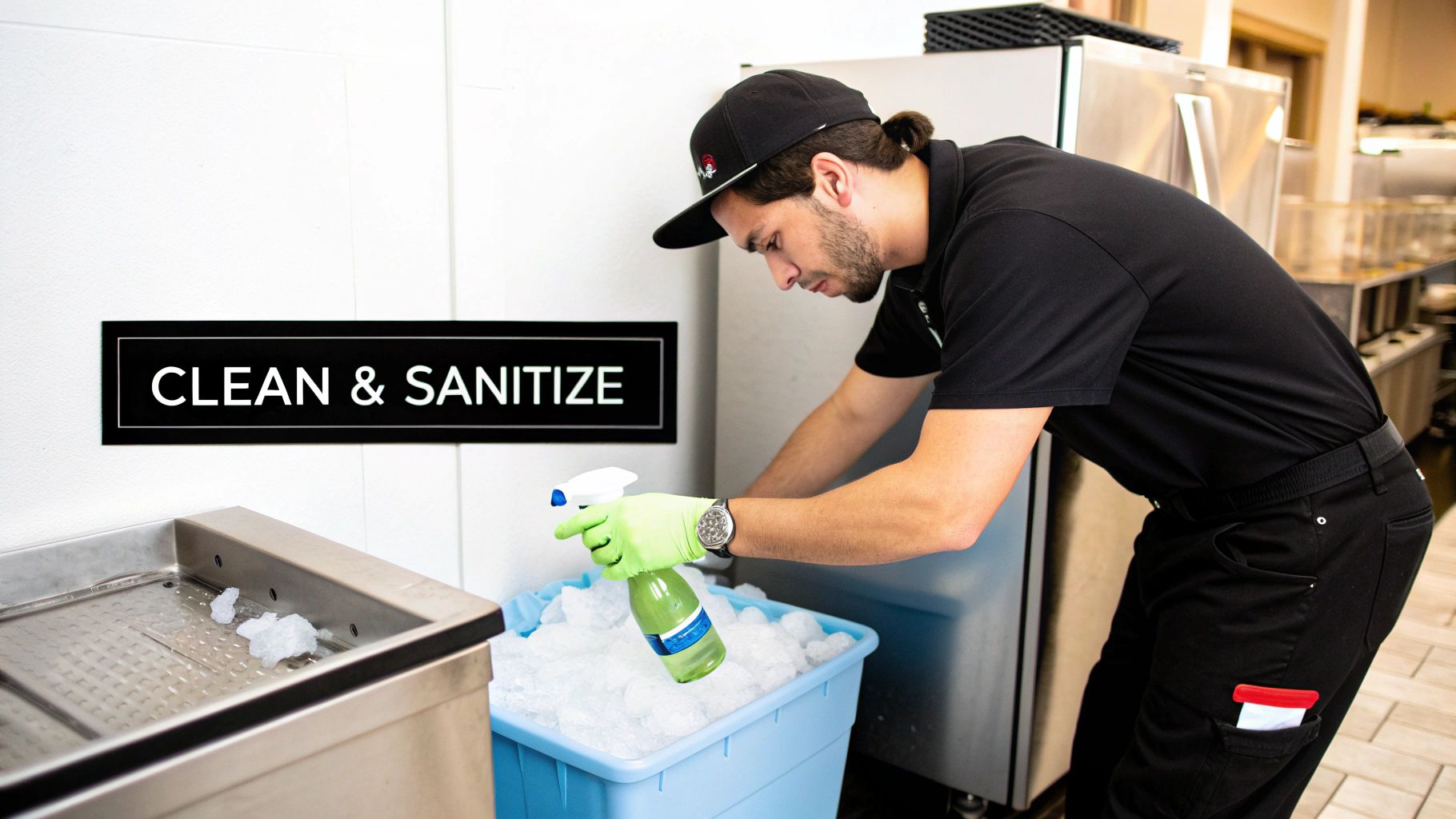
Think of it like regular oil changes for your car. A little effort now prevents a massive, costly breakdown later. A proactive approach helps you avoid those emergency repair calls and the kind of downtime that can absolutely cripple a busy service.
Your Essential Maintenance Checklist
The key to success is building a simple, repeatable cleaning schedule. When you break down tasks into daily, weekly, and monthly duties, your team stays on track and your ice machine stays in top condition. This routine is about both sanitation and peak mechanical performance.
Daily Tasks (Less than 5 minutes)
- Wipe Down the Exterior: Grab a soft cloth and a mild cleaner to wipe down all external surfaces. This gets rid of the daily buildup of dust, grease, and fingerprints.
- Check the Ice Scoop: Make sure the ice scoop is clean and stored properly in its holder. It should never, ever be left inside the ice bin where it can introduce bacteria.
Weekly Tasks (15-20 minutes)
- Sanitize the Storage Bin: Empty the bin completely. Wash it out with an approved food-safe sanitizer, rinse it thoroughly, and let it air dry.
- Clean the Air Filter: A clogged air filter on an air-cooled machine is a huge problem. It restricts airflow, forcing the compressor to work way harder than it should. Pull the filter out, wash it with warm soapy water, and let it dry completely before putting it back.
Monthly/Quarterly Tasks (30-45 minutes)
- Descale the Machine: This is non-negotiable here in Southern California. Our hard water creates mineral scale buildup that chokes performance. Run a descaling solution through a cleaning cycle, following the manufacturer's instructions to the letter.
- Deep Clean Water Components: Take apart and sanitize the water distribution tubes and any other removable parts to stop slime and mold growth before they start.
A clean machine is a healthy machine. Neglecting sanitation can lead to health code violations and, more importantly, put your customers at risk. Ice is food, and it must be handled with the same care as any other ingredient in your kitchen.
Quick Troubleshooting for Common Problems
Even with perfect maintenance, you might run into the occasional hiccup. Before you pick up the phone to call a technician, here are a few simple checks you can do yourself to solve common problems.
Problem 1: Low Ice Production
- Check the Temperature: Is the kitchen too hot? Ice machines work best in environments below 80°F. High ambient temperatures make them struggle.
- Inspect the Air Filter: A dirty air filter is the number one cause of poor performance. Make sure it's clean and that airflow around the machine isn't blocked.
- Look at the Water Filter: If the water filter is clogged, it can slow water flow to a trickle, which will drastically cut your ice output.
Problem 2: Misshapen or Cloudy Cubes
- Time for Descaling: Mineral buildup is almost always the culprit here. Hard water scale on the evaporator plate prevents ice from forming clean, solid cubes.
- Water Filter Check: An old, worn-out filter can't remove impurities effectively, which leads straight to cloudy, off-tasting ice.
Proactively addressing issues like mineral buildup is the best way to prevent costly repairs and ensure consistent ice quality. There are many great scale prevention solutions available that can make a huge difference. For a deeper dive, you can also check out our detailed guide on commercial ice machine maintenance written specifically for Los Angeles restaurants.
We're Your Local Partner in the Trenches
Picking the right refrigerator ice maker isn't just about comparing spec sheets online. It’s about finding a partner who gets the insane pace of the Southern California food scene. From a packed Los Angeles pizza place to a busy food truck or Mexican food spot, your restaurant equipment has to work, period. This is where you stop looking for a supplier and start looking for a real local partner.
At LA Restaurant Equipment, we’re more than just a warehouse full of boxes. We're a dedicated part of your team. We only deal in new, top-quality equipment that comes with a full manufacturer’s warranty. It’s the smarter, safer bet—giving you peace of mind instead of the headaches and risks that come with used equipment.
Warehouse Direct Pricing and Shipping That Keeps Up With You
We believe you shouldn't have to pay a premium for premium restaurant equipment. By selling direct from our warehouse, we cut out the expensive showrooms and sales commissions. We pass those savings straight to you. For a bustling Mexican food spot or a Los Angeles food truck just getting its wheels, that’s real money you can put back into your business.
Choosing the right equipment partner isn’t just about the price tag. It’s about the total package—getting reliable gear delivered fast, with support you can actually reach, so you can keep your doors open and your customers happy.
Our Brea, CA location is the key to our speed. We offer fast, free shipping on all in-state orders, which means a critical piece of equipment like a new refrigerator ice maker can be on your doorstep in just 1-2 business days. When a broken machine can shut you down, that kind of speed isn't a bonus; it's a lifeline.
Your Success Is Our Business
The demand for commercial ice makers is growing like crazy, not just here but globally. It just goes to show how vital these appliances are. For a deeper dive, you can check out some insights on the ice makers market from marketresearchfuture.com.
We also know that a big purchase can be tough on cash flow. That's why we offer flexible financing options through partners we trust. You get the restaurant equipment you need now with predictable monthly payments, freeing up your capital for payroll, inventory, or that new patio you’ve been dreaming of.
At the end of the day, our mission is to support the amazing, diverse food scene here in Los Angeles and Orange County. We're here to provide more than just equipment—we offer dedicated support and local know-how to help your restaurant kill it.
Your Top Questions About Commercial Ice Makers, Answered
Deciding on a new refrigerator ice maker is a big move, and it's totally normal to have a few questions. We talk to restaurant owners across Los Angeles and Orange County all the time, and we've noticed the same challenges tend to pop up when it comes to picking, installing, and taking care of an ice machine.
We've put together some straight-up answers to the questions we hear most often. Our goal is to give you the confidence to choose the right restaurant equipment for your spot, whether you're running a Los Angeles pizza joint, food truck, or a busy Mexican restaurant.
How Often Does My Commercial Ice Machine Need a Pro to Look at It?
Even if you're on top of daily cleaning, you should have a professional service your machine at least twice a year. Think of it like a tune-up for one of the hardest-working pieces of restaurant equipment in your kitchen.
A good technician will do a deep clean, check things like refrigerant levels, and inspect all the moving parts like the motor and sensors. This is a huge deal for catching small problems before they become big, expensive ones—especially here in Southern California where our hard water can cause serious scale buildup you can't even see. A little regular maintenance goes a long way in keeping your machine efficient and extending its life.
What's the Real Difference Between Air-Cooled and Water-Cooled Ice Makers?
This really boils down to your kitchen's setup and what you're willing to spend on utilities.
- Air-Cooled Models: These are what you'll find in most restaurants, and for good reason. They are super energy-efficient, using fans to pull air over the condenser coils to cool everything down. They’re cheaper to run, but they need some breathing room for airflow and don't love kitchens that get crazy hot (you want to keep it under 80°F).
- Water-Cooled Models: These machines use a steady stream of water to do the cooling. The big plus is they're much quieter and can be a lifesaver in tight, hot, or poorly ventilated kitchens where an air-cooled unit would just give up. The downside? They use a lot of water, and you'll definitely see that on your utility bills.
Can I Just Use a Residential Refrigerator Ice Maker for My Small Cafe?
Let me stop you right there—the answer is a hard no. You absolutely have to use a commercial-grade, NSF-certified ice maker in any kind of foodservice business. There are a couple of massive reasons why.
First off, those home units just aren't built for the grind. A commercial kitchen puts a beating on equipment, and a residential ice maker will burn out in no time, leaving you high and dry during a rush.
But here’s the most important part: residential ice makers are a public health nightmare. They don't meet the sanitation standards required by the health department. Using one puts you at risk for fines, getting shut down, and worst of all, making your customers sick. Commercial units are designed to be cleaned thoroughly to keep bacteria and mold from growing. It’s not just about performance; it's about safety.
Ready to find the perfect commercial ice maker for your Southern California restaurant? The team at LA Restaurant Equipment is here to help you select the right machine with warehouse-direct pricing and fast, free local shipping.
Explore our full range of commercial ice makers and refrigeration solutions or give us a call for a personalized quote.