

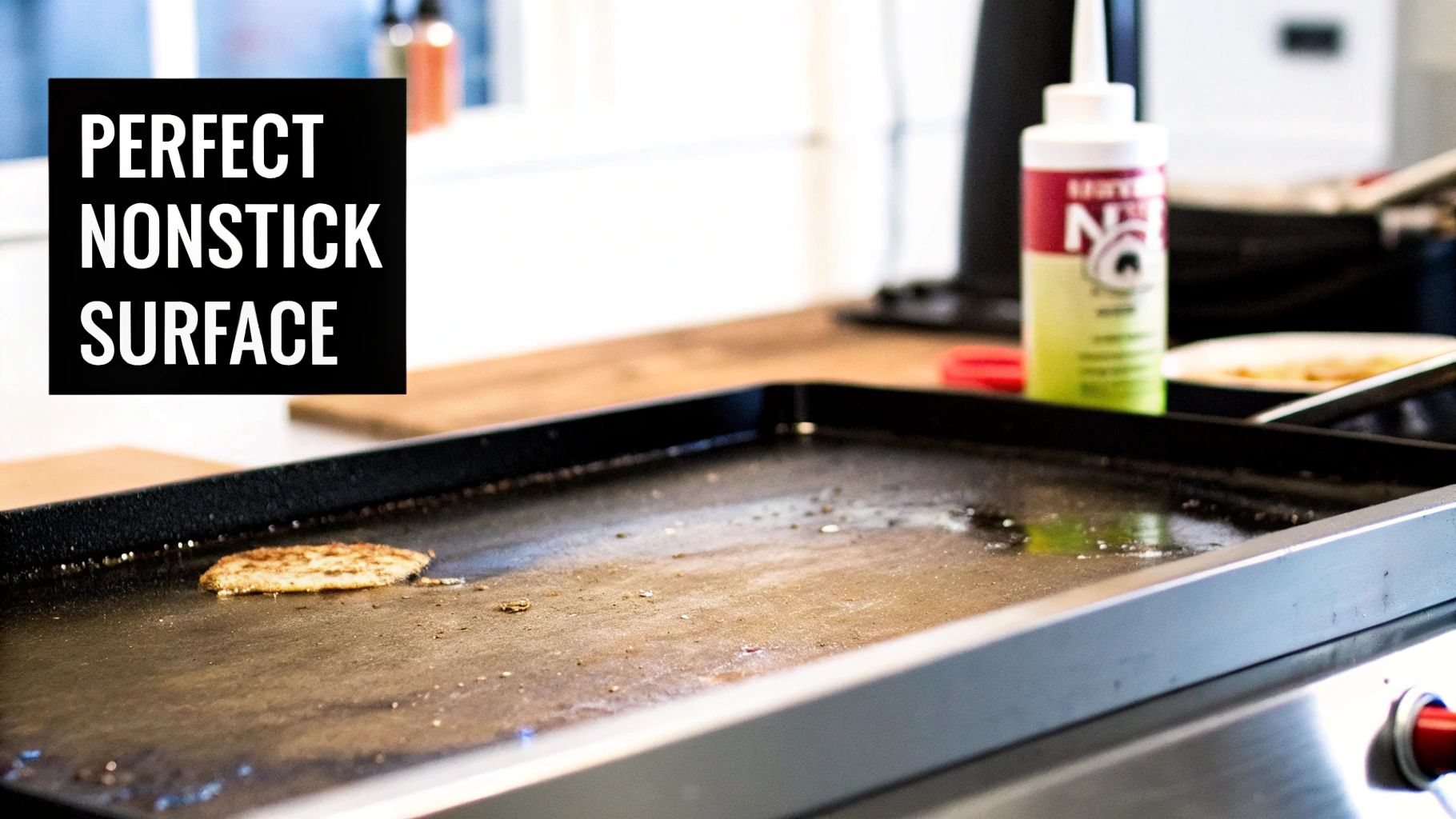
If you want to cook on a griddle like a pro, it all starts with the setup. Mastering the preheat and seasoning isn't just a suggestion—it's what creates that perfect non-stick surface you need for a busy service. By using the right high-smoke-point oils, like canola or clarified butter, and creating specific temperature zones, you turn a simple flat top into a high-powered cooking machine ready for anything from smash burgers to pancakes. This essential piece of restaurant equipment is a staple in successful Los Angeles restaurants for a reason.
Mastering the Fundamentals of Griddle Cooking
The griddle is the undisputed workhorse in so many professional kitchens, from those bustling Los Angeles food trucks slinging Mexican food to high-volume spots specializing in Los Angeles pizza. Its huge, even surface is built for consistency and speed, but you can't unlock its true potential without a solid grasp of prep and heat management.
Honestly, the difference between food sticking and creating an uneven mess versus getting a perfect, golden-brown crust often boils down to the first few steps you take before a single ingredient hits the steel.
This initial setup is way more than just cranking the dials to high. It’s a method that ensures your expensive restaurant equipment lasts and gives you predictable, repeatable results, even during the most hectic dinner rush.
The Critical Role of Seasoning and Oiling
A brand-new steel griddle is porous and a nightmare for sticking. The first seasoning is your solution. You're creating a polymerized, glass-like layer that becomes naturally non-stick over time. It’s done by wiping on a super-thin coat of a neutral, high-smoke-point oil (canola is perfect) and heating the griddle until the oil smokes and bonds to the metal. You'll likely repeat this a few times to build a really durable base.
Daily oiling, on the other hand, is all about maintenance. A light coat of oil before each service ensures food releases easily and adds another micro-layer to that precious seasoning. Think of the initial seasoning as priming a canvas and the daily oiling as adding a fresh coat of paint before you start cooking.
The real goal is to build a dark, slick patina over time. A well-seasoned griddle doesn't just prevent sticking; it adds a unique, subtle flavor to everything you cook—something you just can't get from a regular pan.
Setting Up Your Temperature Zones
One of the biggest perks of a large commercial griddle is creating multiple heat zones at the same time. This is a game-changer for workflow, especially in fast-paced spots like Los Angeles food trucks. You can sear, cook, and hold different parts of a dish, all on one surface.
- High-Heat Zone (400-450°F): This is your sear station. Placed right over a burner, it’s where you get a killer crust on smash burgers, steaks, or a nice char on veggies for Mexican food.
- Medium-Heat Zone (325-375°F): Perfect for general cooking. This is for things that need to cook through evenly without burning, like pancakes, eggs, or chicken breasts.
- Low-Heat/Holding Zone (200-250°F): This cooler spot is for keeping finished food warm, toasting buns, or gently cooking delicate items.
To get your griddle ready for any service, just follow this simple flow.
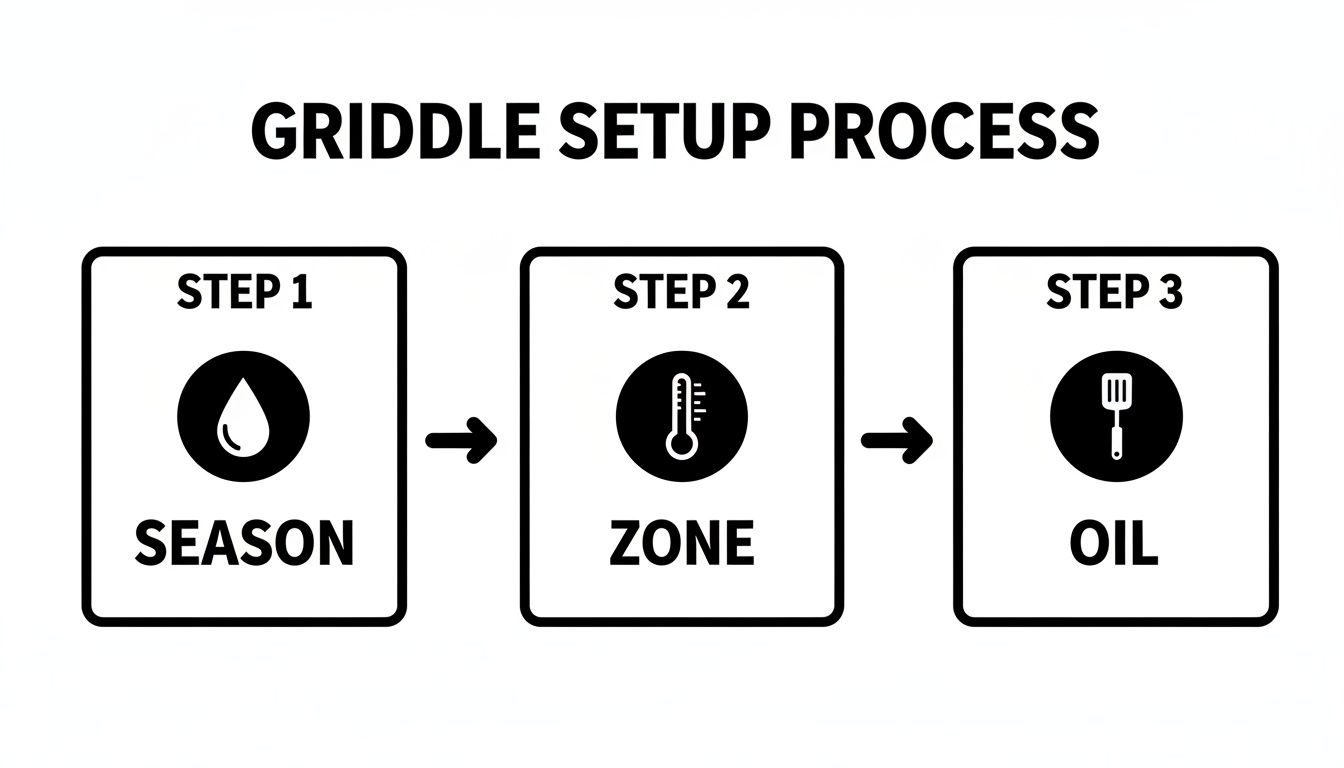
This process—seasoning for the foundation, zoning for control, and oiling for execution—is the core routine for any chef who wants to cook on a griddle the right way.
If you're looking to go even deeper, plenty of online resources offer great insights on griddle cooking techniques. There's no doubt this restaurant equipment is here to stay; the global commercial griddle market is projected to hit USD 943.63 million by 2033, which just shows how much restaurant operators rely on them.
Griddle Temperature Zones for Peak Efficiency
Here’s a quick reference table to help you visualize and set up your griddle zones for a smooth, efficient service. Thinking this way will dramatically speed up your line.
| Zone | Approx. Temperature (°F) | Primary Use Cases | Example Foods |
|---|---|---|---|
| High-Heat | 400-450°F | Searing & Charring | Smash burgers, steak, fajita vegetables, shrimp |
| Medium-Heat | 325-375°F | All-Purpose Cooking | Pancakes, scrambled eggs, chicken breasts, hash browns |
| Low-Heat | 200-250°F | Holding & Gentle Cooking | Toasted buns, melting cheese, keeping bacon warm |
Setting up these zones before service begins allows you to move food seamlessly from searing to cooking to holding, keeping everything at the perfect temperature without overcooking. It's the secret to high-volume output.
Nailing the Classics on Your Griddle
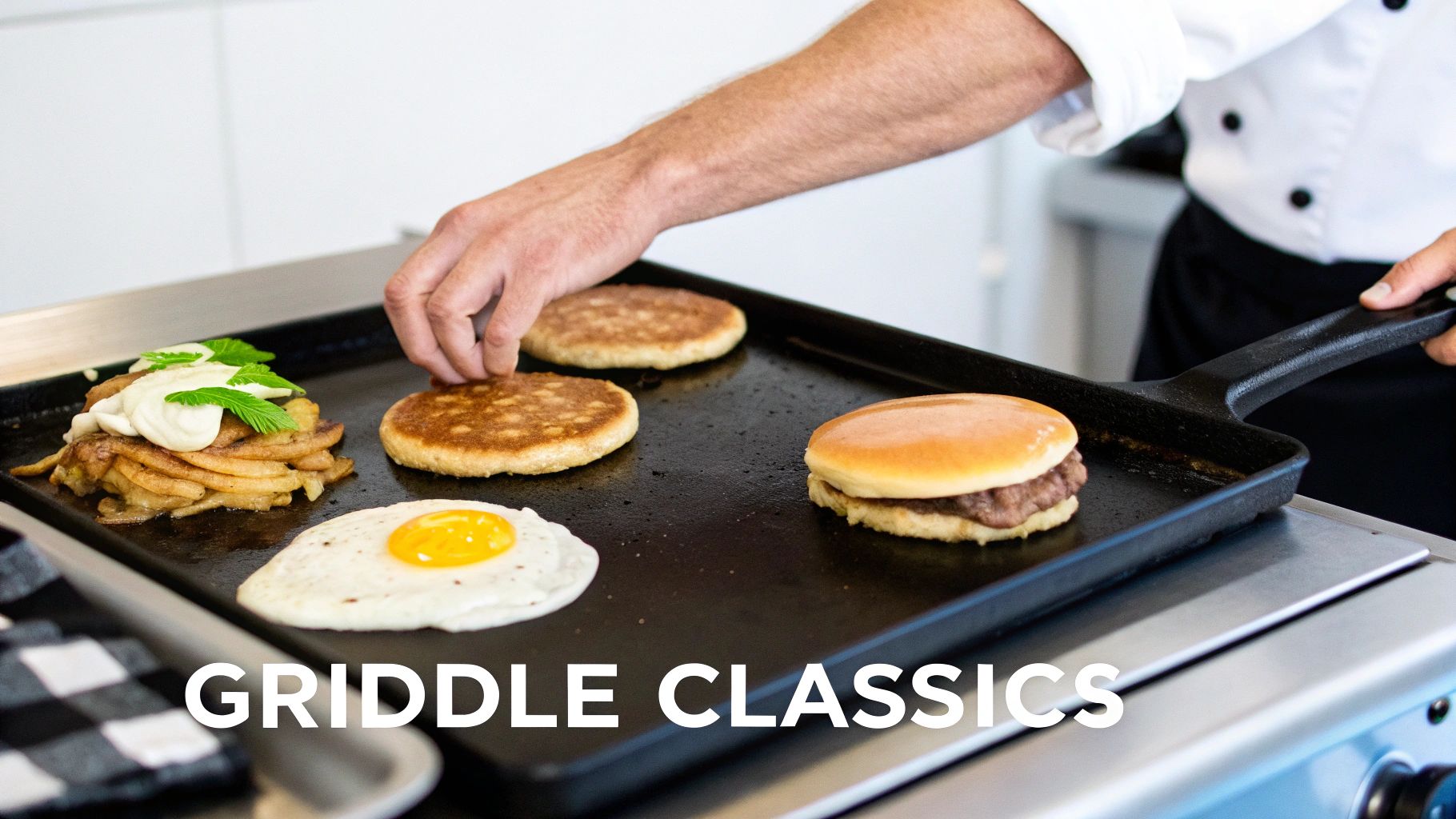
Alright, your griddle is seasoned, you've set up your heat zones, and you're ready to cook. This is where the magic happens. Getting a feel for a few classic dishes is the best way to build the confidence to handle any ticket that comes your way. A griddle isn't just a big, hot piece of metal; it’s a canvas for creating textures and flavors you just can't get from a standard pan.
Think about that perfect, crispy crust on a smash burger or the delicate, lacy edge on an over-easy egg. These are the details that separate good food from great food, and the griddle is your key to unlocking them. Let's walk through a few staples you'll find on menus everywhere, from a bustling Los Angeles food truck to your favorite breakfast spot.
Crafting the Perfect Smash Burger
If there's one dish that defines griddle cooking, it's the smash burger. People go crazy for those lacy, caramelized edges, and that signature crust is a direct result of the Maillard reaction—something that only happens with the intense, direct heat of a well-seasoned flat top. Many Los Angeles restaurants have built their reputation on this single item, all thanks to the right restaurant equipment.
Start by placing a loosely packed ball of ground beef onto your high-heat zone, which should be cranking at around 400-425°F. Grab a heavy-duty spatula or a proper burger press and smash it down hard for about 10 seconds. You want that patty thin. This is the most important step; don't touch it or move it until you see a deep brown crust forming around the edges. Mastering how to cook smash burgers on a Blackstone is a rite of passage and will make you a pro at handling one of the most popular items out there.
After about 90 seconds, use a sharp, stiff spatula to get underneath the patty—scrape hard to make sure you lift all that flavorful crust with it—and give it a flip. Another minute on the other side, top with cheese, and you're done.
Flawless Eggs and Golden Pancakes
Breakfast service is where a griddle really proves its worth, letting you fire multiple orders at once. For delicate items like eggs and pancakes, you'll want to work in your medium-heat zone, somewhere in the 325-350°F range.
- For Flawless Eggs: A little clarified butter or oil goes a long way. Crack your eggs right onto the surface. For over-easy, the trick is patience. Let the whites set completely before you even think about flipping. When you're ready, use a thin, flexible spatula and a confident flick of the wrist. Hesitation is your enemy here.
- For Golden Pancakes: Consistency is everything. A steady temperature is what gives you those perfectly fluffy, evenly browned pancakes. Pour your batter and watch for bubbles to form and pop all over the surface. That’s your signal to flip. If you flip too early, you'll end up with a gummy, pale center.
Pro Tip: Whatever you do, don't overcrowd the griddle with pancakes. Give them space. Piling too many on at once causes the surface temperature to plummet, which ruins your chances of getting that perfect golden-brown color.
Searing Proteins and Sautéing Vegetables
A griddle’s versatility goes way beyond breakfast and burgers. It’s an incredible tool for putting a hard sear on proteins and getting that perfect char on vegetables—a staple technique for amazing Mexican food. Your high-heat zone is where you'll get a deep, flavorful crust on a steak or chicken breast without turning the inside to leather.
First things first: pat your protein completely dry. Any moisture will steam the meat instead of searing it. Lay it down on the hot, oiled surface and leave it alone. Don’t poke it, don’t slide it around. It will release naturally from the griddle when the crust is formed. If you try to force it too early, you’ll just tear the meat and leave all that flavor behind.
For vegetables, like the onions and peppers you see sizzling at Los Angeles food trucks, toss them in a bit of oil and spread them out in a single layer on the hot zone. Let them sit for a minute or two to get a nice char before you start moving them. This gives you that beautiful, blistered texture without steaming them into a soggy mess. Once you get these techniques down, your griddle will quickly become the most valuable player in your kitchen.
Optimizing Your Workflow for a Busy Service
When the tickets start flying, your griddle stops being just a cooking surface and becomes the absolute heart of your operation. A busy service is all about speed, timing, and precision. Every second and every square inch of that steel counts. Success isn't just about cooking good food; it’s about managing the organized chaos to push out as many plates as possible without letting quality slip.
This is never more true than during a breakfast rush. A single ticket might call for pancakes, bacon, and eggs—all with different cooking times and temperature needs. This is where your heat zones are your best friend. You can have bacon crisping on the medium zone, eggs setting gently right next to it, and pancakes bubbling away, all while the low-heat zone keeps the first batch of bacon perfectly warm.
The Power of Mise en Place
"Mise en place," or "everything in its place," isn't just a fancy French term; it's a non-negotiable law when you cook on a griddle. Before that first order comes in, your station needs to be set for battle. This means every ingredient is prepped, portioned, and within arm's reach.
- Pancake Batter: Keep it chilled in squeeze bottles. This makes for fast, clean, and uniform portioning.
- Eggs: Have them pre-cracked into individual ramekins or containers for rapid-fire deployment onto the flat top.
- Burger Toppings: Sliced onions, tomatoes, and cheese need to be in organized containers right beside you.
- Oils and Seasonings: Your oil, salt, and pepper must be accessible without even thinking about it.
A well-organized station eliminates wasted motion. In a high-volume Los Angeles food truck, those seconds you save add up to dozens of extra orders served per shift. This careful arrangement is a cornerstone of your kitchen's overall efficiency. You can dig deeper into how station setup impacts speed with our insights on commercial kitchen layout and design.
Essential Tools and Timing Techniques
The right restaurant equipment and tools become extensions of your own hands, letting you work faster and with more precision. A long, offset spatula is perfect for flipping multiple pancakes at once, while a wide, sturdy burger spatula gives you the leverage needed to scrape up that delicious crust. And don't forget a bench scraper—it's invaluable for clearing debris between orders and keeping your surface clean for the next dish.
The real art of griddle workflow is all in the timing. Firing a burger that takes three minutes at the same time as fries that take five means one item is going to die in the window. You have to learn to cook backward from the longest cook time.
If an order comes in for a well-done steak (8-10 minutes) and some seared shrimp (2-3 minutes), those shrimp shouldn't even think about hitting the griddle until the steak is almost done. This coordination ensures every part of the dish is hot, fresh, and ready to be plated at the exact same moment. Mastering this rhythm is what turns a chaotic line into a synchronized, profitable machine.
Choosing the Right Commercial Griddle for Your Restaurant
Picking out a new commercial griddle isn't a small decision for any kitchen, whether you're building out a new spot for Los Angeles pizza from scratch or just swapping out old equipment in a bustling food truck. This piece of hardware is a serious investment. It's going to directly affect your kitchen's speed, the quality of your food, and ultimately, your bottom line for years to come.
Get this choice wrong, and you could be stuck with unevenly cooked food, shockingly high energy bills, or constant maintenance headaches. But if you take a minute to understand the key differences—like power sources and plate materials—you can find a griddle that feels like it was made just for your kitchen.
Gas Versus Electric Models
The first big question you'll face is gas or electric. Each one has its own set of pros and cons, and the right answer really depends on your kitchen's setup and what you're cooking. A mobile kitchen, like a Los Angeles food truck, is almost always going to lean toward gas for its raw power and the freedom from being tied to an electrical hookup.
- Gas Griddles: These are the undisputed workhorses of the industry, and for good reason. They heat up fast and give you that instant, responsive temperature control every chef loves. That ability to go from a hard sear to a gentle warm-up with a quick turn of the dial is invaluable in a fast-paced environment.
- Electric Griddles: What electric models lack in speed, they make up for in precision. They're known for providing incredibly consistent, even heat across every square inch of the cooking surface. They are often more energy-efficient and are a fantastic solution for spots where a gas line just isn’t an option. The heat-up time might be a bit longer, but for delicate items like pancakes or eggs, that stable temperature is a game-changer.
With outdoor dining and cooking more popular than ever, gas has really cemented its top-dog status. The global outdoor griddle market is projected to hit USD 686 million by 2033, and gas models are driving that growth, holding over 50% of the market share thanks to their power and versatility.
Understanding Griddle Plate Materials
After you've picked a power source, you need to think about the cooktop itself. The material your griddle plate is made from has a huge impact on its performance, changing everything from heat retention to how much time you spend cleaning it.
Steel Plate Griddles are what you’ll see most often. They’re the affordable, reliable standard. These griddles are durable, heat up pretty quickly, and can handle just about anything you throw at them. The trade-off is that they need regular seasoning to keep them non-stick and can sometimes have hot or cool spots.
Chrome Top Griddles, on the other hand, are the premium upgrade. That slick chrome surface is non-porous, which is a huge deal—it means flavors don't transfer. You can sear a piece of fish, give it a quick wipe, and then immediately cook pancakes without any lingering taste. As a bonus, they radiate less heat out into the kitchen, which your line cooks will definitely appreciate on a long shift. They do come with a higher price tag, but the benefits are often worth it.
Your restaurant equipment is the foundation of your kitchen's success. A great griddle becomes the heart of the line, a reliable tool that can handle the pressure of any service. Taking the time to match the griddle's features to your menu and volume isn't just a good idea—it's essential.
Commercial Griddle Comparison
Making the right choice can feel overwhelming, but breaking it down by features helps clarify which griddle will best serve your kitchen's unique needs. This table compares the most common types of this vital restaurant equipment side-by-side.
| Feature | Gas Griddle | Electric Griddle | Chrome Top Griddle |
|---|---|---|---|
| Heat-Up Time | Fast, heats up very quickly | Slower to reach temperature | Moderate heat-up time |
| Temp Control | Instant, precise response | Very stable and consistent, but slower to adjust | Excellent heat retention, very stable |
| Best For | High-volume kitchens, burgers, steaks, fast-paced service | Delicate items like eggs and pancakes, precise applications | Show kitchens, preventing flavor transfer, energy savings |
| Energy Source | Natural Gas or Propane | Electricity | Can be either Gas or Electric |
| Maintenance | Regular seasoning required | Simpler to clean, no burners to maintain | Easy to clean, non-porous surface |
| Initial Cost | $-$$ | $-$$ | $$$-$$$$ |
Ultimately, the best griddle for your restaurant is the one that fits your budget, your space, and your menu. By weighing the benefits of gas versus electric and steel versus chrome, you can make a smart investment that pays off for years.
For businesses here in the Los Angeles area, you can browse a wide selection of commercial griddles suitable for any kitchen to find the perfect match for your operation.
Essential Griddle Cleaning and Maintenance
A griddle caked with yesterday's carbon and grease is more than just an eyesore—it’s a performance killer. When that surface gets dirty, you're looking at uneven heating, unwanted flavor transfer between orders, and a potential food safety hazard. Keeping your griddle in peak condition is one of the most important parts of protecting your restaurant equipment investment.
This isn’t about hours of back-breaking scrubbing. It's about building smart, fast habits into your daily closing routine. The best time to tackle it is right after service when the griddle is still warm. Not scorching hot, but warm enough that grease and food particles come away easily.
Daily Cleaning Your Griddle
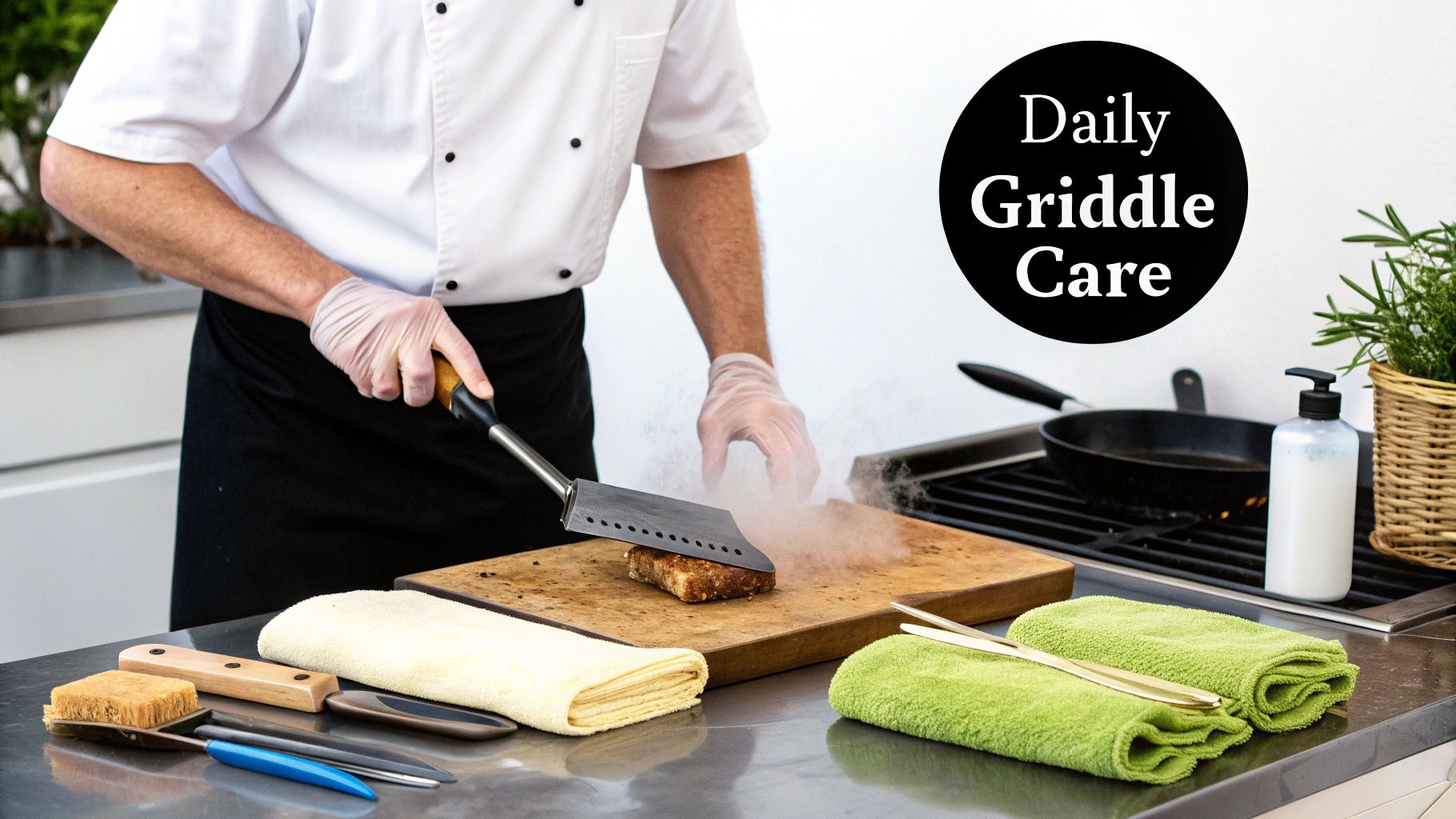
Your most effective daily clean comes down to a few simple tools: a high-quality griddle scraper and a good grill brick or screen. While the flattop is still warm, start by using your scraper to push all the large debris and pooled grease into the grease trap. I find it’s best to work from back to front in long, even strokes.
Next, pour a little warm water or club soda onto the surface. That sizzle and steam you see is your friend—it’s lifting all those stubborn, cooked-on bits. Now, take your grill brick or a griddle-safe scouring pad and give the surface a gentle scrub before scraping the last of the residue into the trap.
Don’t skip the final step: a quick wipe-down with a clean, food-safe cloth and a very light coating of cooking oil. This thin layer of oil is what protects the steel from rust overnight and helps maintain that beautiful seasoning you’ve built up. It's what keeps the surface non-stick and ready for action.
Long-Term Maintenance and Safe Cleaners
Beyond the daily scrape-down, a little long-term care will save you from surprise breakdowns. Every so often, it’s a good idea to visually inspect your gas connections for any leaks and check that your thermostat controls are still accurate. If you notice the griddle struggling to hold its temperature, it might be time for a calibration.
When it comes to chemical cleaners, less is always more. Stay away from harsh, abrasive chemicals or heavy-duty degreasers that can strip away the seasoning. Stick to cleaners specifically formulated to be food-safe for griddles. For a more detailed breakdown, check out our guide on how to clean a commercial griddle.
- Do Use: Water, club soda, vinegar, and specialized food-safe griddle cleaners.
- Don't Use: Caustic oven cleaners, harsh detergents, or steel wool—these can permanently damage the griddle surface.
This commitment to maintenance is smart business. The United States restaurant griddle market is projected to hit USD 328.3 million, with growth expected to accelerate to 7.4% between 2025 and 2035. That growth is fueled by kitchens investing in high-quality, long-lasting restaurant equipment. You can see more data on this growing market at Future Market Insights. Taking care of your griddle is how you ensure you get the absolute most out of that investment.
Common Questions About Griddle Cooking
Even after you've mastered the basics, questions are always going to pop up on the line. Whether you're slinging burgers in a bustling Los Angeles food truck or running a high-end kitchen, getting quick, clear answers is what keeps service moving smoothly.
Let's tackle some of the most frequent hurdles chefs and restaurant owners run into, with straightforward solutions to make your daily griddle work a whole lot easier.
What Is the Best Oil to Use on a Commercial Griddle?
For any kind of high-heat cooking, you absolutely need an oil that can take the punishment. Your best bets are oils with a high smoke point.
Think canola oil, grapeseed oil, and clarified butter (ghee). These are excellent choices because they won't burn and impart a bitter taste at searing temperatures. You’ll want to steer clear of oils like extra virgin olive oil for this kind of intense heat.
When you're seasoning a brand new piece of restaurant equipment, a simple, neutral oil like canola or vegetable is perfect. It helps you build up that durable, non-stick surface that will serve you well for years.
Remember, the right oil isn't just about preventing sticking; it's about flavor integrity. A burnt, bitter oil can ruin an otherwise perfect dish before it even leaves the kitchen.
How Do I Stop Food from Sticking to My Griddle?
Sticking almost always comes down to two culprits: an improperly seasoned surface or the wrong temperature. Any new steel griddle has to be seasoned correctly by applying thin layers of oil and heating them until they polymerize. This process creates that beautiful, glass-like coating you're looking for.
On a day-to-day basis, the golden rule is to make sure the griddle is fully preheated before a single piece of food touches it. Dropping food on a cool surface is a surefire way to get it to stick. And, of course, don't be shy with the fat—use enough for whatever you're cooking.
Can I Cook Fish and Then Pancakes on the Same Surface?
Absolutely, but only if you clean the griddle right after the fish comes off. The last thing you want is flavor transfer. After cooking something with a strong flavor, like fish or the onions for your Mexican food dishes, you need to scrape that surface clean of every last bit of debris and oil.
Here’s a quick trick that works every time:
- Scrape away all the solid food bits.
- Pour a little club soda or water onto the hot surface. The immediate steam will lift off any stubborn, stuck-on residue.
- Scrape it again to clear away the loosened particles.
- Wipe it all down with a clean cloth and a light touch of fresh oil.
This whole reset takes just a few seconds and ensures your next dish—be it pancakes or something else—tastes exactly how it’s supposed to. Keeping your surface pristine is a non-negotiable part of professional griddle work.
Whether you’re just starting your culinary journey or upgrading your kitchen, having the right restaurant equipment is essential. LA Restaurant Equipment offers a wide selection of top-quality, warranty-backed commercial griddles and other essentials at warehouse-direct prices. Get the performance and reliability you need to succeed. Browse our full inventory and find your perfect griddle today at https://larestaurantequipment.com.