

Picking the right commercial ice cream machine isn't just a purchase; it's a core investment in your business. Get it right, and you're churning out consistently amazing desserts that keep customers coming back. Make the wrong call, and you're stuck with frustrating downtime and a melting bottom line. This guide is here to cut through the noise for busy owners like you.
We'll walk through the big three—soft serve, batch freezers (for hard ice cream), and gelato machines—and match them to what you actually need. Whether you're a Los Angeles pizza joint looking to add a simple, profitable dessert, one of LA's famous food trucks with zero extra space, or an artisanal shop crafting authentic Mexican food flavors, you'll walk away knowing exactly what to do.
Finding The Right Machine For Your Business
Here’s the secret: selecting an ice cream machine isn't about finding the "best" one on the market. It’s about finding the right one for your specific operation. The powerhouse machine a high-volume frozen yogurt shop needs would be total overkill for a small, craft gelato maker. It’s like choosing a vehicle—a Los Angeles food truck needs a nimble van, not a semi-truck.
To get there, your decision really boils down to just a few key questions:
- What's On The Menu? Are you serving up quick soft-serve cones, classic hard-packed scoops, or dense, intensely flavored gelato? The product dictates the machine.
- How Busy Will You Be? Think about your peak hours. A machine that can’t keep up during a dinner rush is a machine that’s costing you sales.
- What's Your Setup? Do you have the physical space, the right ventilation, and the correct electrical hookups for the model you’re eyeing?
- What's The Budget? Look beyond the sticker price. You need to account for long-term costs like maintenance, supplies, and your utility bills.
Matching Your Business To The Machine
For so many Los Angeles restaurants, adding a frozen dessert is one of the smartest ways to bump up check averages. A Los Angeles pizza place or a bustling food truck can see a huge return from the speed and simplicity of a soft-serve machine.
On the flip side, a specialty Mexican heladería chasing that authentic, rich flavor—a hallmark of great Mexican food—needs the control that only a dedicated gelato or batch freezer can offer. Those machines give you command over the texture, density, and that perfect mouthfeel.
This quick decision tree can help you see where you fall.
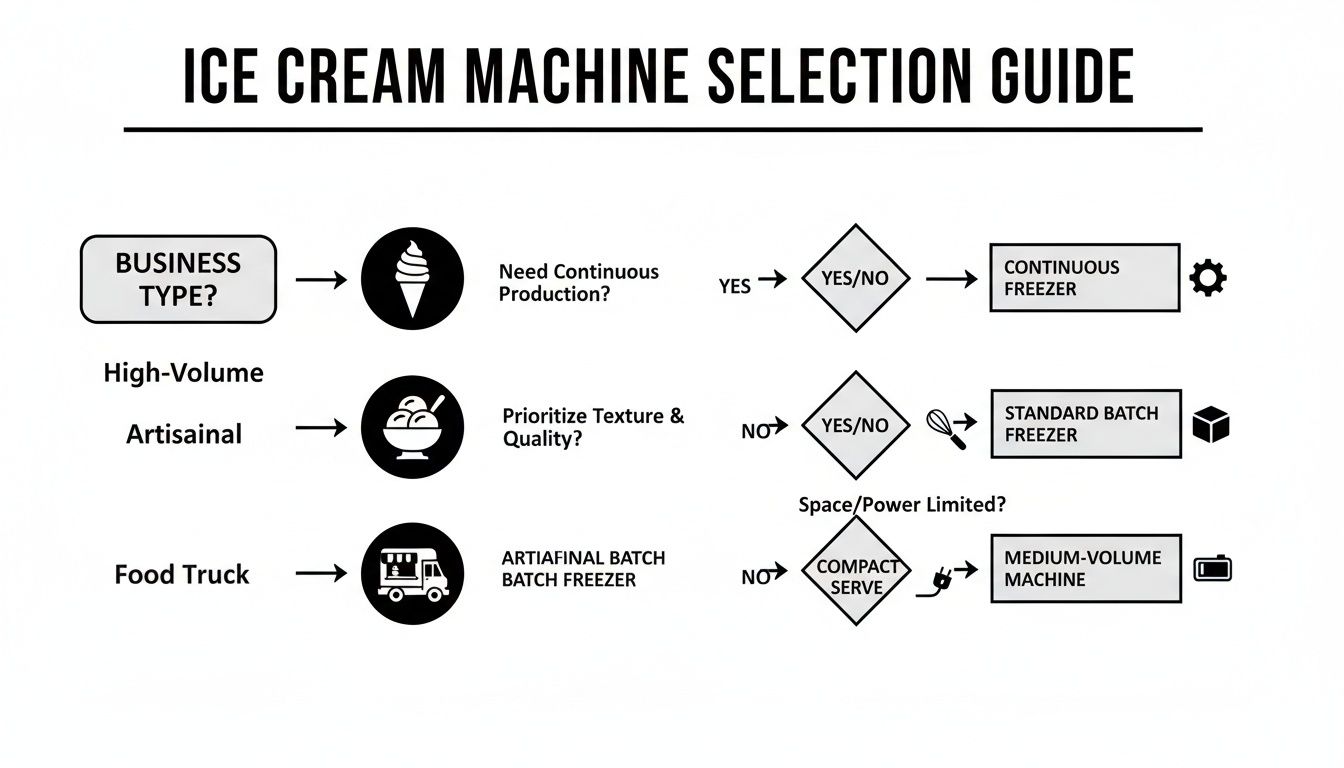
To make it even clearer, here's a quick reference table.
Commercial Ice Cream Machine Quick Selection Guide
| Business Type | Primary Product | Recommended Machine Type | Key Consideration |
|---|---|---|---|
| High-Volume Restaurant / QSR | Simple, fast desserts (cones, sundaes) | Soft Serve Machine | Speed and ease of use are critical for fast service. |
| Los Angeles Food Truck | Soft serve or pre-made hard ice cream | Countertop Soft Serve / Display Freezer | Compact footprint and lower power draw are essential. |
| Artisanal Ice Cream / Gelato Shop | Premium, small-batch hard ice cream or gelato | Batch Freezer or Gelato Machine | Maximum control over ingredients, texture, and overrun. |
| Los Angeles Pizza / Casual Eatery | Add-on dessert menu item | Countertop Soft Serve Machine | Low labor and simple operation make it a profitable addition. |
As you can see, high-volume spots lean toward soft serve for speed, while artisanal shops need batch freezers or gelato machines for that next-level quality control.
An ice cream machine is a serious piece of restaurant equipment, and planning where it will go is essential. To get a better sense of how it fits into your kitchen's big picture, take a look at a complete commercial kitchen equipment checklist to make sure all your bases are covered.
Understanding the Core Machine Types
Choosing a commercial ice cream machine isn't just about picking a piece of equipment; it's about deciding on the exact dessert experience you want to give your customers. The three main players in this game—soft serve, batch freezer, and gelato machines—each work in completely different ways to craft a unique frozen treat. It's never about which one is "better," but which one is the right tool for your menu and your brand.
Think of them like specialized chefs. One is a high-speed line cook built for volume, another is a patient baker perfecting a classic recipe, and the third is an old-world artisan focused on flavor and texture. Understanding what makes each one tick is the first step to matching the machine to your restaurant's goals.
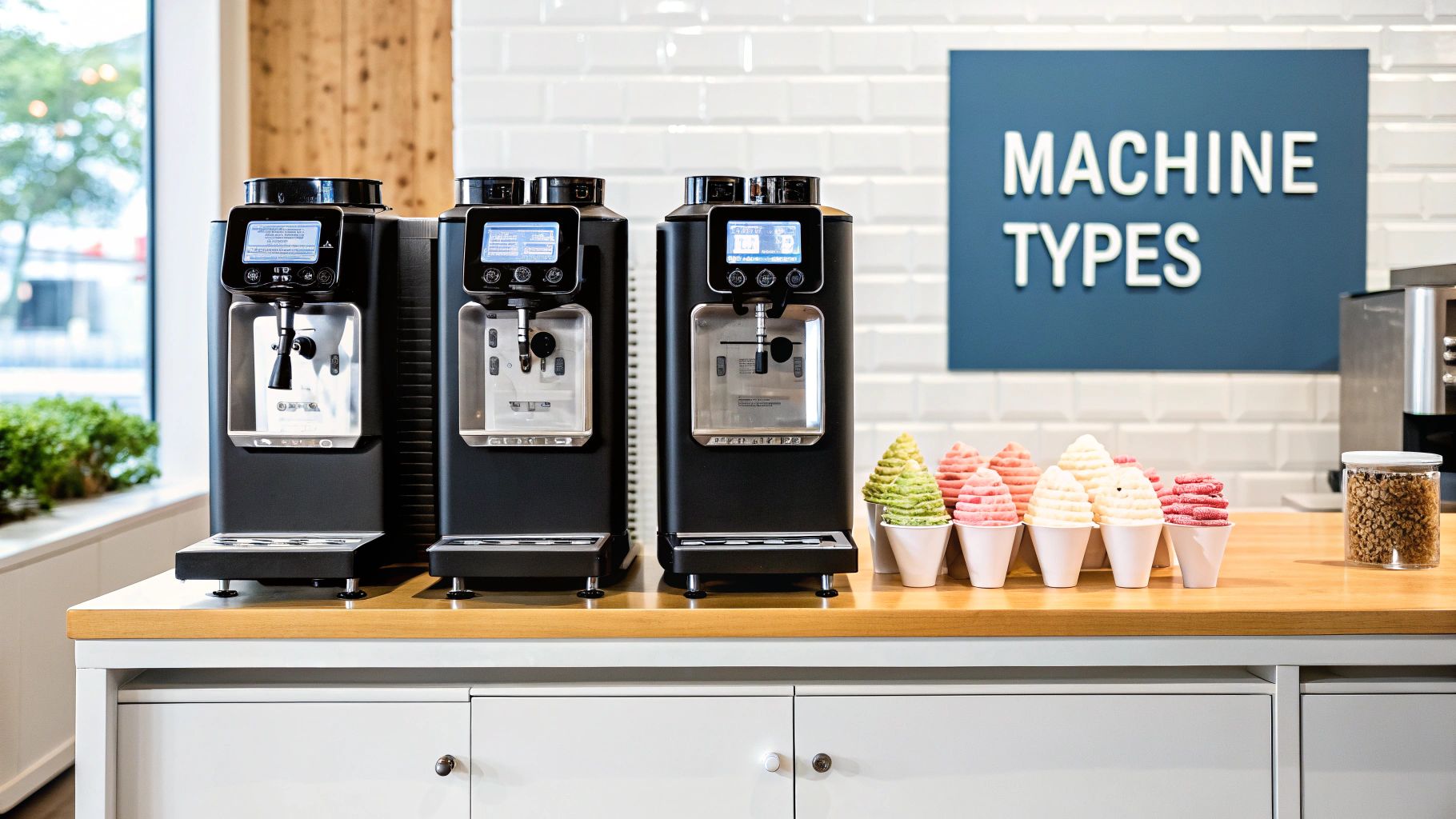
The Instant Gratification Expert: Soft Serve Machines
A soft serve machine is basically a dessert printer that works on demand. It's all about speed, consistency, and simplicity, which makes it a perfect fit for high-traffic spots like Los Angeles food trucks, pizzerias, and quick-service joints.
The process couldn't be simpler. Liquid ice cream mix sits in a refrigerated hopper, ready to go. When a customer orders, the machine pulls a small amount of that mix into a freezing cylinder and dispenses it instantly. This continuous freezing process whips a ton of air—what we call overrun—into the product, giving soft serve that light, airy texture everyone knows.
That high overrun, often 50% or more, means that nearly half of what you're serving is air. This makes soft serve an incredibly profitable item. For any business where speed and volume are the name of the game, the soft serve machine is the undisputed champion.
These machines are everywhere for a reason. Valued at USD 1.08 billion in 2025, the commercial soft-serve machine market is expected to jump to USD 1.49 billion by 2032. That growth is driven by its dominance in quick-service restaurants, where soft serve can account for up to 70% of sales. You can dig into more soft serve machine growth stats on ResearchAndMarkets.com.
The Hard Ice Cream Workhorse: Batch Freezers
If a soft serve machine is a sprinter, then a batch freezer is a marathon runner. This is the heavy-lifter behind every classic scoop of hard ice cream. Instead of dispensing on the spot, a batch freezer is built to produce large quantities of ice cream that you'll store and serve later.
Here’s the breakdown of how it works:
- A big "batch" of liquid ice cream mix gets poured into the freezing cylinder.
- A spinning dasher continuously scrapes the frozen mix from the cylinder walls while folding in air.
- After about 8-15 minutes, when the whole batch hits the right consistency, it's extracted into tubs for "hardening" in a separate deep freezer.
This method gives you total control over the finished product. Batch freezers don't incorporate nearly as much air (around 25-40% overrun) as soft serve machines, which results in a much denser and creamier ice cream. They are absolutely essential for any shop that wants to offer a wide variety of traditional, scoopable hard ice cream flavors.
The Artisan's Choice: Gelato Machines
Gelato machines are the true artisans of the frozen dessert world. They look and operate a lot like batch freezers, but they have one critical difference: they churn at a much slower speed. This isn't a design flaw; it's the secret to authentic gelato.
This slow, gentle churning whips very little air into the mix, leading to a very low overrun—typically just 20-30%. The final product is incredibly dense, silky, and packed with a much more intense flavor than traditional ice cream.
On top of that, gelato is served a few degrees warmer than hard ice cream. This small temperature difference makes a huge impact, allowing the rich flavors to really pop. For an artisanal heladería or a high-end Mexican food restaurant in Los Angeles that wants to serve authentic, flavor-forward desserts, a real gelato machine is a must-have piece of restaurant equipment. Its unique mechanics are what create that signature luxurious texture that defines true gelato.
Decoding Key Technical Specifications
Once you’ve figured out the type of commercial ice cream machine your business needs, the next step is to dive into the numbers. Looking at a spec sheet can feel like reading a foreign language at first, but these figures are what directly impact your daily operations, production speed, and even your utility bills. Getting this right is how you make a smart investment.
Think of it like buying a delivery vehicle for your business. You wouldn't just look at the color; you'd check the cargo capacity, fuel efficiency, and engine power. In the same way, your machine’s specs have to be perfectly aligned with your restaurant’s demand to avoid frustrating bottlenecks or wasteful overspending.
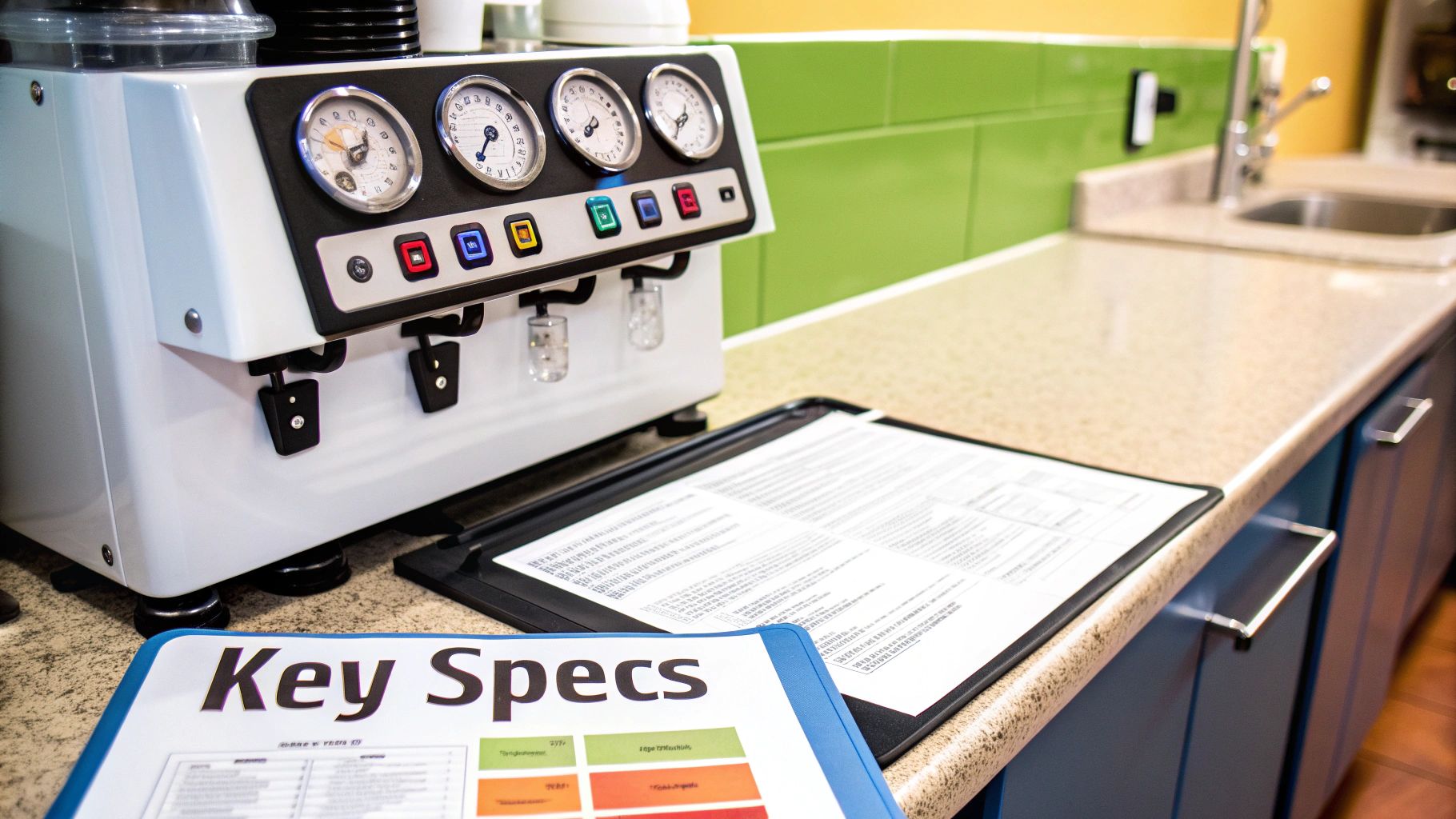
Production Capacity and Throughput
The first number to look for is production capacity, which is usually measured in quarts or gallons per hour. This tells you exactly how much finished product the machine can churn out when it's running nonstop. It’s the single most important metric that determines if you can actually handle the Friday night rush.
A small, quiet cafe might only need a machine that produces 4-7 gallons per hour. But a busy Los Angeles pizza joint or a high-volume food truck will absolutely need a model capable of 10-20 gallons per hour to keep lines moving and customers happy.
Beyond that main number, you need to look at the components that make that output possible:
- Hopper Size: This is the refrigerated tank that holds your liquid ice cream mix. A bigger hopper means your staff isn't constantly having to stop and refill it during a busy service.
- Freezing Cylinder Volume: This is the chamber where all the magic happens—where the liquid mix freezes into delicious ice cream. A larger cylinder can freeze more product at once, which means faster recovery times between servings.
Motor Power and Efficiency
The motor is the heart of your ice cream machine. Its power, measured in horsepower (HP), determines how well the machine can churn a dense, frozen product without straining or overheating. An underpowered motor will struggle, leading to slow freezing times and, eventually, breakdowns.
A higher HP motor can handle thicker mixes and lower temperatures, which is absolutely essential for creating that smooth, creamy texture with tiny ice crystals that customers love. While a bigger motor might use more energy, its efficiency often means faster production and a longer lifespan for the machine itself. This is where modern machines really shine.
Efficiency is a huge deal. Newer machines can boost throughput by up to 50% compared to older models, and advanced automated controls help slash product waste to under 5%. This level of performance is a major reason for the growth in markets like Latin America and the Asia-Pacific region, where the launch of over 20,000 new ice cream shops each year is being fueled by rising demand. You can discover more insights on the global ice cream machine market and what’s driving this growth.
Air Cooled vs. Water Cooled Systems
Finally, you have a big choice to make: air-cooled or water-cooled. This decision really comes down to your kitchen's environment, especially in the warmer climates we have here in Southern California. Each system has its own pros and cons when it comes to installation, cost, and day-to-day performance.
An air-cooled machine works a lot like a car's radiator. It uses a fan to pull in ambient air and blow it over condenser coils to get rid of heat. They are generally easier and cheaper to install because you don't need any plumbing. The catch? They need a lot of breathing room—often 6-12 inches of clearance on all sides—for proper airflow and will pump hot air right back into your kitchen, which can put a strain on your HVAC system.
A water-cooled machine, on the other hand, uses a steady flow of water to cool the condenser. These units are typically quieter and more efficient, especially in hot or cramped kitchens where airflow is poor. They can be installed with zero side clearance, but you'll need an incoming water line and a floor drain, which adds to the complexity and cost of installation.
To help you sort it out, here’s a quick head-to-head comparison.
Air-Cooled vs. Water-Cooled Machine Comparison
Choosing between air- and water-cooled systems depends on your kitchen's layout, utility costs, and local climate. This table breaks down the key differences to help you see which one is the better fit for your operation.
| Feature | Air-Cooled Machine | Water-Cooled Machine |
|---|---|---|
| Installation | Simpler; no plumbing needed. | More complex; requires water and drain lines. |
| Space Needs | Requires significant clearance for airflow. | Can be installed with zero side clearance. |
| Kitchen Impact | Vents hot air, increasing ambient temperature. | Does not add heat to the kitchen. |
| Operational Cost | Higher electricity use, especially for HVAC. | Adds to your monthly water bill. |
| Best For | Well-ventilated kitchens or mobile setups. | Hot, tight kitchens or high-volume operations. |
Ultimately, an air-cooled model might be perfect for a spacious kitchen with great ventilation, while a water-cooled machine is often the hero in a small, bustling kitchen where every degree of ambient temperature matters.
Calculating Your True Cost of Ownership
That shiny new ice cream machine has a sticker price, but that’s just the opening act. To really understand the investment you're making, you need to think about the Total Cost of Ownership (TCO). This isn't just about the day you buy it; it's about every dollar you'll spend to keep it running for years to come.
Smart operators in LA and Orange County know this instinctively. It’s like buying a delivery van for your restaurant. The price to drive it off the lot is just the beginning. You still have gas, insurance, and oil changes to worry about. Your ice cream machine is exactly the same—it’s an asset that requires ongoing investment to perform.
Beyond the Purchase Price
The initial price tag is a big number, but it's the smaller, recurring expenses that truly define your profitability over the long haul. Getting a handle on these costs ahead of time means no nasty surprises down the road. It ensures your dessert menu becomes a money-maker, not a money pit.
Here are the key ongoing costs you absolutely must factor into your budget:
- Utilities: Your electricity and water bills are going up, period. An air-cooled machine will pump heat into your kitchen, forcing your HVAC system to work overtime. A water-cooled unit, on the other hand, will add directly to your water consumption.
- Supplies: This goes way beyond just the ice cream mix. You'll need a constant supply of food-safe sanitizers, special lubricants for all the moving parts, and the right brushes to keep things clean every single day.
- Maintenance: You have to budget for a preventative maintenance plan. It might feel like an extra cost, but having a pro service your machine regularly is what stops a catastrophic failure right in the middle of a July heatwave.
Many restaurant owners get sticker shock from the high upfront costs—often $10,000 to $50,000 for a single machine. But the good news is that a strong return on investment usually happens within 18-24 months in busy spots. Plus, modern energy-efficient models can slash power use by 20-25%, which really adds up. You can dig into more of these ice cream machine market trends from Fact.MR.
Calculating Your Return on Investment
Once you’ve got your costs figured out, it's time for the fun part: calculating your potential return. And here's why ice cream is such a popular addition—frozen desserts often have incredibly low food costs, sometimes as little as 15-25%. That's a huge profit margin.
To figure out your ROI, start by calculating your Cost Per Serving. Add up what you pay for the ice cream mix, the cone or cup, and any sprinkles or toppings. For instance, a simple soft-serve cone might only cost you $0.75 in materials.
Now, let's talk menu price. If you sell that cone for $4.50, your gross profit on that one item is a cool $3.75. From there, you can work backwards to figure out how many cones you need to sell to pay off the machine and cover all those ongoing expenses. It’s a straightforward calculation that gives you a clear financial roadmap. For a more detailed guide on budgeting for new equipment, don't miss our complete restaurant startup costs breakdown.
Taking the time to think through the entire financial picture—from the initial price to daily utility bills and long-term upkeep—is what separates the pros. This foresight is what turns a commercial ice cream machine into a profitable asset from day one.
Mastering Installation and Maintenance
Think of your new commercial ice cream machine as the profit engine for your shop. Just like any high-performance engine, it needs the right care from day one to keep running at its peak. Proper setup and a solid maintenance routine are the secrets to a long, reliable life.
Skimping on this stuff is like buying a brand-new sports car and deciding oil changes are optional. It might work for a little while, but you're just asking for an expensive breakdown down the road.
Turning a simple daily chore into a powerful business habit starts with getting the foundation right. From checking the electrical hookups before it even arrives to locking down a simple cleaning process, every step protects your investment. More importantly, it guarantees food safety and keeps the quality of every scoop you serve sky-high.
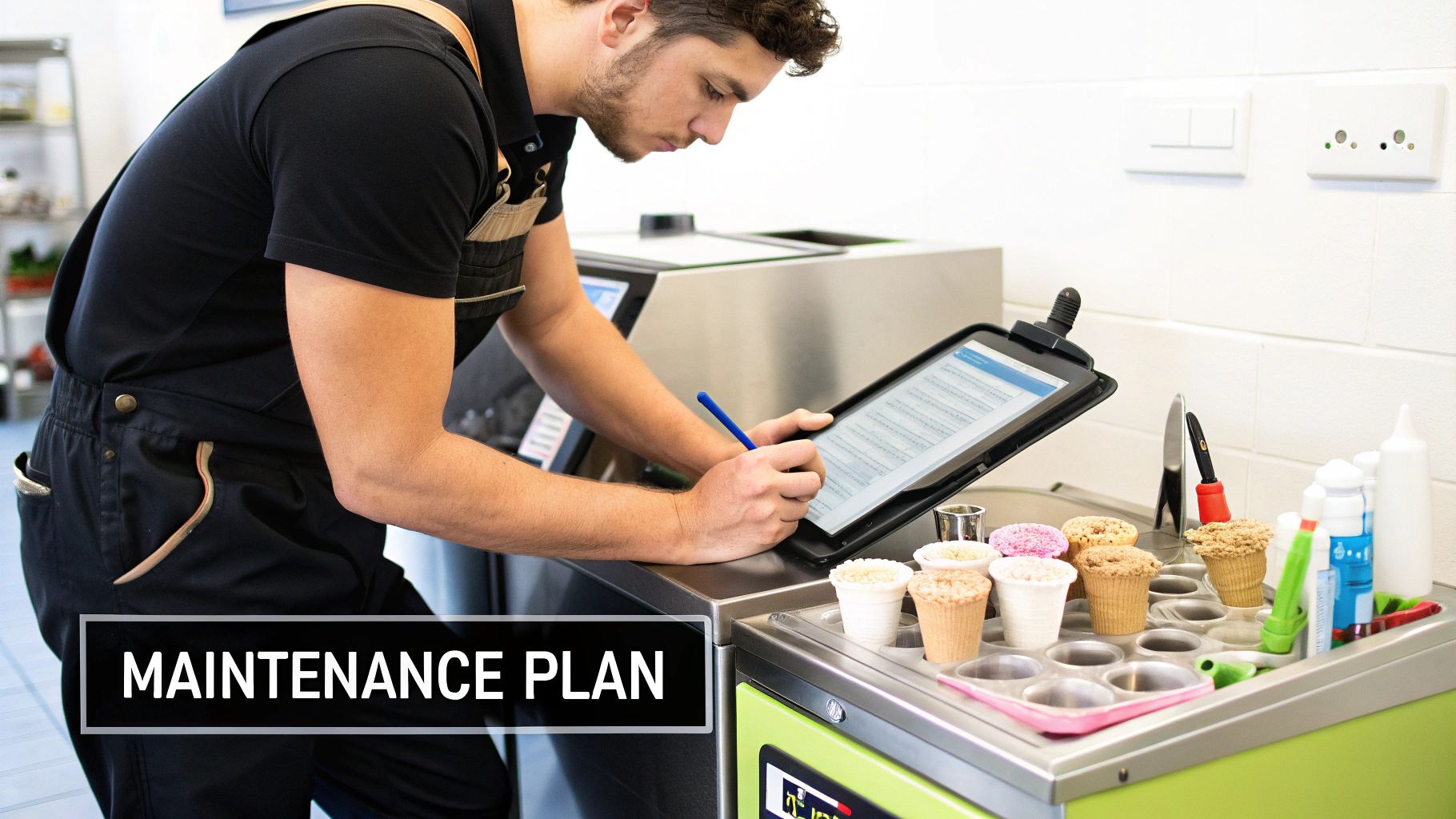
Your Pre-Installation Checklist
Before the delivery truck even pulls up, a little prep work can save you a world of headaches. The goal is a smooth, painless setup so you can start churning out product immediately. Rushing this part is where easily avoidable problems pop up.
First things first, make sure your site is actually ready. Run through this quick checklist:
- Verify Electrical Connections: Does the outlet you have match the machine's voltage and amperage? A mismatch is a surefire way to damage the unit or keep tripping your breakers.
- Check Plumbing (If Applicable): For any water-cooled models, you need accessible water lines and a floor drain nearby. It's a common oversight that can bring an installation to a dead stop.
- Ensure Proper Ventilation: Air-cooled machines have to breathe. They typically need 6-12 inches of clear space on all sides. Shoving it into a tight corner will cause it to overheat and put a massive strain on the compressor.
A well-maintained machine is non-negotiable for food safety and performance. Neglecting daily cleaning can lead to bacterial growth, while skipping regular service can turn a minor issue into a major repair costing thousands. Think of it as preventative medicine for your most profitable piece of equipment.
Creating a Routine Maintenance Schedule
Once your machine is up and running, consistency is the name of the game. A simple, repeatable maintenance schedule is your absolute best defense against surprise downtime. It's what ensures every serving is just as safe and delicious as the one before it.
The easiest way to make this stick is to break tasks down into daily, weekly, and monthly duties for your team.
Daily Cleaning and Sanitizing
This is, without a doubt, the most critical part of the whole routine. At the end of every single day, the machine has to be completely emptied, taken apart, cleaned, and sanitized based on the manufacturer's guide.
- Drain and Rinse: Get all the leftover product mix out and flush the system with warm water.
- Disassemble Parts: Carefully remove all the parts that touch food, like the dasher, seals, and dispensing doors.
- Wash and Sanitize: Wash every piece thoroughly with approved cleaning solutions, then let them soak in a food-safe sanitizer.
- Air Dry: Let all the parts air dry completely overnight. This prevents moisture from building up and causing problems.
Weekly and Monthly Checks
Beyond the daily grind, a few other tasks need attention less often but are just as crucial for the machine's long-term health.
- Weekly: Lubricate all the moving parts, especially seals and O-rings. Use a food-grade lubricant to prevent them from drying out and cracking.
- Monthly: Clean the condenser coils. On air-cooled units, these coils get clogged with dust and grease, which forces the compressor to work way harder and kills your energy efficiency.
- Quarterly: Get a professional tune-up on the calendar. A trained technician can spot signs of wear, check refrigerant levels, and catch small problems before they become big, expensive ones.
Taking care of your equipment is a cornerstone of running a great kitchen. For a wider view on upkeep, check out our guide on commercial kitchen equipment maintenance. This disciplined approach will ensure your ice cream machine remains a reliable workhorse for years to come.
Alright, let's tie this all together. We've talked specs, costs, and features, but now it's time to translate all that technical jargon into the right machine for your business.
Choosing a commercial ice cream machine isn't about finding the "best" one on paper. It's about finding the one that slots perfectly into your reality. The right choice for a high-volume pizza joint is a world away from what an artisan heladería needs to nail its signature flavors.
Let's walk through a few scenarios you'd find right here in Los Angeles to see how this plays out.
Scenario 1: The Los Angeles Pizza Shop
Imagine a bustling pizzeria in the Valley. They want to add a simple, can't-miss dessert that pumps up their profit per ticket without giving the kitchen crew a headache. The name of the game is speed, simplicity, and a crowd-pleasing product.
- Recommendation: A countertop, air-cooled, twin-twist soft serve machine.
- Why it works: This is the ultimate efficiency play. A soft serve machine is dead simple to operate, dispenses a perfect cone on demand, and gives you two classic flavors plus a twist. Best of all, the food cost is unbelievably low—often under 25%—which means it starts paying for itself almost immediately. It’s a low-effort, high-reward money-maker for any Los Angeles pizza business.
Scenario 2: The Artisanal Mexican Heladería
Over in East LA, a new shop is getting ready to open. Their concept is all about authentic Mexican food-inspired gelato and ice cream, made with top-shelf local ingredients. For them, it's all about texture, intense flavor, and crafting unique small-batch creations.
- Recommendation: A mid-capacity batch freezer or a dedicated gelato machine.
- Why it works: These machines are all about control. A gelato machine's slow churn rate produces that dense, silky texture with very little air (low overrun), letting those carefully sourced flavors pop. A batch freezer gives you that same level of control for traditional hard-pack ice cream. It empowers the owner to create the premium, handcrafted product their entire brand is built on.
Your location in Southern California plays a huge role. Finding a supplier with local inventory, like LA Restaurant Equipment, is crucial. It means avoiding long cross-country shipping delays and having access to local service technicians in LA and Orange County who can keep you running.
Scenario 3: Los Angeles Food Trucks
Picture a food truck hitting up farmers' markets and festivals across OC. They want to add a frozen treat, but space is gold and you can't always count on the power source. The machine has to be tough, tiny, and reliable on the move.
- Recommendation: A single-flavor, air-cooled countertop soft serve machine.
- Why it works: For Los Angeles food trucks, every inch counts. A compact countertop model is a no-brainer. Air-cooling is non-negotiable—it means no messy water hookups, which is a lifesaver in a mobile setup. Its simple operation ensures anyone on the team can serve customers quickly, keeping the line moving during a rush. It’s a smart move that turns a tiny corner of the truck into a serious profit center.
Your Top Questions Answered
When you're looking to add frozen desserts to your menu, a few questions always come up. From budgeting to day-to-day operations, getting the right information upfront is key to making a smart investment. Here are the straight-up, practical answers to what we hear most often from restaurant owners just like you.
What Certifications Do I Absolutely Need for My Machine?
To run a legitimate, safe operation, your commercial ice cream machine needs the right credentials. Think of these certifications as the official green light from health and safety inspectors—they're not optional.
The two big ones you must look for are NSF (National Sanitation Foundation) and UL (Underwriters Laboratories). The NSF stamp tells you the machine is built for easy, thorough cleaning, which is a must for preventing bacteria. The UL mark is your guarantee that the electrical guts of the machine are safe and up to code.
Here in Southern California, health inspectors from LA County to Orange County will be looking for those stickers. Don't even think about buying a machine without both NSF and UL listings, or you’ll be facing some serious compliance headaches.
How Much Money Can I Really Make Selling Ice Cream?
Let's be blunt: the profit margins on frozen desserts are fantastic. It’s easily one of the most lucrative items you can add to your menu. Your only significant ongoing expense is the dairy or plant-based mix you pour in.
On average, a single serving of soft serve or scooped ice cream has a food cost of just 15-25% of its menu price. That leaves you with a gross profit margin that can hit an incredible 75-85%.
Let’s break that down with a real-world example. A simple soft-serve cone—including the mix, the cone, and a moment of labor—might cost you $0.75. In a hot market like Los Angeles, you can sell that cone all day long for $4.00 to $5.00. That kind of markup means you’ll earn back your investment in the machine way faster than with almost any other piece of kitchen equipment.
How Long Will a Commercial Ice Cream Machine Last?
A good commercial ice cream machine isn't a purchase; it's a long-term asset. If you treat it right with consistent maintenance, you can easily expect a well-made unit to serve you for 10 to 15 years, sometimes even longer.
Of course, its actual lifespan depends on a few things:
- Brand Reputation: Top-tier brands build their machines with beefier components that can handle a beating.
- How Hard You Run It: A machine in a busy food truck that’s on from open to close will wear down faster than one in a restaurant with moderate dessert traffic.
- How You Treat It: This is the big one. Sticking to the manufacturer’s cleaning and service schedule is everything.
If you slack on daily cleaning or skip professional tune-ups, you’re asking for early breakdowns and costly repairs that will absolutely shorten the life of your machine.
Can I Just Use My Own Homemade Mix?
You can, but it’s a risky move, especially with soft serve machines. Commercial mixes are engineered with a very specific balance of sugar, fat, and stabilizers that the machine is designed to work with.
Going rogue with your own recipe can cause all sorts of problems. Too much sugar and the mix won't freeze right, turning into a soupy mess. Too little, and you get large, unpleasantly crunchy ice crystals. This imbalance puts a huge strain on the motor and can wreck the dasher or freezing cylinder. For batch freezers and gelato machines, you have a bit more wiggle room for creativity, but you should always start with the manufacturer’s recommendations.
How Often Should I Get the Machine Professionally Serviced?
Even if you’re a pro at daily cleaning, your machine needs a professional tune-up to keep it humming. It’s just like getting the oil changed on your delivery van—it catches small issues before they blow up into big, expensive ones.
The standard recommendation from most manufacturers is to have a technician come out at least once or twice a year. During this service call, they’ll do the deep-dive stuff: inspect belts, check refrigerant levels, recalibrate the temperature settings, and look for early signs of wear on the compressor and motor.
Think of it as an investment in your uptime. This proactive maintenance is the best way to make sure your machine doesn't die on you during a Saturday night rush in the middle of summer.
Ready to find the perfect commercial ice cream machine for your Los Angeles or Orange County business? At LA Restaurant Equipment, we offer top-quality, warranty-backed equipment at warehouse-direct prices. Explore our full selection and get fast, free shipping at https://larestaurantequipment.com.