

Let's be honest, in the chaos of a busy Los Angeles kitchen, the last thing you or your crew should be waiting for is a kettle to boil. A commercial hot water dispenser isn't just a fancy gadget; it's a workhorse that delivers precisely heated water, on demand, every single time. It's the unsung hero that streamlines your entire operation.
For any LA restaurant, from a popular pizza spot to a fleet of food trucks or a beloved Mexican food joint, this piece of equipment is fundamental. It's a direct investment in your speed, product quality, and ultimately, your bottom line.
Why Your Business Needs a Commercial Hot Water Dispenser
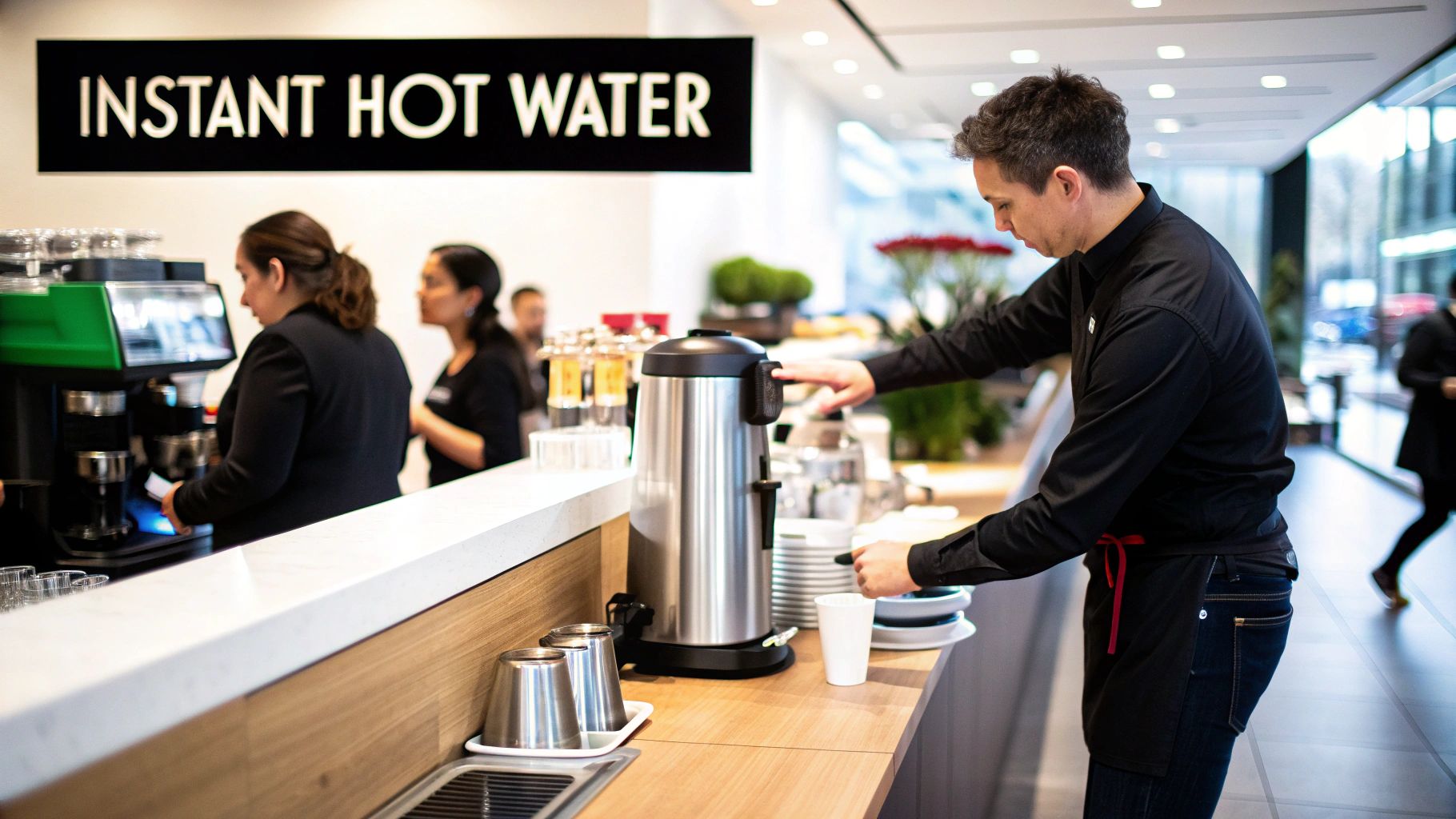
Picture the morning rush. You’ve got a line out the door for coffee, Americanos, tea, and instant oatmeal. Your staff is stretched thin, and the biggest bottleneck is waiting for water to heat up. Each minute wasted is a potential sale lost and a customer's patience tested.
Now, imagine a different scene. A dedicated dispenser provides an endless stream of hot water at the exact temperature you need. No waiting, no guesswork. That’s not just convenience—it’s smart business.
A commercial-grade unit is built to withstand the relentless pace of a professional kitchen, something a residential model simply can't handle. It’s designed to do one job perfectly, freeing up your team to focus on what they do best: creating amazing food and drinks for your customers.
The Strategic Advantage of Instant Hot Water
Whether you're running a high-volume Mexican restaurant in East LA or a gourmet food truck in Venice, the need for instant hot water is a constant. This one machine can solve a surprising number of daily headaches.
- Boosts Speed and Efficiency: It completely cuts out the wait time for boiling water. That means your baristas and line cooks can prepare beverages, soups, and other dishes in a fraction of the time, keeping the line moving during your busiest hours.
- Ensures Product Consistency: Getting the water temperature right is everything. Brewing a delicate green tea at the wrong temp ruins it. Same for activating yeast for pizza dough or getting that perfect pour-over coffee bloom. A dispenser gives you that crucial consistency, so every customer gets the same great experience.
- Improves Workflow and Safety: Setting up a dispenser at a dedicated beverage station organizes the flow of your kitchen. More importantly, it means no more staff hauling heavy pots of scalding water across a slippery floor. It’s a simple change that makes your workspace significantly safer.
Think of a commercial hot water dispenser as a dedicated kitchen assistant—one that never calls in sick and performs its task flawlessly. It’s a strategic move that pays for itself through speed, safety, and happy customers.
The industry is catching on fast. The global hot water dispenser market was valued at USD 1.58 billion and is expected to hit USD 2.93 billion by 2032. The commercial side of that market is predicted to see the fastest growth, and for good reason. Chefs and owners are realizing these durable, high-capacity units are essential for modern operations. You can dig into more insights on the hot water dispenser market to see where things are headed.
By adding one to your kitchen, you're not just buying another piece of equipment; you're fundamentally upgrading how your business runs.
At-a-Glance Benefits for LA Food Businesses
To put it simply, here’s how different Los Angeles restaurants can benefit from making the switch.
| Business Type | Key Benefit | How It Improves Operations |
|---|---|---|
| Los Angeles Pizza Shops | Dough Consistency | Provides water at the perfect temperature to activate yeast, ensuring a perfect rise for every pizza crust. |
| Full-Service Restaurants | Kitchen Workflow | Frees up stovetop space and provides instant hot water for blanching vegetables, making broths, and speeding up prep. |
| Mexican Food Restaurants | Prep Speed | Instantly rehydrate dried chiles for moles and sauces, or quickly prepare large batches of café de olla for brunch service. |
| Los Angeles Food Trucks | Space & Time Saver | A compact unit eliminates the need for bulky kettles, maximizing precious counter space and serving customers faster. |
| Hotels & Catering | Self-Serve Efficiency | Ideal for breakfast buffets, conference rooms, and event setups, allowing guests to serve themselves tea or oatmeal. |
Ultimately, integrating a commercial dispenser is one of the smartest, most impactful upgrades you can make to your daily workflow.
Breaking Down the Types of Dispensers
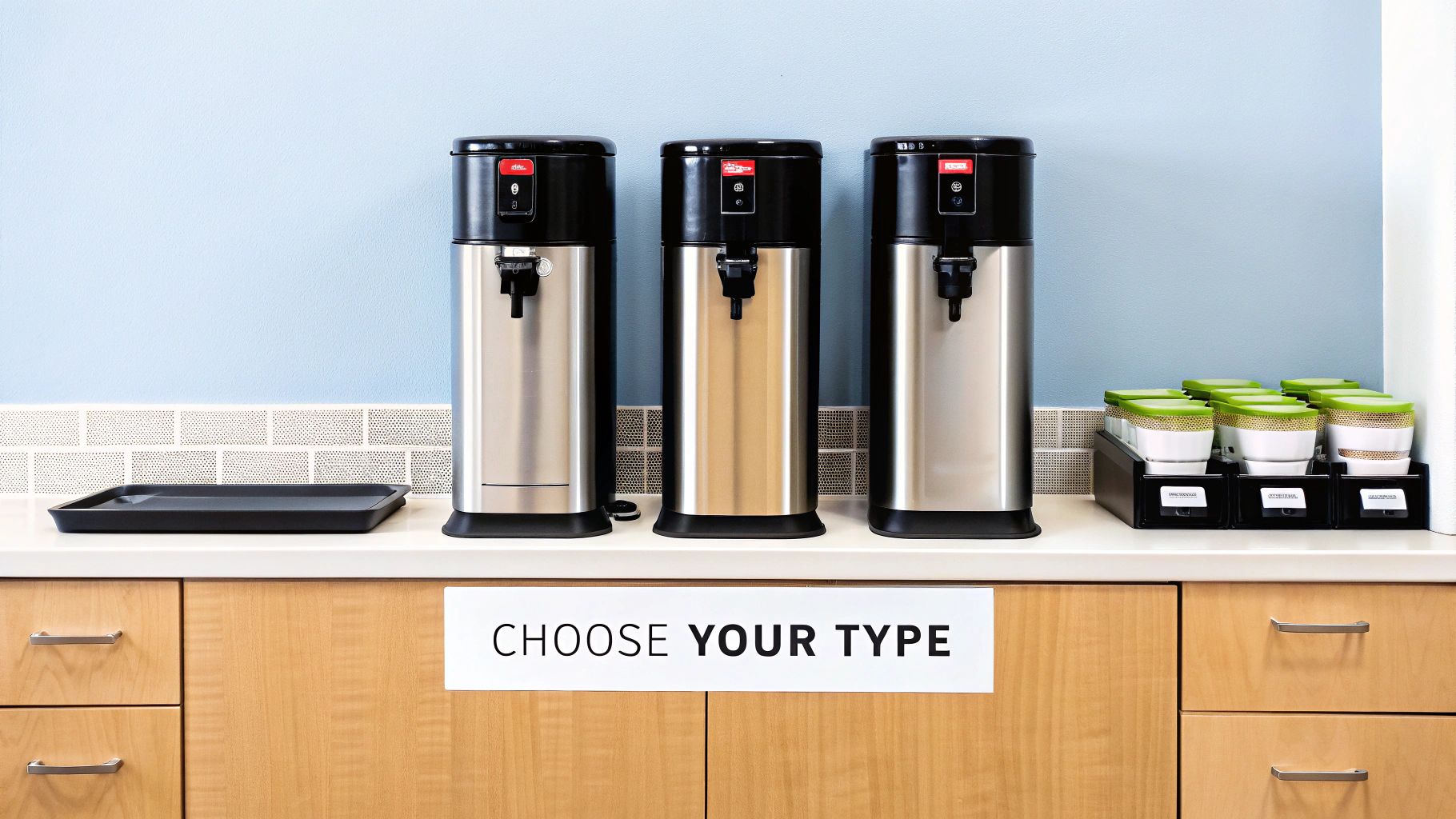
Choosing a commercial hot water dispenser isn't a one-size-fits-all kind of deal. The right machine for a huge downtown LA restaurant is going to be worlds apart from what a nimble food truck needs. Figuring out the basic types is the first step to finding a model that actually fits into your workflow, not one that messes it up.
It really boils down to two things: where you’re going to put it (physical placement) and how it heats the water (heating technology). Get these two right, and you’ll have a machine that performs exactly as you need it to without hogging precious space or jacking up your utility bills.
Placement Matters: Where Will It Fit?
The physical footprint of your dispenser is a huge deal, especially when you’re working in the tight quarters of a commercial kitchen. Each style has its own perks, depending on your layout and how you operate.
-
Countertop Dispensers: These are the workhorses you see most often. They’re self-contained units that just sit on a counter, making them perfect for self-service beverage stations or right behind the bar. A bustling Los Angeles pizza joint could stick one near the prep line for quick access when making dough.
-
Undercounter Dispensers: If your counter space is prime real estate, these are a lifesaver. The main heating unit is tucked away in a cabinet below, leaving just a sleek little tap on the counter. A high-end café can use this to keep their pour-over coffee bar looking clean and uncluttered.
-
Wall-Mounted Dispensers: Perfect for saving both counter and cabinet space, these units bolt right onto the wall. You'll often find them in break rooms or prep areas where every inch of floor and counter space is already claimed by other restaurant equipment.
Picking the right placement helps organize your kitchen so your team can move around without bumping into equipment. This is where a little bit of planning really pays off.
Tank vs. Tankless: The Core Technology
Beyond where the dispenser sits, the biggest difference is in how it heats water. This is the engine of your dispenser, and it determines everything from capacity and recovery speed to energy use.
A tank-style (or reservoir) unit is a lot like your water heater at home. It keeps a set amount of water—anywhere from 3 to 10 gallons or more—hot and ready to go at all times. This makes it a fantastic choice for businesses that have predictable, heavy demand.
On the other hand, a tankless (or on-demand) unit works like an instant water heater. It uses a powerful heating element to heat water as it flows through the machine, right when you need it. This approach is incredibly energy-efficient because it only burns power when it's actively dispensing.
The choice between tank and tankless is a classic trade-off: do you need immediate high-volume output, or are you focused on long-term energy savings? A tank gives you a buffer for those sudden rushes, while a tankless model is great for places with more sporadic but continuous demand.
To make it even clearer, let's put them side-by-side.
| Feature | Tank-Style (Reservoir) | Tankless (On-Demand) |
|---|---|---|
| Best For | High-volume, predictable rushes (e.g., morning coffee rush) | Steady but less predictable demand (e.g., all-day tea service) |
| Initial Output | Can deliver its entire tank capacity instantly. | Provides an endless, continuous flow of hot water. |
| Recovery | Needs time to reheat after the tank is depleted. | No recovery time is needed; it's always ready. |
| Energy Use | Consumes energy to keep the stored water hot (standby loss). | Only uses significant energy when actively heating water. |
| Footprint | Generally larger due to the internal water tank. | Often more compact and space-efficient. |
For a busy Mexican food restaurant in Los Angeles, a big tank model would be perfect for the dinner rush, pouring out gallons of hot water for soups and drinks all at once. Meanwhile, a mobile food truck would get a huge benefit from a compact, energy-sipping tankless commercial hot water dispenser that won’t overload its generator. When you match the technology to the rhythm of your business, you make sure your investment works for you every single day.
Understanding the Specs That Matter Most
When you start shopping for a commercial hot water dispenser, the spec sheets can feel a little intimidating. All those numbers and technical terms can look like a foreign language. But once you know what to look for, you'll see they’re just telling a story about how that machine will perform when you're slammed.
These specs are the secret to finding a unit that won’t let you down during a rush. Let's break down the numbers that actually matter for your daily grind, connecting what's on paper to what happens in your kitchen.
Capacity Gallons Per Hour
First on the list is capacity, which is almost always measured in gallons per hour (GPH). This number tells you the absolute maximum amount of hot water the machine can crank out in 60 minutes. It's the most critical spec for matching a dispenser to your daily customer traffic.
Think about a busy Mexican spot in LA on a Saturday night. You're constantly needing hot water for everything from making big batches of café de olla to rehydrating dried chiles for your mole. A small, 5 GPH dispenser would tap out in minutes, creating a serious bottleneck. On the other hand, a beefy unit with a 20 GPH capacity will keep up with that constant demand without even breaking a sweat.
Flow Rate and Recovery Rate
While GPH gives you the big picture, flow rate and recovery rate tell you how fast you get that water. Flow rate is all about how much water pours out of the tap each minute—super important when you're trying to fill a big stockpot or a line of coffee carafes in a hurry.
The recovery rate is arguably even more vital. This tells you how quickly the unit can heat up a fresh batch of cold water after the tank has been drained. A dispenser with a slow recovery is like a star athlete who needs a long breather after every single play. That’s not going to work during the lunch rush. A fast recovery rate means your dispenser is ready for the next order almost instantly.
Think of it this way: Capacity is the size of your fuel tank. Flow rate is how fast the fuel comes out. Recovery rate is how quickly you can refill the tank. For a busy kitchen, you need all three working together perfectly.
Precision Temperature Control
For a lot of businesses, just "hot" isn't good enough. Having the ability to dial in and hold an exact water temperature can completely change your final product. After all, not all hot water is created equal.
- For the Artisan Baker: A local LA pizzeria needs water that's right around 110°F to activate the yeast for their pizza dough. If it's too cold, the yeast stays asleep; too hot, and it's game over. Precision is everything.
- For the Tea Specialist: A high-end tea house has to be even more precise. Brewing a delicate green tea might require water at 175°F, while a bold black tea needs to be closer to 205°F. A dispenser with adjustable temperature controls lets them nail that perfect steep every time.
This kind of control is what creates consistency, and consistency is what builds a great reputation.
Power Requirements Voltage and Phase
Finally, let's talk about power. It’s not the most glamorous spec, but ignoring it can cause some massive headaches down the road. You absolutely have to make sure your building's electrical setup can handle the dispenser you want to buy.
Most of the smaller countertop models will run on a standard 120V circuit—the same kind you plug a blender into. But the bigger, more powerful workhorses often require a 208V or 240V connection, which is more like what a commercial convection oven needs. You’ll also see the "phase" listed (single-phase or three-phase), another key detail your electrician needs to know.
Before you get your heart set on a specific model, double-check its power requirements. A quick chat with an electrician can save you from buying a powerful machine that your facility can't even turn on.
To make this a bit easier, here’s a quick-glance table to help you match your business needs with the right specs.
Matching Dispenser Specs to Your Business Needs
This table gives you a starting point for figuring out what kind of power you'll need based on your daily volume and what you're using the water for.
| Specification | Los Angeles Pizza Place | Mid-Volume Mexican Food | High-Volume Food Truck |
|---|---|---|---|
| Capacity (GPH) | 5-8 GPH. Enough for single-cup tea, Americanos, and oatmeal without long waits. | 10-15 GPH. Handles drink service, basic food prep, and some cleaning needs. | 15-20+ GPH. Built for non-stop use—filling large pots, batch cooking, and high-speed service. |
| Temperature Control | Precision is key. Essential for consistent pizza dough activation around 110°F. | Adjustable temps are ideal for a varied menu (soups, sauces, different teas). | A high, fixed temperature is often best for speed and food safety in a fast-paced environment. |
| Recovery Rate | Standard recovery is acceptable, as demand is sporadic. | A moderate-to-high recovery rate is needed to avoid downtime during lunch/dinner rushes. | Highest possible recovery rate is critical. There's no time to wait for water to reheat. |
| Power Needs | Usually a standard 120V plug-and-play unit works perfectly. | Often requires a 208V/240V connection; professional installation is a must. | Needs a heavy-duty 208V/240V connection, planned into the truck’s generator and electrical system. |
Remember, these are just general guidelines. Always think about your busiest hour, not your average one, when choosing a dispenser. It’s always better to have a little more power than you need than to come up short during a rush.
Calculating the True Cost of Ownership
The sticker price on a new hot water dispenser is just the beginning of the story. To really get the full picture, you have to look at the total cost of ownership—that’s everything you’ll spend, and save, over the life of the machine. It’s what tells you if you’re making a smart investment or just adding another recurring bill to your books.
Think of it like buying a delivery van for your LA restaurant. You could go for the cheaper model upfront, but if it guzzles gas, it’s going to cost you a fortune down the road. It’s the exact same logic with a hot water dispenser. An older, less sophisticated unit is constantly burning electricity just to keep a tank of water hot, letting precious energy (and money) bleed away through standby heat loss.
This chart breaks down the key specs that play into both performance and your long-term operating costs.
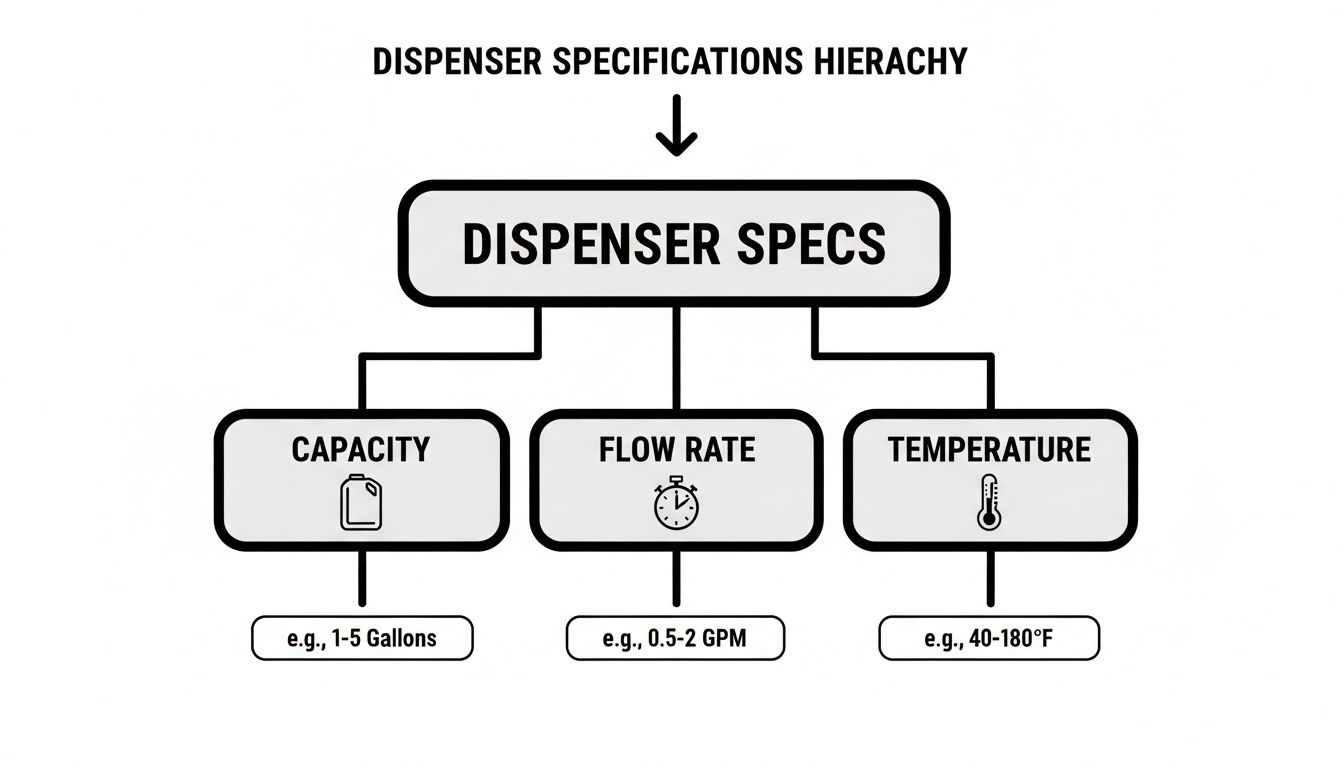
As you can see, things like capacity, flow rate, and temperature are all tied together. Nailing the right balance is crucial. You don't want to overspend on a monster unit you don't need, but you also don't want to lose business because your machine can't keep up.
Beyond the Initial Price Tag
Modern commercial hot water dispensers are built from the ground up with savings in mind. You'll find features that might seem small at first but add up to a big difference on your utility bills.
- Advanced Insulation: This is a big one. High-quality insulation keeps the heat locked inside tank-style units, so the heating element doesn't have to kick on nearly as often. This alone can seriously cut down your energy use.
- Programmable Timers & Sleep Modes: Why pay to keep water at a rolling boil when your doors are closed? Dispensers with programmable timers or sleep modes power down during your off-hours. You only pay for the energy you’re actually using.
Smart features like these are changing the game. Compared to constantly reboiling a kettle, a modern dispenser with sensors and efficient heating can slash energy use by 20-30%.
Factoring in Filtration and Water Costs
Another sneaky long-term cost is the water itself, especially if you’re concerned about quality. Plenty of businesses, from coffee shops to food trucks, end up relying on bottled water to get that clean taste. A point-of-use commercial hot water dispenser makes that entire expense disappear.
By hooking directly into your water line and running it through a built-in filter, you get a virtually endless supply of pure, hot water for a fraction of what bottled water costs. You'll have to budget for new filters every six to twelve months, but that cost is tiny compared to the savings you'll rack up.
A point-of-use dispenser is an investment in self-sufficiency. It frees your business from the fluctuating costs and logistical hassles of bottled water deliveries, giving you a predictable, low-cost solution for a critical ingredient.
When you do the math on the total cost of ownership, it becomes clear that a slightly more expensive, energy-efficient unit is almost always the smarter financial choice. The monthly savings on electricity and water add up fast, quickly covering the higher initial price. For many LA business owners, it’s a no-brainer for boosting the bottom line.
Of course, smart financial planning is key. Our guide on financing restaurant equipment can walk you through the options for getting the right gear without putting a strain on your cash flow.
Installation and Maintenance Made Simple
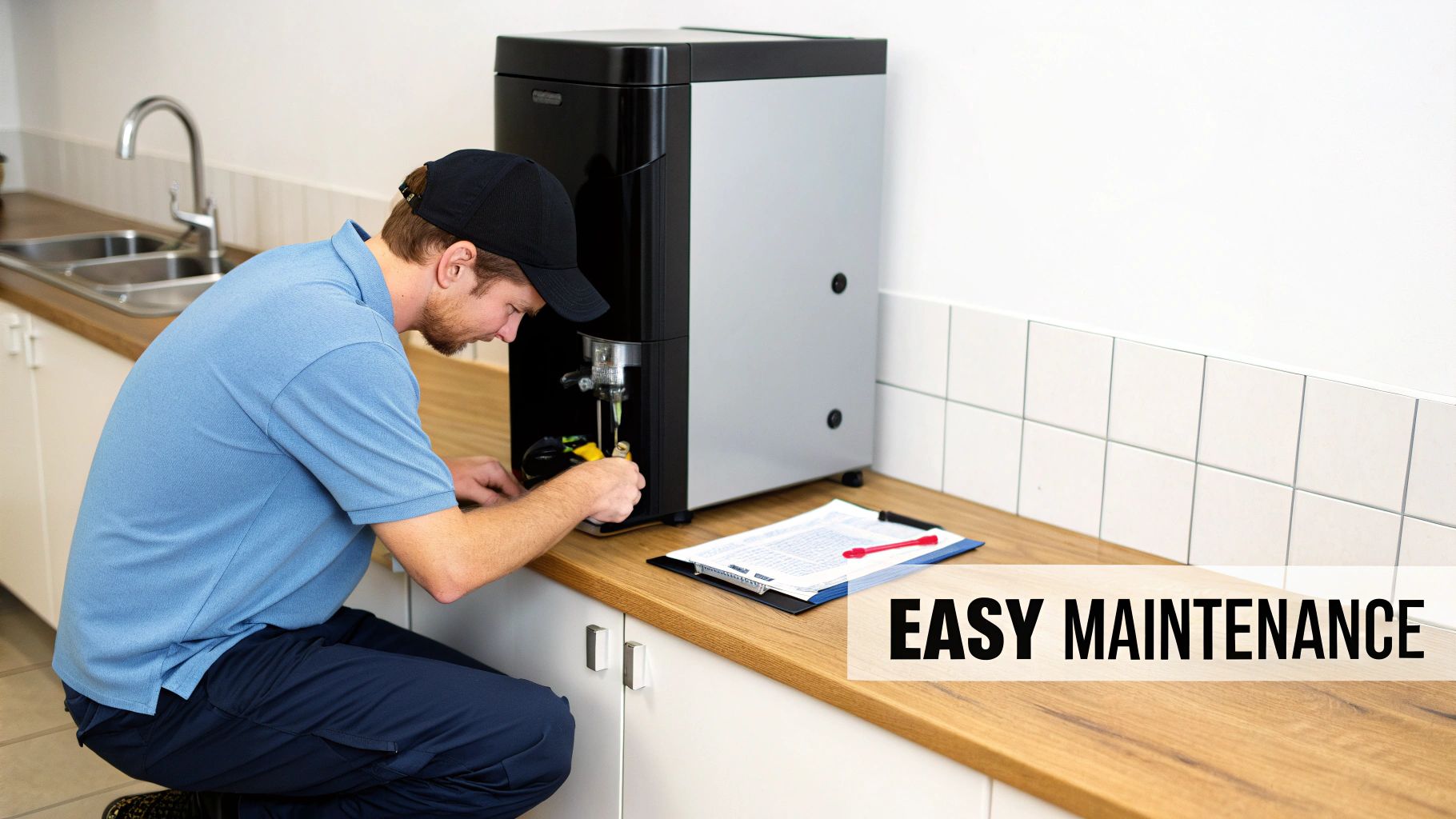
Getting a new piece of equipment for your Los Angeles restaurant should feel like a step forward, not the start of a new headache. A commercial hot water dispenser is designed for a pretty straightforward setup, but getting the installation right from the start is critical for both safety and performance.
The whole process really boils down to two key areas: plumbing and electrical.
For any point-of-use unit, whether it's hiding under your counter or sitting on top, you'll need a dedicated cold water line. This isn't a job for a slow Tuesday afternoon. Bringing in a licensed plumber ensures the connection is secure, totally leak-free, and—most importantly—compliant with local LA health codes. That part is non-negotiable.
On the flip side, you have to respect the electrical requirements. Smaller units might get by with a standard 120V outlet, but the more powerful models often demand a 208V or 240V connection. Always have a qualified electrician confirm your restaurant's wiring can handle the load before you buy. This simple check prevents the nightmare of tripped breakers during a dinner rush and protects your new investment from electrical damage.
Creating a Simple Maintenance Routine
Once your dispenser is up and running, a simple, consistent maintenance schedule is your best friend. It’s the easiest way to make sure it operates efficiently for years to come. Think of it as a quick health check-up for one of your hardest-working machines.
Protecting your investment is all about prevention. A few minutes of routine maintenance each month can prevent the kind of emergency breakdown that brings your beverage service to a halt on a busy Friday night.
Your maintenance plan doesn't need to be some complicated, multi-page document. Just focusing on a few key tasks will cover the most important bases and keep your unit in top shape.
Your Essential Maintenance Checklist
Here’s a simple, actionable checklist to follow. Sticking to these tasks will ensure your dispenser delivers clean, perfectly heated water every single time.
-
Descale to Remove Mineral Buildup: Hard water is a reality in many parts of Los Angeles. Over time, mineral deposits (limescale) can build up inside your dispenser, clogging components and making it work harder to heat water. Descaling every 3 to 6 months with a manufacturer-approved solution is essential to keep it running smoothly.
-
Replace Water Filters Regularly: The filter is your first line of defense against impurities that can mess with the taste and quality of your drinks. Most filters need to be swapped out every 6 to 12 months, depending on your local water quality and how much you use the machine. A fresh filter means every cup of tea or coffee tastes exactly as it should.
-
Clean Nozzles and Drip Trays Daily: This is a simple but vital step for hygiene. At the end of each day, wipe down the dispensing nozzle and take a moment to empty and clean the drip tray. It’s a small thing that prevents bacterial growth and keeps your beverage station looking clean and professional for customers and health inspectors alike.
Following these steps will maximize the lifespan and performance of your commercial hot water dispenser. For a more detailed breakdown, check out our comprehensive guide on commercial kitchen equipment maintenance, which offers tips for all your essential gear.
Finding the Perfect Dispenser for Your LA Business
Alright, let's connect the dots. We've talked specs and features, but the real magic happens when you match that technical jargon to the reality of your kitchen floor. A commercial hot water dispenser isn't just another piece of stainless steel; it's a tool that has to fit the unique pulse of your business. What works for a massive downtown eatery would be a total disaster for a nimble food truck.
Let's get practical and walk through how different Los Angeles food businesses can pick a dispenser that truly pulls its weight. By looking at real-world scenarios, you can zero in on the features that will actually make a difference to your bottom line.
For the Bustling Mexican Restaurant
Think about a high-volume Mexican restaurant in LA on a Saturday night. The demand is relentless. You're rehydrating dried chiles for mole, brewing huge batches of café de olla, and constantly cleaning greasy equipment. Hot water isn't a luxury—it's the lifeblood of your operation.
For this kind of environment, two words matter most: capacity and recovery. You absolutely need a large tank-style dispenser with a 15-20 GPH capacity. This ensures your crew has an endless supply of hot water on demand, even during the peak dinner rush. Pinpoint temperature control isn't the main priority here; you just need a beast of a machine built for non-stop, heavy-duty use.
For the Agile LA Food Truck
Los Angeles food trucks play by a completely different set of rules. Space is everything, and every amp of power is precious. A huge, power-hungry dispenser is a non-starter. The perfect commercial hot water dispenser for a food truck needs to be compact, energy-efficient, and tough enough to handle the bumps and vibrations of being on the road.
A tankless model or a countertop unit with a small footprint and low power draw is the way to go. These units won't eat up valuable counter real estate or overload your generator. Keep an eye out for models designed specifically for mobile use—they often have reinforced parts to withstand the constant movement.
The key takeaway is this: Match the machine to the mission. A high-capacity dispenser is wasted in a small space, while a compact unit would cripple a high-volume restaurant. The right choice is always the one that solves your specific operational bottlenecks.
The demand for these specialized units is growing fast. In fact, the commercial side of the hot water dispenser market is expected to see the fastest growth from 2025 to 2032. This boom is fueled by restaurants and hotels that need durable, high-flow machines to keep up with constant use while meeting strict hygiene standards. You can find more insights on the rising demand for commercial dispensers.
For the Dedicated Pizzeria
The secret to amazing pizza dough is consistency, and that starts with the water. The temperature you use to activate the yeast is a make-or-break factor. If it’s too cold, the dough won’t rise. Too hot, and you kill the yeast before it even gets started.
A Los Angeles pizza joint needs a dispenser that delivers precise and reliable temperature control. A unit that can hold water steady in that perfect 105-115°F range is a game-changer. It takes all the guesswork out of making dough, guaranteeing every batch has the ideal texture and rise. A mid-range capacity of around 8-12 GPH will get the job done for most pizza shops.
The Non-Negotiable LA Requirement: NSF Certification
No matter what kind of food business you run, there’s one requirement that’s universal across Los Angeles County: NSF certification. This little seal means the equipment has been rigorously tested and certified to meet public health and safety standards.
An NSF-certified dispenser is non-negotiable if you want to pass your health inspections. When you're shopping for restaurant equipment, make sure that NSF mark is clearly visible on the unit. It’s your guarantee that the materials and design are safe for a commercial kitchen, giving you peace of mind and keeping the health inspector happy. For a full rundown of the gear you'll need, our commercial kitchen equipment checklist can help make sure you've got all your bases covered.
Frequently Asked Questions
When you're close to pulling the trigger on new equipment, a few last-minute questions always seem to pop up. We get it. To make sure you’re 100% confident in your choice, we’ve put together some straight-up answers to the questions we hear most from LA’s restaurant and food truck pros.
What’s the Real Difference Between a Commercial and a Home Dispenser?
It really boils down to three things: durability, capacity, and speed. A commercial hot water dispenser is a workhorse, built from heavy-duty parts that can handle the non-stop grind of a busy kitchen or cafe.
These machines also have a much quicker recovery rate, so you're never left waiting during a rush. Plus, they’re NSF-certified, a non-negotiable for passing health inspections that you just won't find on a standard home unit.
Do I Need to Call a Plumber for This?
Yep. If you're installing a point-of-use or undercounter unit, you'll need a licensed plumber to connect it to your cold water line. It's a routine job for them, and they'll make sure it’s done right—no leaks and totally up to Los Angeles County code.
Don't forget to plan for a drain line for the drip tray. It’s a small detail that keeps your workspace safe, clean, and slip-free for your team.
Paying for a professional installation is one of the smartest moves you can make. It heads off leaks, keeps you compliant, and ensures the unit runs safely from day one. Think of it as an insurance policy for your equipment and your business.
How Often Do I Need to Descale the Unit?
That all depends on your water. Here in Los Angeles, we have pretty hard water in most areas, which means you'll probably need to descale your dispenser every 3 to 6 months to keep mineral scale from building up.
If you let that limescale go, it can clog up the works, make your heater less efficient, and even leave a funky taste in the water. Just follow the descaling steps from the manufacturer for your specific model—it’s the best way to keep it running like new for years.
Can This Thing Actually Replace My Cafe's Kettle?
Absolutely, and you'll wonder why you didn't do it sooner. A commercial dispenser gives you an endless supply of hot water at the perfect, steady temperature, instantly. You can say goodbye to the annoying wait times and temperature guessing games you get with a kettle.
It's a game-changer for your workflow, speeding up everything from brewing tea to making Americanos. Every drink comes out consistent, which your customers will definitely notice. For an LA food truck where every second and every inch of counter space is gold, it's a no-brainer.
Ready to make your kitchen faster and more consistent? Check out the huge selection of top-notch commercial hot water dispensers at LA Restaurant Equipment. We’ve got warehouse-direct pricing, fast and free shipping across Southern California, and flexible financing to help your business grow. Find the perfect dispenser for your spot today at https://larestaurantequipment.com.