

For any restaurant, cafe, or food truck in Los Angeles, the commercial coffee machine is so much more than just another piece of equipment. It’s the heart and soul of your beverage program. Think of it as a powerful engine humming away, driving profits one cup at a time for everything from pizzerias to Mexican restaurants.
When you invest in the right machine, you’re investing in consistency. You're guaranteeing a high-quality coffee that keeps customers coming back, whether they're grabbing a latte on their morning commute or capping off a perfect dinner.
Why the Right Coffee Machine Is Your Secret Ingredient
In a food scene as competitive as L.A.'s, every single detail matters. While the top Los Angeles Pizza spots obsess over the perfect crust and the best Mexican Food restaurants have their salsa down to a science, the quality of your coffee can truly make you stand out. A fantastic cup of coffee does more than just taste good—it elevates the whole experience for your guests. It encourages them to stick around, order another round, and it can seriously boost your average ticket size.
Picking the right machine is a huge decision. It directly impacts your daily workflow, how efficiently your staff can operate, and even how people perceive your brand. A machine that’s too small will immediately create a bottleneck during your morning rush. On the other hand, one that’s too complicated for your team to master will just lead to inconsistent, disappointing drinks.
A bustling Los Angeles food truck needs something compact and powerful. A high-volume cafe, however, needs an absolute workhorse that can pump out hundreds of drinks a day without breaking a sweat or sacrificing quality.
Aligning Equipment with Your LA Business Goals
The perfect commercial coffee machine is the one that fits seamlessly into your operation. To find that perfect match, you need to think about a few key things:
- Enhanced Customer Experience: A machine that pulls a superb shot of espresso or brews a rich, aromatic drip coffee can turn a first-time visitor into a lifelong regular. It’s that simple.
- Increased Revenue Streams: Let's be honest, great coffee commands a premium price. The profit margins are excellent, and a smart investment here can pay for itself surprisingly quickly.
- Operational Efficiency: The right machine makes life easier for your baristas. It helps them serve customers quickly and consistently, even when there's a line out the door.
- Brand Reputation: Serving exceptional coffee sends a clear message. It says you care about quality, and that reflects positively on your entire menu and establishment.
This guide is your roadmap. We’ll walk you through everything from understanding the different types of machines to figuring out the return on your investment. By the end, you'll have all the knowledge you need to make a smart decision for your Los Angeles restaurant or food truck.
And with partners like LA Restaurant Equipment, you’re not alone. You get access to expert advice, professional installation, and even flexible financing to lock in the perfect coffee setup for your business.
Choosing Your Coffee Machine Type
Figuring out the right commercial coffee machine isn't about finding the "best" one on the market. It’s about finding the one that perfectly fits the rhythm and goals of your Los Angeles business, whether it's a pizzeria, food truck, or Mexican restaurant. Think of it like a chef's kitchen—you wouldn't use a delicate paring knife for a job that needs a heavy cleaver. The machine that works for a high-volume diner is completely different from the one you’d want for a specialty coffee bar.
This decision is the foundation of your entire beverage program. The commercial coffee machine market is huge, expected to hold a 57.8% share of the total market by 2025. North America is leading the charge, making up 41.3% of that market, so it’s clear that from small cafes to large chains, businesses rely on these machines. With the total market projected to hit USD 7.53 billion, getting this choice right is your first step to tapping into that growth.
If you're stuck, this flowchart can help simplify your decision by zeroing in on what matters most: revenue, customer experience, and quality.
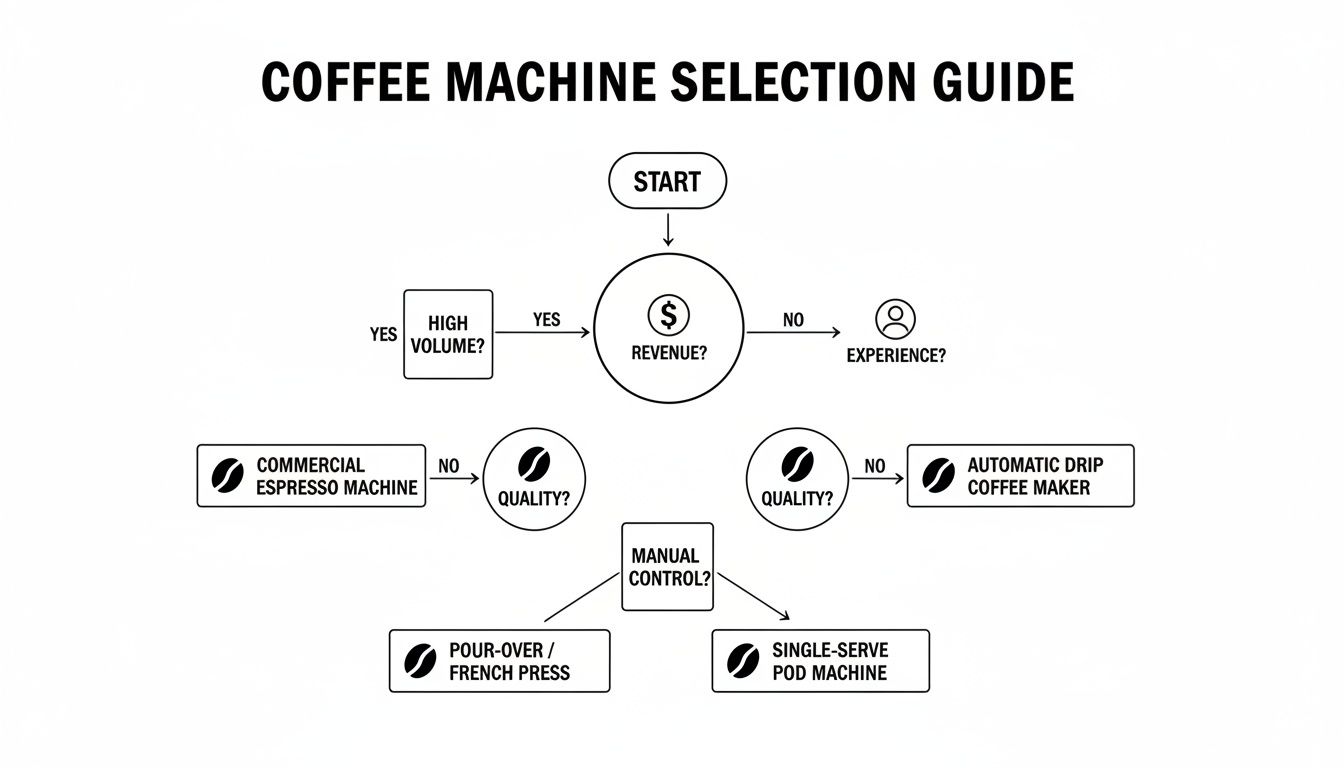
As you can see, your priorities—whether that’s speed, craft, or convenience—point you directly to a specific kind of machine.
To help you compare, here's a quick look at the four main types of commercial coffee machines you'll be choosing from.
Commercial Coffee Machine Types at a Glance
| Machine Type | Best For | Typical Output (Cups/Hour) | Required Staff Skill |
|---|---|---|---|
| Espresso Machine | Specialty coffee shops, upscale restaurants, craft-focused cafes. | 50 - 250+ | High (Trained Barista) |
| Bean-to-Cup | Offices, hotels, QSRs, self-serve environments. | 30 - 150+ | Low (Push-button) |
| Drip Coffee Brewer | Diners, conference centers, catering, high-volume breakfast spots. | 100 - 400+ | Very Low (Basic operation) |
| Single-Serve | Hotel rooms, office breakrooms, waiting areas, low-volume settings. | 20 - 60 | None (Self-serve) |
Each of these machines has a place. The key is knowing which one belongs in your place.
Espresso Machines: The Artisan's Toolkit
A traditional espresso machine is the ultimate artist's toolkit. It gives a skilled barista complete manual control to dial in every single variable—grind size, tamp pressure, shot timing—to pull a truly exceptional shot of espresso. This is the machine you get when coffee isn't just another item on your menu; it’s a core part of your brand.
These machines are the heart and soul of specialty coffee shops and upscale Los Angeles restaurants that want to offer a premium, handcrafted coffee experience. They absolutely require trained staff to get the most out of them, but the payoff is incredible quality and the theater of watching a full menu of espresso drinks, from lattes to macchiatos, come to life. For an LA food truck specializing in gourmet coffee, a compact but powerful espresso machine could be its biggest draw.
Key Takeaway: Choose an espresso machine when quality and craft are non-negotiable. It turns coffee making into a performance, creating an engaging customer experience centered on your barista's skill.
Bean-to-Cup Machines: The Automated Barista
Bean-to-cup machines are all about efficiency and consistency. Just imagine a robotic barista that grinds fresh beans, tamps the grounds, brews the coffee, and even steams and froths the milk—all with a single button press. These machines are built for speed and simplicity, delivering good quality coffee with almost no staff training.
They are the perfect fit for places where coffee is an important amenity but not the main event.
- High-volume offices that need a quick, quality caffeine fix for employees.
- Hotel breakfast bars where guests can help themselves.
- Quick-service restaurants or pizzerias that want to offer lattes without hiring a dedicated barista.
For any Los Angeles business looking to add espresso drinks to their menu with a zero learning curve, a bean-to-cup commercial coffee machine is the answer. It guarantees that every single drink is made the exact same way, every time.
Drip Coffee Brewers: The Reliable Workhorse
The commercial drip brewer is the unsung hero of the coffee world. It’s the reliable, high-capacity workhorse designed to pump out large volumes of consistently good black coffee, quickly and efficiently. Think of it as the dependable engine powering a bustling diner, a conference center, or a large catering operation.
It might lack the flair of an espresso machine, but its value is in its sheer output and ease of use. These machines can brew gallons of coffee every hour, keeping pots full and fresh even during the craziest morning rushes. For a classic Mexican food restaurant in LA serving breakfast or a high-traffic event venue, a drip brewer ensures no customer ever has to wait for a hot cup.
Single-Serve Systems: The Convenience Specialist
Finally, we have single-serve pod or capsule machines, which are all about convenience and variety. They are the ultimate plug-and-play solution, offering a huge array of coffee and tea options with absolutely zero mess or waste. Each cup is brewed fresh in under a minute, making them perfect for low-volume or self-serve areas.
These systems really shine in places like office breakrooms, hotel rooms, and client waiting areas where people appreciate having a choice and don't need any instructions. While the cost-per-cup is higher and they create more packaging waste, the trade-off is unmatched convenience and a super clean, user-friendly experience. They aren't built for a busy cafe, but they excel where speed and ease are top priorities.
Sizing Your Machine for Peak Performance
Picking the right size for your commercial coffee machine is a lot like choosing an engine. You wouldn't put a sports car engine in a semi-truck and expect it to haul a heavy load. You also wouldn't drop a massive truck engine into a compact car—it’s just wasteful overkill. Your coffee machine needs to be perfectly matched to your business’s real-world demands, or you'll either create bottlenecks or burn cash.
Getting this wrong is a classic, costly mistake. An undersized machine will have your baristas scrambling and your customers tapping their feet during the morning rush. On the flip side, an oversized machine means you’ve tied up precious capital in capacity you’ll never actually use—money that could’ve been put to better use elsewhere in your Los Angeles spot.
Calculating Your Peak Demand
First things first, you need to get brutally honest about your busiest hour. This isn’t about your average day. We’re talking about the absolute peak of service. For a cafe in downtown LA, that’s probably the 8:00 AM to 9:00 AM commuter stampede. For a popular Mexican restaurant, it might be the post-dinner espresso surge around 8:30 PM.
Think about how your specific operation flows:
- LA Food Trucks: Your peak is usually a short, intense lunch rush or a specific event window. You need a machine that recovers lightning-fast between shots.
- Pizzerias and Restaurants: Your demand is more spread out, but you'll see spikes after meals. Consistency is just as critical as raw speed here.
- High-Volume Cafes: You’re staring down a constant, heavy stream of orders for hours on end. Your machine needs pure stamina to perform without a single hiccup.
Once you’ve nailed down that busiest hour, estimate the maximum number of coffee drinks you make. If you sling 60 coffees in that hour, your target is 60 cups per hour. That number is your North Star for everything that follows.
Decoding Boiler Technology
The boiler system is the heart of your espresso machine. It’s the engine room, directly responsible for how quickly you can pull espresso shots and steam milk at the same time—absolutely crucial for keeping lattes and cappuccinos flying out the door. A little knowledge here goes a long way in matching the tech to your peak demand.
A machine’s boiler system dictates its ability to handle pressure. Choosing the right one ensures your team can steam milk for a latte while pulling an espresso shot without any drop in temperature or performance, keeping the line moving.
There are really three types of boiler systems you’ll run into:
- Single Boiler: These machines use one boiler for everything—brewing and steaming. Since it can't do both at once, you get a frustrating delay when switching between tasks. This setup is only okay for very, very low-volume spots where speed is an afterthought.
- Heat Exchanger: This is a clever step up. A heat exchanger has one big boiler for steam, with a copper tube running through it that heats brew water on the fly. This design lets you brew and steam simultaneously, making it a workhorse for many small to mid-sized Los Angeles cafes and restaurants.
- Dual Boiler: This is the top of the line for serious performance. With two separate boilers—one just for brewing and one just for steaming—a dual boiler machine delivers rock-solid temperature stability and power. It can crank out drink after drink without breaking a sweat, making it the only real choice for a truly high-volume operation.
To see how a coffee machine fits into the bigger picture of your kitchen's workflow, take a look at our guide on building a complete commercial kitchen equipment checklist. It’ll help you plan your entire layout for maximum efficiency. Nailing the boiler choice ensures your machine can keep up when it matters most.
Understanding Essential Machine Components
Let's look under the hood. Beyond the shiny stainless steel and the fancy brand name, the real muscle of a commercial coffee machine is in its internal components. These are the parts doing the serious work, turning simple beans and water into the amazing, consistent coffee your customers will come back for.
Getting these components right is everything. It impacts flavor, how long your machine will last, and how smoothly your baristas can work during a rush.
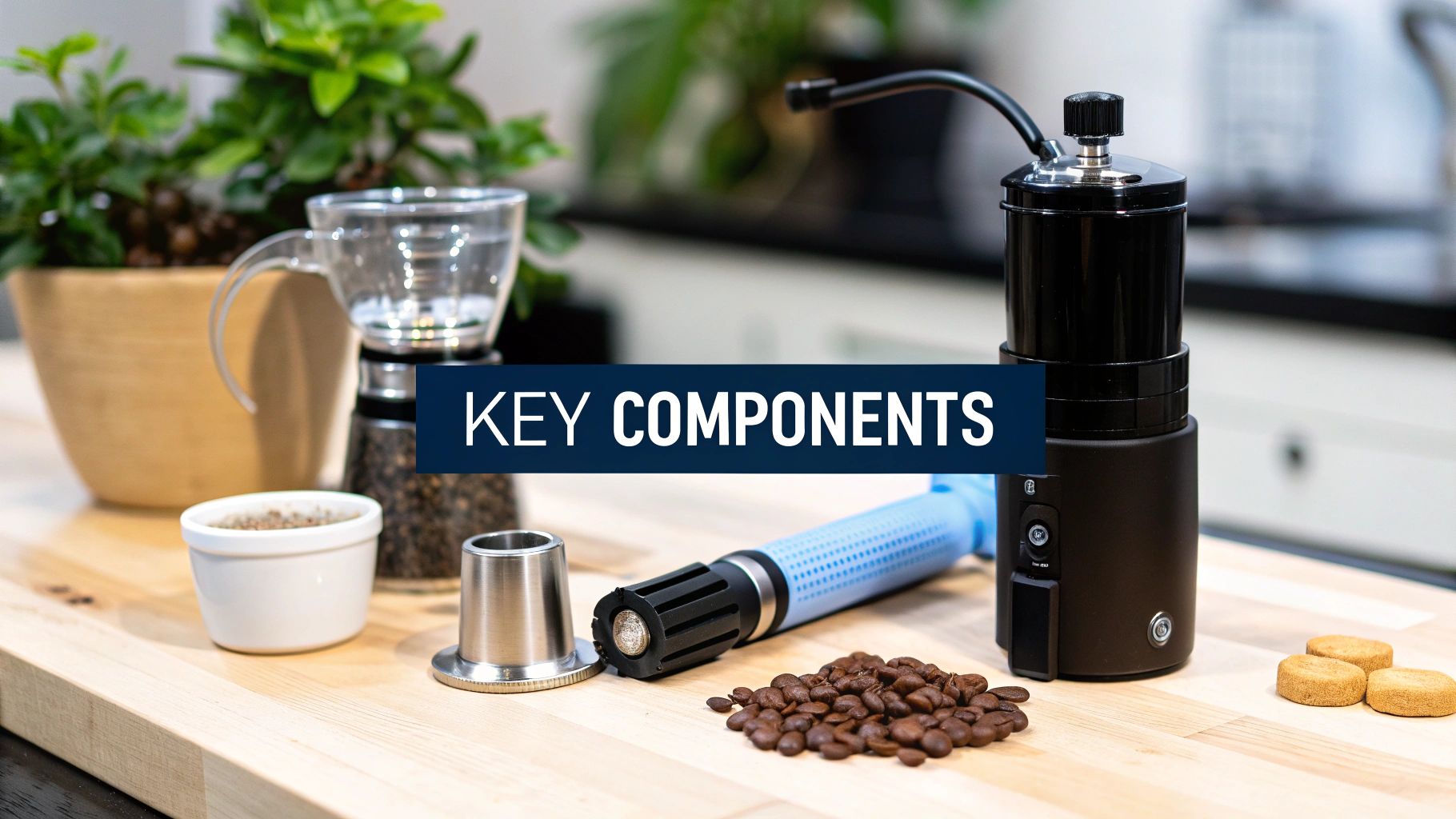
Think of it like building a custom car. A beautiful frame is great, but if the engine and transmission can’t handle the heat, you’re not winning any races. For your coffee setup, the grinder, water filter, and steam wand are your high-performance engine parts.
The Grinder: The Unsung Hero of Flavor
You could have the most expensive espresso machine on the market, but without a top-notch grinder, your coffee will always taste a little... off. The grinder’s one and only job is to create perfectly uniform coffee particles, and consistency is king. A cheap grinder produces an inconsistent grind, meaning some grounds get over-extracted (bitter!) and others are under-extracted (sour!). The result is a muddy, disappointing cup.
This is exactly why a burr grinder isn't just a suggestion—it's a must-have for any serious commercial operation. Unlike blade grinders that just chop beans into random-sized chunks, burr grinders use two revolving surfaces to precisely crush the beans to a uniform size. This gives your barista total control to dial in that perfect grind for a balanced, rich espresso shot, every single time.
For a busy Los Angeles spot or a food truck on the move, an on-demand burr grinder that grinds fresh for every single shot is the gold standard. It guarantees peak freshness and cuts down on waste, which is a win for both your quality and your bottom line.
Water Filtration: The Investment Protector
It’s easy to forget about water, but it's one of the most critical parts of your entire coffee program. The water you use has a massive impact on both the taste of your coffee and the long-term health of your machine. Here in Los Angeles, our water is notoriously hard, which makes this even more important.
Hard water is full of minerals like calcium and magnesium. When you heat that water, the minerals form limescale—that chalky gunk that clogs up pipes, sensors, and heating elements. Honestly, limescale buildup is the number one killer of coffee machines, leading to costly repairs and frustrating downtime you can't afford.
A proper water filtration system isn't a luxury; it's essential insurance for your commercial coffee machine. It removes chlorine for better taste and softens the water to prevent limescale, protecting your investment and ensuring your machine runs efficiently for years.
Putting a quality water filtration system in place is a proactive move that absolutely pays for itself. Not only does it shield your expensive equipment, but by stripping out chlorine and other impurities, it lets the true, delicate flavors of your coffee beans shine through. This is also a major consideration for other equipment, which you can read more about in our guide to the commercial hot water dispenser.
Other Key Features for Peak Performance
Beyond the grinder and filter, a few other components make a huge difference in the day-to-day grind and the quality of what you serve.
- Steam Wand Performance: If you’re serving lattes and cappuccinos, the steam wand is your money-maker. You need a powerful wand, preferably with a multi-hole tip, that can whip up that silky, velvety microfoam in seconds. This lets your baristas produce beautiful drinks and keep the line moving.
- Programmability and Volumetrics: Consistency is the name of the game, especially when you have multiple baristas. Volumetric machines let you program the exact amount of water for single and double shots. This feature means every espresso gets pulled to the exact same recipe, guaranteeing consistent flavor no matter who’s behind the counter.
- Build Quality: A commercial coffee machine is a long-term investment, not a disposable appliance. Look for machines built with tough materials like stainless steel and brass. High-quality internal parts, from the pump to the group heads, are designed to handle the abuse of a high-volume café and will give you a much longer, more reliable service life.
Planning Your Installation and Setup
You’ve found the perfect commercial coffee machine. Great! But the work isn't quite done. A common mistake I see is operators assuming they can just unbox it, plug it in, and start brewing. These aren't your home kitchen appliances; they're powerful machines with very specific utility needs that are non-negotiable for performance, safety, and keeping your warranty intact.
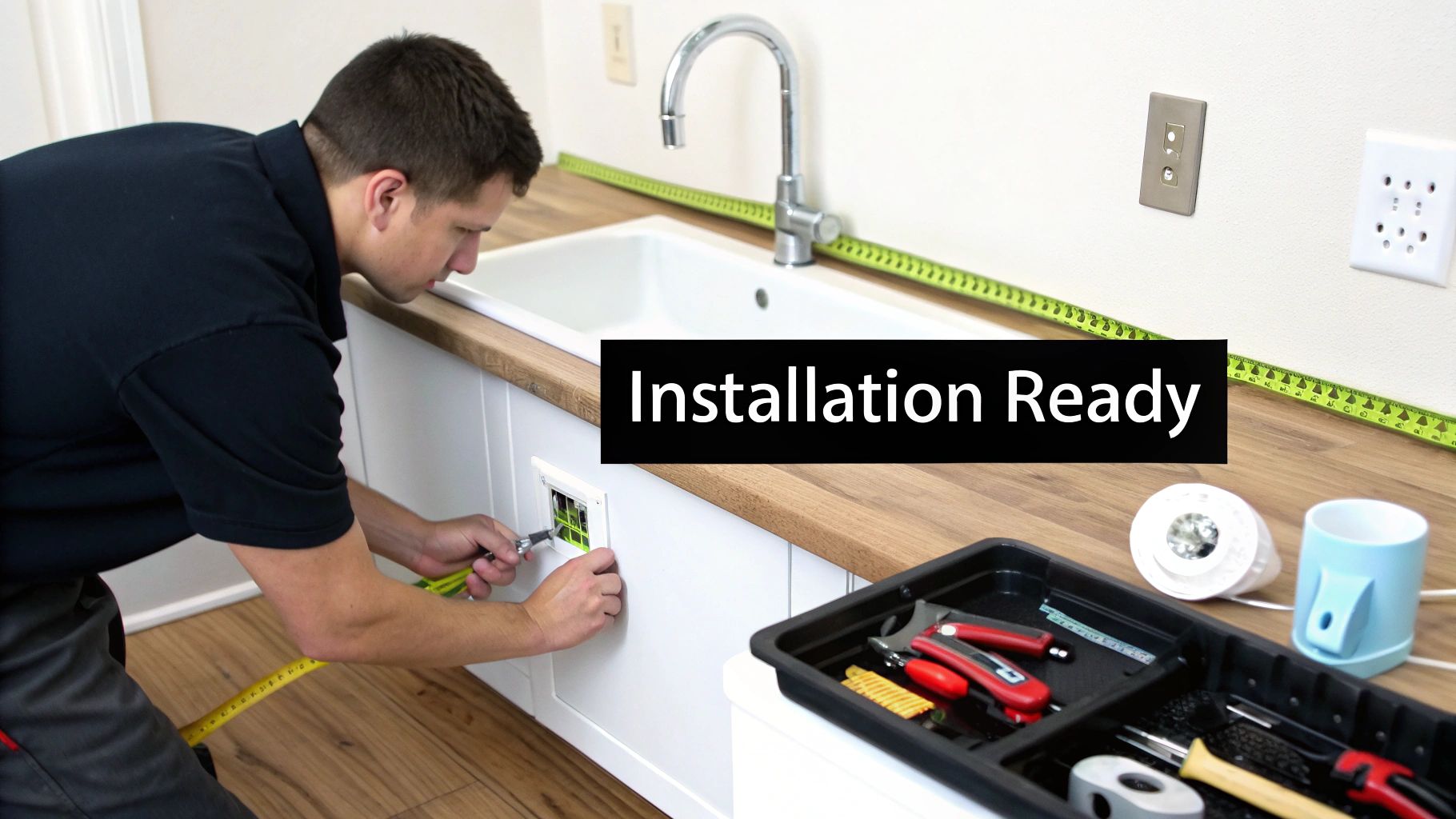
Getting your space ready before the machine arrives is the secret to a headache-free launch. Sorting out your electrical, plumbing, and counter space ahead of time means installation day goes smoothly, and you can start serving amazing coffee right away.
Site Readiness Checklist
Before that delivery truck pulls up, run through this simple checklist. Think of it as building the perfect home for your new machine, giving it everything it needs to perform at its best from day one. This is especially critical in tight spaces, like a bustling Los Angeles food truck or a pizzeria where every square inch is gold.
Here’s what you absolutely have to get right:
- Electrical Requirements: First, check the machine’s voltage. Smaller units might get by on a standard 110V outlet, but nearly every high-performance commercial espresso machine needs a dedicated 220V circuit. Plugging into the wrong one is a fast way to fry your new investment and kiss that warranty goodbye.
- Water Line and Drainage: Your machine needs a dedicated cold water line with its own shut-off valve close by. Just as important is where the wastewater goes. You'll need a proper drain line or a nearby floor sink to handle everything from the drip tray to the backflushing cycles.
- Counter Space and Workflow: Don’t just measure the machine’s footprint and call it a day. You need to leave space all around it for proper ventilation so it doesn't overheat. Think about your staff’s workflow, too. Is there enough room for the grinder, a knock box, and a clear area to build drinks?
Professional installation is not just a recommendation; it's an investment in reliability. A certified technician makes sure every connection is secure, the water pressure is dialed in, and the machine is perfectly calibrated. This step is almost always required to keep your manufacturer's warranty valid.
Partnering for a Flawless Setup
Trying to figure out all these technical details can be overwhelming, especially when you’re already juggling a million other things to run your business. This is where having a good local partner really pays off. For restaurant owners all over Los Angeles, working with a supplier who knows the local scene can make the whole process a breeze.
A knowledgeable partner like LA Restaurant Equipment does more than just sell you a box. We can help you with a site assessment to make sure your Mexican food restaurant or pizzeria is truly ready. We handle the logistics, take the guesswork out of the equation, and help coordinate a professional installation so your coffee machine is set up for success from the start. That local expertise means you get your equipment installed right and fast, letting you get back to what you do best—serving your customers.
Calculating Your Total Cost and ROI
It's easy to get sticker shock when you look at a commercial coffee machine, but the price tag is only part of the story. If you want to understand the real value of this investment, you need to look at the Total Cost of Ownership (TCO). This gives you the full picture of what your machine will actually cost you over its entire working life.
The machine's price is just the starting line. You’ve got to factor in professional installation, which is often a must-do to keep your warranty valid. Then there's the initial staff training to make sure every drink served from day one is perfect. These upfront costs are just as critical as the price of the equipment itself.
And it doesn’t stop there. Think about the ongoing expenses: daily cleaning supplies, routine preventative maintenance to keep things humming, and the occasional repair that will inevitably pop up. Adding all this up gives you a realistic budget for the long haul.
From Expense to Profit Center
Here’s where you need a mental shift: stop seeing your coffee machine as just another expense and start seeing it as a profit-generating asset. That's where calculating your Return on Investment (ROI) comes into play. A simple framework can show you just how quickly that machine will pay for itself and start making pure profit for your Los Angeles business.
The math is pretty straightforward:
- Figure Out Your Cost Per Cup: Add up the cost of everything that goes into a single drink—coffee beans, milk, the cup, lid, and sleeve. For a typical latte in LA, you're looking at around $0.75 - $1.25.
- Calculate Your Gross Profit Per Cup: Just subtract that cost per cup from what you charge on your menu. If you sell that latte for $5.50, your gross profit is a solid $4.25.
- Find Your Breakeven Point: Divide the total cost of your machine and setup by your gross profit per cup. This number tells you exactly how many coffees you need to sell to pay off the entire investment.
For example, let's say your machine and installation cost you $8,000. With a profit of $4.25 per cup, you'd need to sell about 1,882 coffees to break even. For a busy cafe, that could happen in just a few months.
Making High-Value Equipment Accessible
Dropping a huge amount of cash upfront for a top-tier commercial coffee machine can feel intimidating, especially if you're an independent pizzeria or a new food truck. The good news is, smart financing can put this essential equipment in your hands without wiping out your cash reserves.
Financing lets you spread the cost out over time with predictable monthly payments. This way, the machine starts generating revenue and literally pays for itself from the very first cup. It keeps your working capital free for other crucial things like marketing, payroll, or stocking up on inventory. You can get into the nitty-gritty by reading our guide on financing restaurant equipment.
Ultimately, financing turns a major capital expense into a manageable operational cost, empowering you to get the best machine for your business and start seeing a positive ROI almost right away.
Answering Your Top Commercial Coffee Machine Questions
Diving into the world of commercial coffee equipment can feel a bit overwhelming, but we're here to clear things up. We've put together answers to the most common questions we hear from LA business owners—whether you're running a pizzeria, a cafe, or a food truck—to help you feel confident in your decision.
How Often Does a Commercial Coffee Machine Need Maintenance?
It’s best to think about maintenance in two ways: what your team does every day and what the pros handle. Daily cleaning is absolutely non-negotiable. This means having your staff backflush the group heads, wipe down the steam wands, and clean every surface. This stops coffee oils from building up, which can go rancid and make your drinks taste awful.
Beyond the daily grind, you'll want to schedule professional preventative maintenance every 6 to 12 months. A technician will come in to replace worn-out parts like gaskets, check the pump pressure, and descale the boiler. For a busy LA spot, we'd strongly recommend getting this done every six months. It’s a small investment that prevents a major breakdown during your morning rush.
Can I Use a Home Espresso Machine in My Small Cafe?
We get this question a lot, and the answer is a hard no. In fact, it's often a health code violation. Home espresso machines simply aren't built for the relentless pace of a commercial business. They don't have the power, the durability, or—most importantly—the NSF certification that's required for professional food service.
Trying to get by with a residential machine will only lead to constant breakdowns, inconsistent coffee, and slow service that frustrates customers. It will also immediately void any warranty. Trust us, investing in a proper commercial machine from the start will save you a ton of money, time, and stress down the road.
What Is the Difference Between a Volumetric and a Manual Machine?
This really comes down to a choice between control and consistency. A manual (or semi-automatic) machine puts the barista in the driver's seat, giving them full control over starting and stopping the espresso shot. This is great for an experienced barista who wants to dial in the perfect shot, but it's tough to get the same result every single time, especially when there's a line out the door.
A volumetric machine, on the other hand, is all about consistency. You can program it to push a precise, pre-measured amount of water through the coffee grounds for every single or double shot. This automation means that every espresso tastes just as good as the last, no matter which staff member is on duty. For most LA restaurants and cafes where speed and quality control are key, a volumetric machine is almost always the better choice.
Ready to find the perfect commercial coffee machine for your business? The team at LA Restaurant Equipment is here to provide expert guidance, competitive pricing, and the flexible financing you need to elevate your beverage program. Explore our selection and get a personalized quote today at https://larestaurantequipment.com.