

For any restaurant owner in Los Angeles, picking the best commercial fridge isn't just another purchase—it's a massive business decision. You need a unit that can take the heat of a fast-paced kitchen, sail through health inspections, and protect thousands of dollars in inventory. From bustling Los Angeles pizza joints to innovative Los Angeles food trucks, a great commercial refrigerator is about reliability, efficiency, and ultimately, peace of mind.
Choosing the Right Commercial Fridge for Your LA Business
In the dog-eat-dog foodservice world of Los Angeles and Orange County, your equipment can either be your strongest asset or a crippling liability. Unlike the fridge in your home, commercial refrigerators are built for the grind. They're engineered for constant use, quick temperature recovery after the doors swing open, and meeting strict NSF (National Sanitation Foundation) standards. Picking the wrong one can mean failed health inspections, spoiled food, and total operational chaos.
This guide isn't about generic advice. We're diving into a strategic comparison of restaurant equipment specifically for the Southern California food scene. We’ll look at how different models affect everything from your kitchen’s workflow to your monthly LADWP bill. The whole point is to frame this decision around real-world Los Angeles scenarios, so you can land on a solution that’s both dependable and cost-effective.
Local Business Needs
Whether you’re running a busy Mexican food restaurant in East LA, a popular taco truck, or a classic Los Angeles pizza joint, your cooling needs are totally unique. A high-volume kitchen simply doesn't have the same requirements as a tiny mobile setup.
- Mexican Food Restaurants: You're going to need large reach-in fridges for bulk produce like avocados, tomatoes, and meats, plus specialized prep tables to keep the assembly line moving fast.
- LA Food Trucks: It’s all about compact, tough-as-nails undercounter units and chef bases. This restaurant equipment has to withstand the bumps of travel and make every square inch of a tight space count.
- Los Angeles Pizza Shops: These businesses live and die by their refrigerated pizza prep tables. They need deep ingredient wells and solid, insulated lids to keep toppings fresh and organized through the dinner rush.
A commercial refrigerator is the heart of any professional kitchen. When it fails, it’s not an inconvenience; it's a catastrophe that stops operations cold, spoils inventory, and can wreck your reputation. Investing in the right unit from day one is non-negotiable.
Key Fridge Types at a Glance
Getting a handle on the main types of commercial fridges is the first step. Each piece of restaurant equipment is designed to solve a specific problem in the kitchen.
| Fridge Type | Best For | Typical LA Application | Key Advantage |
|---|---|---|---|
| Reach-In Fridge | Bulk storage, back-of-house | Storing produce for a Mexican food restaurant | High capacity and accessibility |
| Undercounter Fridge | Limited space, workstations | A compact Los Angeles food truck | Space-saving and workflow integration |
| Prep Table | Assembly lines, high-volume prep | A busy Los Angeles Pizza shop | Combines storage with a food-safe work surface |
| Merchandiser | Customer-facing display | A grab-and-go section in a cafe | Boosts impulse sales and product visibility |
Breaking Down the Types of Commercial Refrigerators
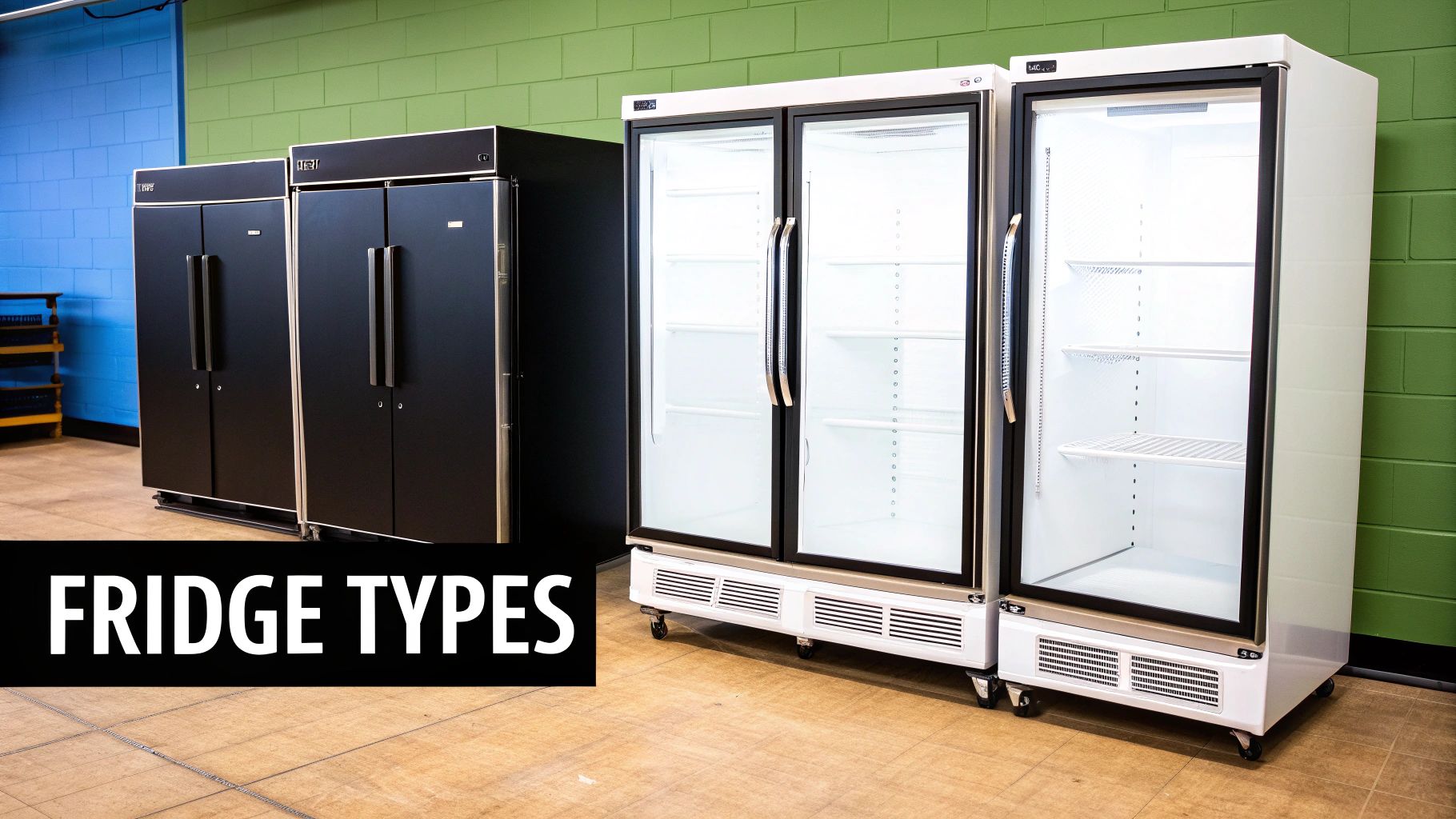
Before you can pick the best commercial fridges for your restaurant, you need to know what you’re looking at. Each style is built for a specific job, and choosing the right one directly impacts your kitchen's flow, how you use your space, and even how much you sell. It all comes down to how you plan to use this crucial restaurant equipment day in and day out.
The market reflects just how critical this equipment is. The global commercial refrigeration industry is booming, expected to hit USD 51.66 billion in 2025 and climb to an eye-popping USD 82.78 billion by 2034. For any sharp operator in Southern California, this just proves that reliable equipment is a cornerstone of a successful business. Making a smart investment now is just good sense for the long haul. You can dive deeper into these commercial refrigeration market trends to see what it means for your operation.
Reach-In Refrigerators: The Kitchen Workhorse
Every commercial kitchen needs a workhorse, and the reach-in refrigerator is it. These are the freestanding vertical units you see in almost every back-of-house, designed for storing ingredients in bulk. They come in a few standard sizes, usually with one, two, or three doors.
- Single-Door Models: Perfect for smaller kitchens or for a specific station that needs its own cold storage. They give you professional-grade cooling without taking up a massive footprint.
- Double and Triple-Door Models: For a high-volume spot like a busy Mexican food restaurant in LA, these are non-negotiable. They offer huge capacity, letting your team organize everything for fast access when the orders start flying.
You’ll also need to decide on compressor location. Top-mounted compressors are a smart choice for hot kitchens because they pull in less dust from the floor and vent hot air up and away. On the flip side, bottom-mounted compressors are easier to get to for maintenance and are a bit more efficient in cooler environments since they don’t have to fight rising heat.
Undercounter and Worktop Fridges: Maximizing Every Inch
When space is tight—think a bustling Los Angeles food truck or the service area of a coffee shop—undercounter and worktop refrigerators are lifesavers. These compact powerhouses slide right under standard countertops, putting cold storage exactly where you need it.
A worktop model takes it a step further by giving you a food-safe stainless steel surface on top, effectively extending your prep area. It’s the perfect setup for assembling sandwiches or plating desserts, keeping everything chilled and within reach to make your line more efficient.
Food Prep Tables: Built for Assembly
Food prep tables are the specialists. They’re a hybrid unit, combining the cold storage of an undercounter fridge with a dedicated prep surface designed for assembly-line style work.
For a high-volume Los Angeles pizza shop, a pizza prep table isn't a luxury; it's the central hub of the entire operation. Its refrigerated rails keep toppings perfectly chilled and organized, while the deep cutting board provides the ideal surface for assembly, directly impacting speed and consistency.
You’ll find them in specific setups, like sandwich/salad prep tables with cutouts for multiple small pans, or pizza prep tables with raised rails built to hold larger containers of cheese, sauce, and pepperoni.
Merchandisers and Bar Coolers: Putting Your Products Front and Center
While most fridges stay in the kitchen, merchandisers and bar coolers are made for your front-of-house. Their job is simple: store products and show them off to drive sales.
- Glass Door Merchandisers: Ideal for showcasing bottled drinks, pre-packaged salads, and other grab-and-go items in a cafe or market. Bright interior lighting and crystal-clear doors are what trigger those impulse buys.
- Back Bar Coolers: These are the low-profile units that fit neatly under the bar. They give bartenders instant access to bottled beers, wine, and mixers, which is crucial for keeping service moving on a busy night.
- Kegerators (Direct-Draw Refrigerators): If you're serving draft beer, a kegerator is essential. It keeps your kegs at the perfect temperature and pressure, ensuring you pour a perfect pint every single time.
Digging Into the Features That Matter
Once you know what type of fridge you need, it's time to get into the nitty-gritty. The spec sheet tells you what a fridge can do, but what really matters is how those features hold up during a chaotic Southern California dinner rush.
Let's cut through the noise and focus on the four pillars that separate a great investment from a future headache for any LA restaurant owner.
Capacity and Footprint
This is the classic kitchen conundrum: balancing how much you need to store with the physical space you actually have. A fridge's capacity (in cubic feet) tells you its internal volume, but the footprint dictates where—or if—it will fit in your kitchen layout.
A high-volume Mexican food spot might dream of a massive three-door reach-in, but can they afford to give up that much floor space? For a Los Angeles food truck operator, every square inch is precious real estate, making a compact undercounter unit that doubles as a prep surface the only smart play.
The real goal isn't just stuffing in as much product as possible; it's about optimizing your kitchen's workflow. A smaller, well-placed fridge is infinitely more valuable than a huge one that creates bottlenecks and gets in your staff's way.
Temperature Control and Compliance
Food safety starts and ends with consistent temperature. Commercial fridges are built to hold a tight range, usually between 33°F and 41°F, even when the doors are swinging open and shut all night. Always look for units with easy-to-read digital thermostats and external displays so your team can monitor temps at a glance.
Here in Los Angeles County, meeting health codes is non-negotiable. Your refrigerator absolutely must be NSF-certified. This seal guarantees it's built with food-safe materials that are a breeze to clean and sanitize—a critical box to check before any health inspection.
Energy Efficiency and Refrigerant Type
Your fridge is always on, running 24/7. That makes it one of the hungriest energy hogs in your entire kitchen. An old, inefficient model can silently siphon hundreds of dollars a year right out of your profits.
To protect your bottom line, look for these two game-changers:
- ENERGY STAR Certification: This isn't just a sticker. It's an independent verification that the unit uses 15-30% less energy than standard models. That’s real money back in your pocket.
- R290 Refrigerant: Modern, high-performance refrigerators have moved to R290 (a pure form of propane). It’s a natural, eco-friendly hydrocarbon that's far more efficient than older refrigerants like R134a or R404a.
Choosing an energy-efficient fridge isn't just about being green; it's a direct investment in lowering your monthly overhead. For a deeper dive, check out our guide on energy-efficient commercial refrigerators.
Durability and Construction
A commercial kitchen is a battlefield. Your equipment has to stand up to constant heat, grease, moisture, and the occasional collision with a prep cart. The build quality of your fridge is the single best predictor of how long it will last.
Stainless steel is the answer, but not all stainless is the same. You want 304-grade stainless steel for the interior and exterior, as it has far better corrosion resistance than the cheaper 430-grade you often see on the back and sides. Also, keep an eye out for practical features like self-closing doors, heavy-duty adjustable shelving, and smooth-rolling casters.
For most busy LA kitchens, a top-mounted compressor is the way to go. In hot, greasy environments—think pizza shops or kitchens with a bank of fryers—top-mount units are less likely to suck in floor dust and gunk that can clog the coils and cause a catastrophic failure.
Commercial Refrigerator Feature Comparison by Use Case
To make this even clearer, here’s a quick table showing how these features line up with the real-world needs of different Southern California foodservice businesses.
| Fridge Type | Ideal For | Typical Capacity | Energy Focus | Key Feature |
|---|---|---|---|---|
| Reach-In | Bulk storage in a Mexican food restaurant | High capacity, large footprint | Top-mount compressor in a hot kitchen | 304-grade stainless steel interior for durability |
| Undercounter | A busy Los Angeles food truck | Low capacity, minimal footprint | ENERGY STAR certified to lower utility bills | Reinforced worktop surface for extra prep space |
| Pizza Prep Table | High-volume Los Angeles pizza shops | Moderate storage, built for a prep line | Insulated lids to hold cold air in | Heavy-duty, easy-to-clean pan rails |
| Glass Door Merchandiser | Cafes displaying grab-and-go items | Varies, focused on visibility | LED lighting to reduce heat and energy use | Double-paned thermal glass doors to maintain temp |
This table helps connect the dots between a feature on a spec sheet and how it will actually benefit your specific operation, whether you’re running a coffee shop in Silver Lake or a bustling taqueria in East LA.
Matching a Fridge to Your Foodservice Model
Knowing the specs is one thing, but seeing how a commercial fridge actually performs in the middle of a chaotic dinner rush is what really counts. A choice that looks great on paper can quickly become a bottleneck in a busy kitchen. Let's move from theory to the real world and look at specific recommendations for different foodservice models you'll find all over Los Angeles and Orange County.
First, here's a quick way to visualize your main priorities—capacity, efficiency, and sheer durability—when you're trying to narrow down your options.
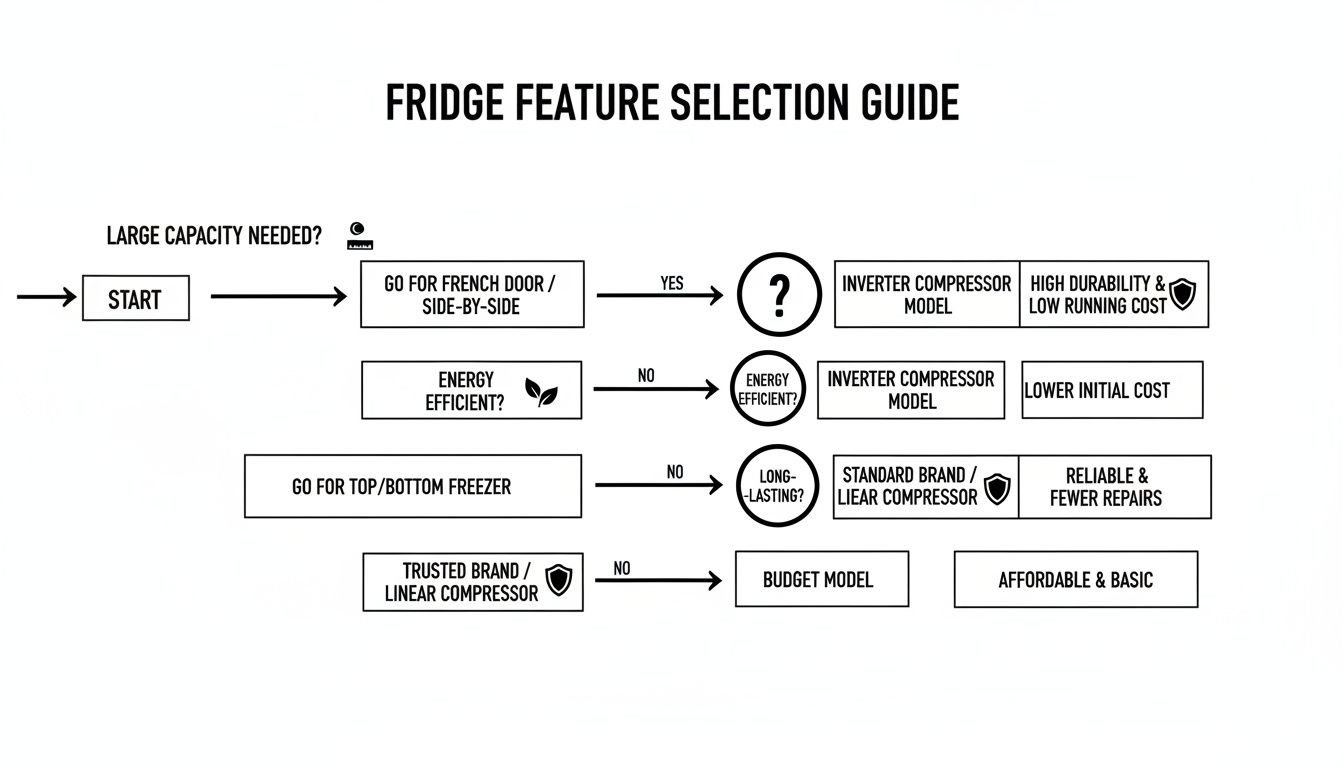
This decision tree drives home a key point: the best choice always starts with your most urgent operational need. Is it about cramming in as much product as possible, keeping that utility bill low, or just knowing your unit can take a beating day in and day out?
The Bustling LA Pizza Shop
For any Los Angeles Pizza joint, the pizza prep table is the heart of the whole operation. This isn't just another refrigerator; it's mission control for your entire assembly line. The trick is to find a model with a deep, refrigerated rail that can hold all your must-have toppings in large pans, keeping everything from pepperoni to peppers perfectly chilled and food-safe during that relentless dinner service.
You'll want to look for features like heavily insulated lids that trap cold air when they're closed, which eases the strain on your compressor and saves on energy costs. A wide, tough cutting board is also non-negotiable—it gives your crew plenty of space to stretch dough and build pies without bumping elbows. The undercounter storage is just as vital for holding backup ingredients and cutting down on time-wasting trips to the walk-in.
The SoCal Food Truck
When your kitchen is on wheels, the rules change completely. For Los Angeles food trucks, your equipment has to be compact, tough, and able to pull double duty. Space is the ultimate luxury here, making undercounter refrigerators and chef bases your smartest bets. A chef base is a game-changer, giving you low-profile refrigerated drawers that also serve as a sturdy stand for your griddle or fryers.
In a mobile kitchen, every piece of equipment must justify its footprint. A durable chef base that can withstand the vibrations of travel while providing immediate access to chilled ingredients is not just a refrigerator—it’s a workflow multiplier.
Durability is everything. You need units with reinforced construction, heavy-duty casters that lock down tight, and compressors built to handle the constant jostling of daily travel. For more help on how to squeeze these workhorses into tight spots, check out our detailed under-counter fridge size guide.
The Independent OC Coffee Shop
An independent coffee shop in Orange County is often pulling double duty as a quick-service beverage bar and a grab-and-go food spot. This means you need a two-part refrigeration strategy. Behind the counter, an undercounter refrigerator is perfect for keeping milk, cream, and syrups right where your baristas need them, no extra steps required.
Out front, a glass door merchandiser is your silent salesperson, essential for driving impulse buys. These units are designed to show off bottled cold brews, juices, and pre-made sandwiches. Make sure to pick a model with bright, energy-efficient LED lighting and anti-fogging glass doors so your products always look fresh and appealing.
The Downtown LA Bar or Brewery
For any bar or brewery in Downtown LA, it’s all about speed and easy access. Your refrigeration setup has to help your bartenders, not slow them down. The essential tools for the job are back bar coolers and direct-draw kegerators.
- Back Bar Coolers: These low-profile units slide right under the bar, giving bartenders instant access to bottled beers, wines, and mixers. Glass door models are great for quickly spotting what you need, while solid door versions offer a slight edge in insulation.
- Direct-Draw Kegerators: If you're serving draft beer, a kegerator is a must-have. It keeps your kegs at the perfect temperature and pressure for a great pour, every single time. Look for models with durable towers and faucets that are simple to clean and maintain.
Understanding the specific rhythm of each business is what separates a good choice from a great one. The sheer variety in the commercial refrigeration market proves there’s no one-size-fits-all solution. Globally, refrigerated display cabinets are a huge market, projected to pull in over USD 66 billion by 2034, but for a food truck operator, that means nothing—they need transportation-grade gear. It just goes to show why making a strategic choice is absolutely crucial for succeeding in the competitive Southern California market.
Calculating the True Cost of Your Equipment
Every restaurant owner in Los Angeles knows the budget is king. It’s easy to get fixated on the upfront price of a new commercial refrigerator, but that sticker price is just the tip of the iceberg. The real pros look past the initial hit to the wallet and calculate the Total Cost of Ownership (TCO). This is what shows you the true financial impact an appliance will have over its entire life in your kitchen.
Thinking about the long game is where the new versus used debate gets really interesting. A second-hand fridge might look like a great deal at first, but it often comes with a laundry list of hidden risks. Those "savings" can disappear in a flash, leaving you with a much bigger bill down the road.
Beyond the Initial Price Tag
The TCO isn't just one number; it's the purchase price plus every dollar you'll spend to keep that machine running day in and day out. Getting a handle on these numbers upfront is the key to making a smart investment that actually supports your business, instead of draining it with surprise expenses.
Here are the big financial factors you need to weigh:
- Operating Costs: This is mostly your electricity bill. An old, inefficient unit is an energy hog, plain and simple, and will drive up your monthly overhead. In contrast, modern, ENERGY STAR certified models running on R290 refrigerant are built from the ground up to keep those costs low.
- Maintenance Expenses: Used equipment is almost always out of warranty, which makes it a huge gamble. One service call for a busted compressor or a refrigerant leak can set you back hundreds of dollars. As the unit gets older, those calls become more and more frequent.
- Downtime Costs: This is the real killer. When your main fridge goes down, you're not just paying for a repair. You're losing thousands in spoiled food, your service grinds to a halt, and your reputation takes a hit.
An unreliable refrigerator is a liability that can bring your entire operation to a halt. The cost of one major failure—in lost product and business—can easily exceed the initial savings of buying a used unit.
New Equipment and Strategic Financing
This is exactly why investing in new, warrantied restaurant equipment from trusted brands like Atosa is almost always the smarter move. A new unit gives you guaranteed performance, top-tier energy efficiency, and reliability straight out of the box. Best of all, it’s backed by a solid warranty that shields you from those gut-wrenching repair bills in its first few years.
Of course, for many independent restaurants and food trucks in Los Angeles, the upfront cost of new equipment can feel like a major hurdle. That’s where smart financing comes in. A good supplier, like LA Restaurant Equipment, will offer flexible financing options that let you get the best commercial fridges for your kitchen with affordable monthly payments.
This strategy lets you hold onto your working capital for other essentials—like payroll, inventory, or marketing—while immediately getting the benefits of a modern, reliable, and energy-efficient refrigerator. By financing, you're investing in the long-term health of your business without a crippling upfront cost. It’s a savvy financial play for any growing foodservice operation.
Why Smart Operators Choose Warehouse-Direct Suppliers
Let's be honest, hunting for the right commercial fridge can be a massive headache. You're trying to juggle quality, your budget, and all the local compliance rules. For any busy operator in Los Angeles, the old way of buying from a showroom just adds extra costs and frustrating delays you don't have time for.
This is exactly why a growing number of savvy restaurant owners, food truck pros, and bar managers are skipping the middleman. They're going straight to warehouse-direct suppliers to get a real competitive edge. It just makes sense—you cut out the high-rent showroom costs and sales commissions that always inflate the final price tag. Sourcing your restaurant equipment directly means you get top-tier, reliable brands like Atosa for a whole lot less. Your money goes into the quality of the machine, not someone else's overhead.
The Warehouse-Direct Advantage
Partnering with a warehouse-direct supplier isn't just about saving a few bucks. It’s about plugging into a system built for the fast-paced, demanding world of the Southern California food scene. This model is designed from the ground up to solve the biggest headaches operators face when buying gear.
- Fast, Free Local Shipping: When a fridge dies, you need a replacement yesterday, not next week. A supplier with a local warehouse can get a new unit to you in Los Angeles or Orange County in just one to two business days, often for free. That means less downtime and less money down the drain.
- Comprehensive Warranties: Buying new equipment with a solid warranty is the best insurance policy you can have. It gives you peace of mind and protects your budget from the nasty surprise of a huge repair bill—something that’s all too common with used or off-brand units.
- Accessible Financing: Any modern supplier worth their salt knows that cash flow is king. Flexible financing lets you get the best commercial fridges without a huge upfront payment, freeing up your cash for inventory, payroll, and actually growing your business.
A Partner for the LA Market
The commercial refrigeration market is blowing up. In the U.S. alone, it's projected to jump from USD 8.3 billion in 2025 to a staggering USD 12.2 billion by 2035. This boom just underscores how critical it is to invest in modern, efficient equipment if you want to keep up.
For anyone running a food business in the fast-moving LA market, finding a supplier who gets the local grind is more important than ever.
Choosing the right equipment supplier is as crucial as choosing the equipment itself. A partner who offers warehouse-direct pricing, fast local delivery, and solid warranties isn't just selling you a fridge; they're providing a solution that strengthens your entire operation.
At the end of the day, working with a warehouse-direct supplier like LA Restaurant Equipment just fits the needs of a modern food business. It's a strategic move that gets you reliable, energy-efficient equipment at a better price, with the speed and support you need to succeed. If you want to dig deeper, you might be interested in our guide on selecting commercial kitchen equipment suppliers. It’s all about making a smart, forward-thinking investment in the future of your kitchen.
Frequently Asked Questions
When you're running a busy restaurant in Los Angeles, you've got enough on your plate without worrying about your refrigeration. But getting the right answers upfront is the key to making a smart investment that won't let you down. Here are a few of the most common questions we hear from local operators.
How Often Does a Commercial Fridge Need Maintenance?
Think of professional maintenance as cheap insurance against a catastrophic failure. While your team should be handling daily and weekly wipe-downs, you absolutely need a pro to look under the hood at least twice a year.
A good technician does the stuff your staff can't:
- Deep Coil Cleaning: They'll scrub the condenser and evaporator coils. When these get caked in grease and dust, your compressor has to work overtime, jacking up your utility bill and leading to burnout.
- Gasket Inspection: They check door seals for tiny tears or hardening. A bad seal is like leaving the door cracked open all day, bleeding cold air and money.
- Refrigerant Check: They make sure the system has the exact right amount of refrigerant. Too little or too much, and it won't cool efficiently.
- Temperature Calibration: They'll confirm your thermostat is telling the truth, ensuring everything is held at a food-safe temperature.
Trust us, paying for proactive service is always less painful than the cost of an emergency repair and a cooler full of spoiled product.
What Are the Key Health Code Requirements for Refrigeration in Los Angeles?
The Los Angeles County Department of Public Health doesn't mess around. The single most important rule is that all your refrigeration equipment must be NSF (National Sanitation Foundation) certified. This is non-negotiable. It’s your guarantee that the unit is built with food-safe materials that are tough and easy to clean properly.
Inspectors will also zero in on temperature. Your fridges have to prove they can consistently keep potentially hazardous foods at 41°F or below. That’s why having a reliable, easy-to-read thermometer on every single unit is an absolute must for passing your inspection.
Is a Top-Mount or Bottom-Mount Compressor Better for My Kitchen?
This one really comes down to your specific kitchen environment. For most hot, hectic LA kitchens—think pizzerias with deck ovens or spots with a long bank of deep fryers—a top-mounted compressor is the way to go. It sits up high, pulling in cleaner, cooler air from above the grease and grime on the floor.
A bottom-mounted compressor, on the other hand, is great for cooler prep areas and is a bit easier for technicians to service since they don't need a ladder. The trade-off is that it can suck in floor dust and debris, meaning you have to be much more diligent about cleaning the coils to keep it from overheating.
For the vast majority of high-volume Los Angeles restaurants, a top-mount compressor is simply the more durable, reliable choice. It's built to handle the unique punishment of a demanding kitchen, requiring less babysitting and giving you more peace of mind.
Ready to find the perfect, reliable refrigeration for your LA business without the retail markup? At LA Restaurant Equipment, we offer a full line of Atosa commercial refrigerators and freezers with fast, free shipping directly from our Southern California warehouse. Explore our collection of the best commercial fridges today!