

Picking the right size for your undercounter fridge is one of those make-or-break decisions for a kitchen's flow. It seriously impacts everything, from how smoothly your cooks move around to what your utility bill looks like at the end of the month.
This isn't just about slotting a metal box into an empty space. It's about designing an efficient workflow, especially when every square inch is prime real estate—think a packed L.A. food truck or a cozy pizza joint. The right restaurant equipment is a game-changer for any Los Angeles establishment, whether it's a bustling pizzeria, a trendy food truck, or an authentic Mexican food spot.
Why the Right Fridge Size Maximizes Your Kitchen Workflow
Getting the fridge size right is like choreographing a dance where every step is perfectly timed for speed. The wrong size is a disaster—it creates traffic jams and forces chefs to waste precious seconds walking back and forth for ingredients.
But the perfect unit? It becomes a silent partner in your kitchen's success. It ensures fresh ingredients are always right where you need them, directly impacting your team's sanity and your bottom line.
A well-chosen fridge, like a workhorse from Atosa, keeps your prep line humming along, whether you’re cranking out orders in a high-volume Mexican restaurant or a quiet neighborhood café. The goal is simple: match the unit's size and capacity to what you’re actually cooking and selling. That’s how a simple appliance becomes a strategic asset.
Integrating a Fridge into Your Kitchen Design
If you're planning a kitchen remodel, this is the time to really nail down your appliance placement. Making sure your undercounter fridges fit perfectly isn't just a detail; it's the foundation of a space that actually works.
It's no surprise that the global undercounter refrigerator market has ballooned to $3.2 billion. That growth is fueled by constant demand from busy commercial kitchens, especially in places like Los Angeles where space is pure gold.
In these major markets, the 5-10 cubic feet capacity units are king, holding nearly 50% of the revenue share. They hit that sweet spot of offering enough storage without eating up your whole prep line—perfect for Atosa undercounter units that keep pizza stations running efficiently.
An optimized fridge isn't just cold storage; it's a productivity tool. By placing refrigeration exactly where it's needed, you eliminate wasted motion, reduce ticket times, and keep your ingredients at peak freshness.
This kind of strategic placement is a core principle of any efficient kitchen layout. To dig deeper into how to set up your space for success, check out our full guide on commercial kitchen layout design—it's packed with tips that work for any foodservice business.
Decoding Standard Undercounter Fridge Dimensions
Getting a handle on standard undercounter fridge dimensions is like learning the basic language of kitchen design. Most of these units are built to slide right under a standard 36-inch high countertop, which is a huge help. It means you can create a seamless, efficient workspace without having to pay for expensive custom-built counters.
These fridges come in a few common widths, and each one is cut out for a different job in a fast-paced kitchen. The real trick is matching the width to the task, whether you're outfitting a Los Angeles food truck or a massive restaurant kitchen.
Common Widths and Their Applications
The width of your fridge is the biggest factor in how much it can hold and how much floor space it’ll eat up. Here’s a quick rundown of the most common sizes you'll see out there:
-
24-Inch Models: These are the compact champs. With a single door, they’re perfect for squeezing into tight spots. Think of one holding milk and creamers at a small café’s coffee station or keeping essential garnishes chilled and ready at a bar.
-
36 to 48-Inch Models: Generally rocking two doors, these are the versatile workhorses of the kitchen. A 48-inch refrigerated base sitting under a griddle is an absolute game-changer for a Mexican food truck, keeping all your meats and cheeses right where you need them.
-
60 to 72-Inch Models: When you need serious capacity for a high-volume spot, these are your go-to. A 72-inch, three-door prep table is pretty much non-negotiable for a busy Los Angeles pizzeria, giving you plenty of room for every topping you can imagine.
Width gets a lot of the attention, but don't forget about depth. It's what makes the difference between a clean, flush installation and a unit that sticks out awkwardly. Most undercounter refrigerators have a depth around 24 to 25 inches, letting them line up perfectly with standard cabinets. No tripping hazards, just a clean line.
This is more than just fitting into a space; it's about building an efficient system from the ground up.
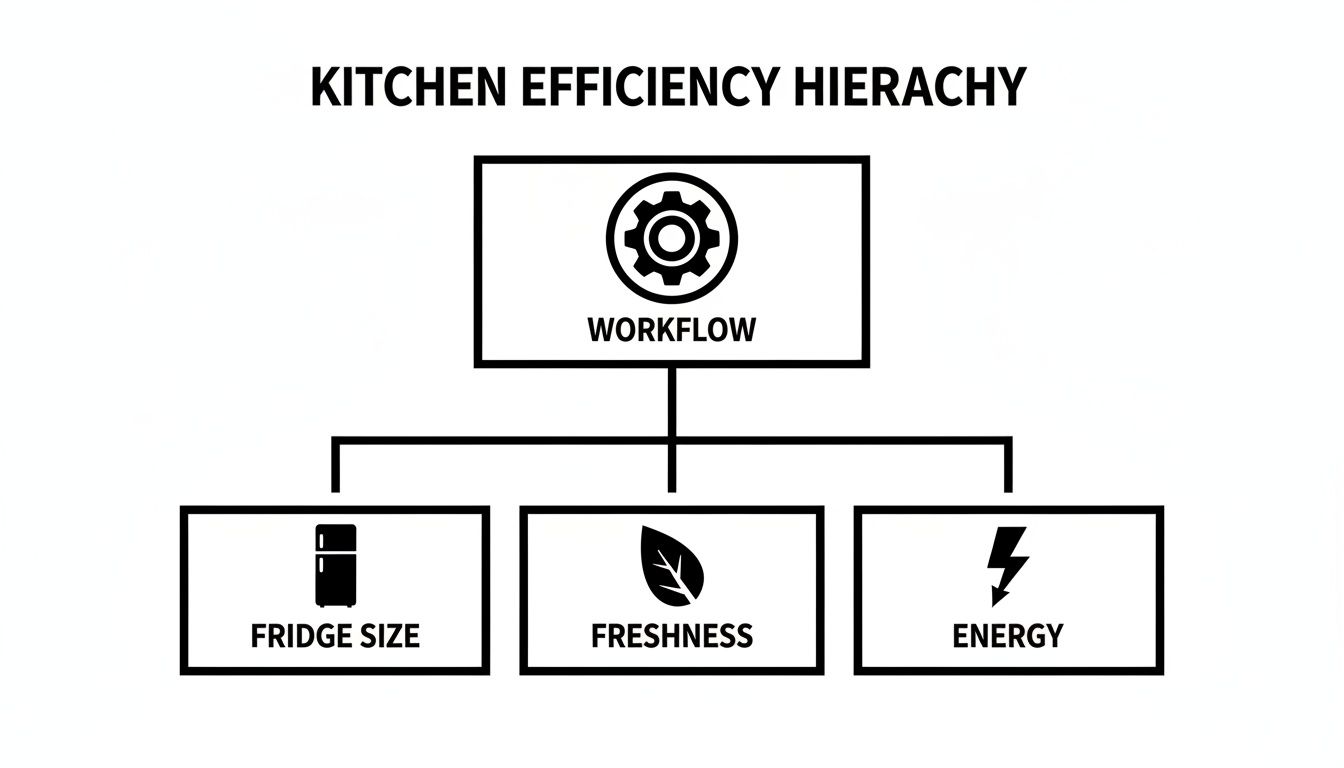
As you can see, getting the fridge size right is the foundation. A smart choice improves your workflow, which keeps ingredients fresher and even helps manage energy costs.
The Most Popular Size for Commercial Kitchens
While the big guys have their place, it’s the 24-inch wide undercounter refrigerator that really rules the roost. It absolutely dominates sales in commercial kitchens all over the world. This is especially true in foodservice hubs like the U.S. West Coast, where LA cafes and sandwich shops live and die by their efficiency.
Their standard depth, usually right around 24 inches, creates that perfect flush fit with the cabinetry—it’s a design dream for pop-up vendors in Southern California trying to make every square inch count. For bar managers in LA nightclubs, the 15, 18, and 24-inch widths offer some nice options, but the 24-inch is the sweet spot for everything from kegerators to back bar coolers.
The goal is to choose a size that minimizes steps for your staff. If a chef has to walk across the kitchen for a common ingredient, you've lost a battle in the war for efficiency.
Knowing these standard dimensions gives you the confidence to measure your space and pick a unit that doesn't just fit physically, but slots perfectly into your kitchen's rhythm. It's the first step to building a more productive—and profitable—operation. You can learn more about how different undercounter refrigerator sizes fit various commercial needs to find the perfect match for your business.
Common Undercounter Fridge Sizes at a Glance
To make things even easier, here’s a quick-reference chart. Think of it as your cheat sheet for matching the right size fridge to the right job in your kitchen.
| Width | Typical Doors | Cubic Feet (Approx.) | Best For |
|---|---|---|---|
| 24 inches | 1 | 5-7 cu. ft. | Bar stations, coffee shops, small prep areas, single-task storage. |
| 36 inches | 2 | 9-12 cu. ft. | Smaller prep lines, salad stations, under-grill storage for moderate use. |
| 48 inches | 2 | 12-16 cu. ft. | The all-rounder for most prep tables, chef bases, and high-use stations. |
| 60 inches | 2 | 16-20 cu. ft. | Busy sandwich or pizza prep lines needing more ingredient storage. |
| 72 inches | 3 | 20-25 cu. ft. | High-volume kitchens, large pizzerias, centralized prep areas. |
| 93+ inches | 3-4 | 28+ cu. ft. | Mega prep lines, large-scale catering operations, institutional kitchens. |
This table helps you visualize how a few inches in width can dramatically change a unit's capacity and ideal use case, ensuring you pick the perfect fit for your workflow.
How to Measure Your Space for a Perfect Fit
Getting your measurements wrong is one of the most frustrating—and expensive—mistakes you can make. It’s the classic carpenter's rule: "measure twice, cut once." A few minutes with a tape measure now will save you a world of hurt later, ensuring your new undercounter fridge slides right into place without any last-minute drama.
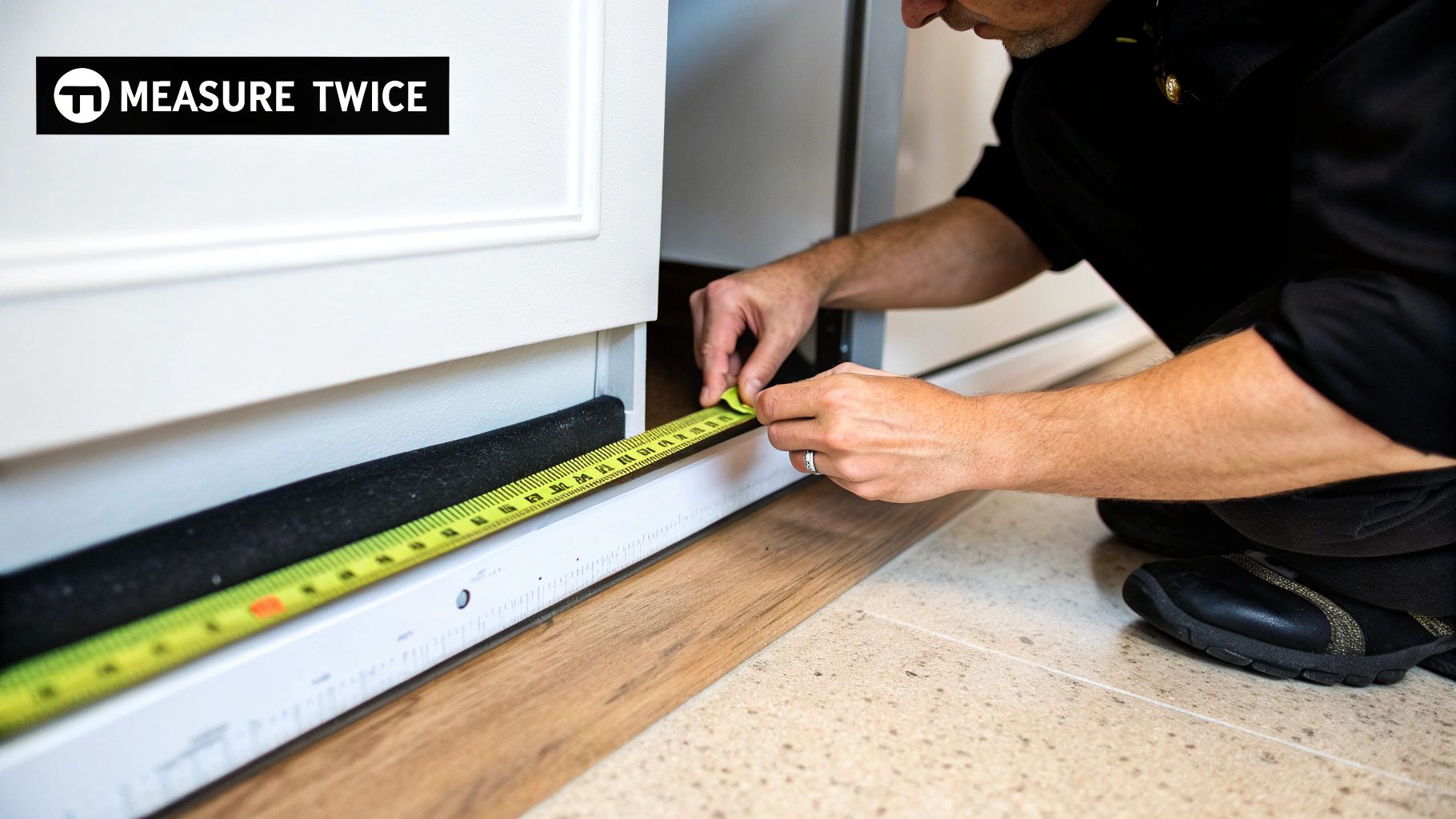
Follow this simple process, and you’ll guarantee a perfect fit, even with the funky quirks every commercial space seems to have.
The Triple-Check Measurement Method
Let’s be honest, commercial floors are rarely perfectly level, and cabinets are almost never perfectly square. Trusting a single measurement is just asking for trouble. To get the real story of your available space, you need to check three dimensions at three different points.
- Width: Measure the horizontal gap from left to right. Do this at the top, middle, and bottom of the opening.
- Height: Measure the vertical space from the floor to the bottom of the counter. Check this on the left, center, and right sides.
- Depth: Measure from the back wall to the front edge of your cabinetry. Be sure to check this on both the left and right sides.
Once you have all your numbers, take the smallest measurement for each dimension (width, height, and depth). That smallest number is your true workable space. It’s your safety net, making sure the unit won't get hung up on a high spot on the floor or a bowed-in cabinet wall.
The Crucial "Breathing Room" Rule
Here’s the step everyone forgets: ventilation. That refrigerator compressor is a workhorse, and it throws off a lot of heat that needs somewhere to go. If you cram the unit in without any airflow, you're essentially suffocating it. This leads to overheating, poor cooling, and a drastically shorter lifespan for your equipment.
Always leave 1 to 3 inches of clearance around the back and sides of the unit for air circulation. This one simple step keeps the compressor from overworking, cuts down on your energy bill, and saves you a fortune on future repair calls.
Now, some front-venting models are specifically designed for a tight, zero-clearance fit. But you absolutely must confirm this in the manufacturer’s spec sheet before buying. If you're ever in doubt, just leave the gap.
One last thing—don't forget about the delivery path. Measure the width of every doorway, hallway, and tight corner the fridge has to navigate to get into your kitchen. The most perfectly sized unit in the world is useless if you can't get it through the door.
Matching Fridge Type and Size to Your Menu
Alright, let's connect the dots between the tape measure and the daily grind. Picking the right undercounter fridge isn’t just about finding a unit that slots into an empty space. It’s about choosing a piece of restaurant equipment that will actually speed up your workflow and make your menu sing.
Think of your fridge less like a cold box and more like a highly specialized member of your kitchen crew. Get the right one, and you’ll see efficiency go up, food waste go down, and your team’s stress levels drop. The wrong one? It just creates bottlenecks and headaches. Let's break down how this works in real-world kitchens across Los Angeles.
For High-Volume Prep and Pizzerias
A busy L.A. pizzeria lives and dies by its prep line. In this world, a 72-inch refrigerated prep table is an absolute non-negotiable. This beast gives you a massive, chilled surface area to keep dozens of toppings—pepperoni, mushrooms, cheese, you name it—right where your cooks need them. For Los Angeles pizza restaurants, this piece of equipment is essential for assembling pizzas fast without losing consistency.
It's the same story for a bustling sandwich shop or salad bar. A 60-inch or 72-inch worktop refrigerator is your best friend. You get tons of cold storage underneath and a tough stainless steel work surface on top. This setup streamlines the entire process, letting your team build orders right on the unit, pulling ingredients directly from below.
For Food Trucks and Specialty Lines
In a food truck, every inch counts. For a truck slinging authentic Mexican food, a 48-inch refrigerated chef base tucked right under the griddle is a total game-changer. It keeps your meats, cheeses, and salsas perfectly chilled and literally at the chef’s fingertips. For Los Angeles food trucks, this efficiency is key to cutting out wasted movement during a chaotic lunch rush.
The goal is to create "stations" where everything a chef needs is within arm's reach. A chef base turns the cooking area into a self-sufficient powerhouse, dramatically speeding up ticket times.
This idea applies to any specialized station you can dream up. When you match the equipment to the menu, you create a kitchen that just flows better. Getting this right is a huge deal, and you can dive deeper into the options in our guide to finding the best commercial refrigerator for your kitchen's unique needs.
For Bars and Customer-Facing Areas
It's not all about the back of the house, either. For a craft beer bar or a hip café, presentation is just as important as preparation. A slick, compact 24-inch glass door back bar cooler is the perfect tool for showing off your selection of bottled beers, canned wines, or artisanal sodas.
The glass door acts as a silent salesperson, letting customers see what’s on offer, which can give your sales a nice little bump. At the same time, it lets bartenders grab what they need in a flash without constantly opening a solid door and hunting around. This specific size is designed for both looks and function.
There's a reason the commercial undercounter refrigeration market is booming—it reached USD 11,402.25 million and is projected to hit USD 15,014.58 million by 2032. The most popular 5-10 cubic feet models are king, making up 50% of the revenue because they're the perfect fit for high-volume spots from commissaries to pizza stations. For operators in Orange County and LA, this means reliable, energy-efficient Atosa units, stocked for chef bases and merchandisers, are delivering smart features like remote monitoring to cut downtime in fast-paced kitchens. You can find more insights on the commercial refrigeration market on Credence Research.
Key Features to Consider Beyond Dimensions
Once you've nailed down the perfect under counter fridge size for your layout, it’s time to get into the details. These are the features that really separate a good piece of equipment from a great one—impacting everything from your energy bills to how smoothly your team moves during a frantic dinner rush.
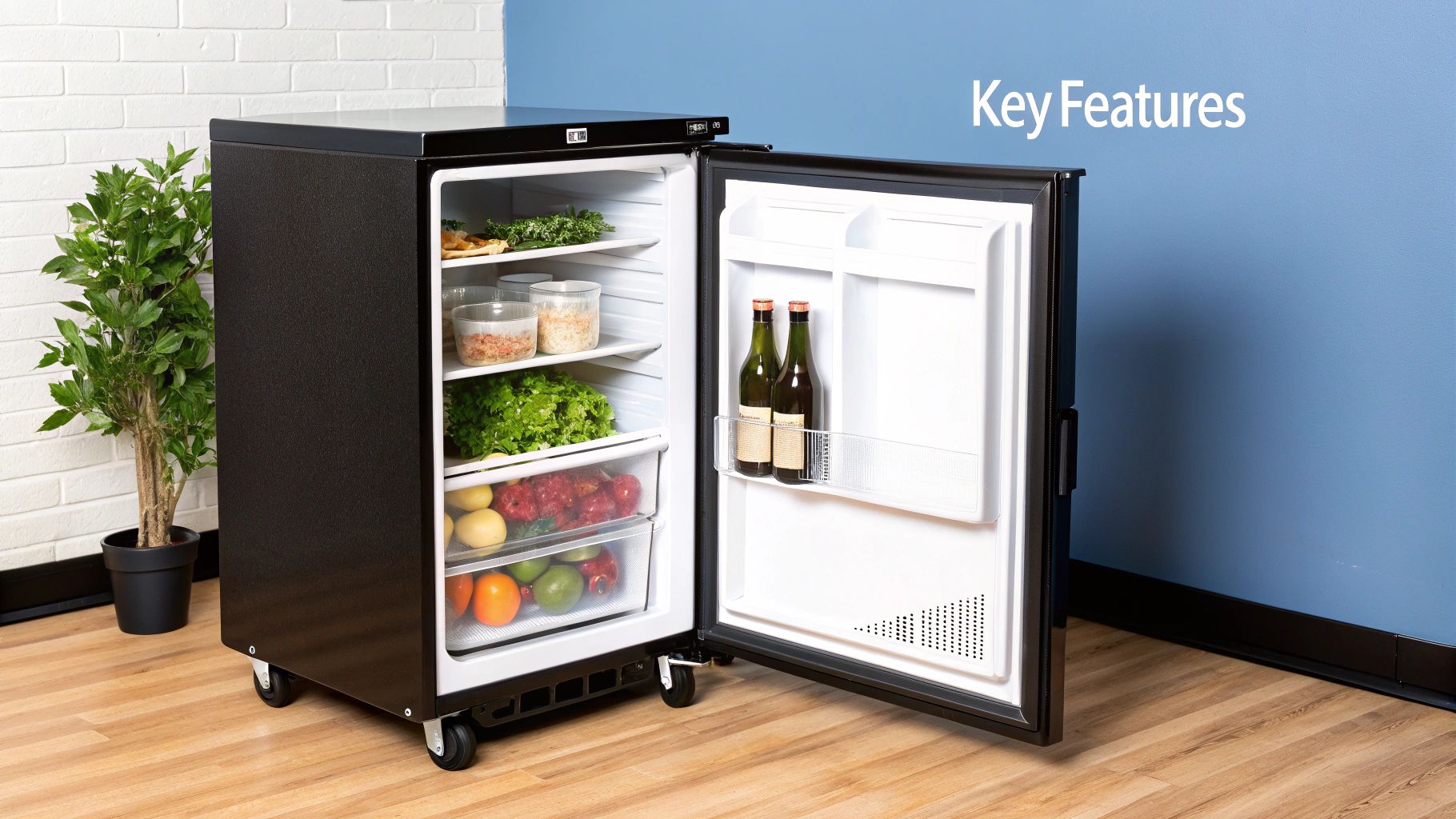
Getting these choices right ensures your new fridge becomes a long-term asset, not a short-term headache.
Ventilation Front and Center
One of the most critical things to check is how the refrigerator breathes. This is all about its ventilation style, which flat-out dictates where you can install it.
-
Front-Venting Models: These are the champs for any built-in setup. They pull air in and push it out through grilles right on the front. This means you can slide them in completely flush with your cabinets without ever worrying about them overheating.
-
Rear-Venting Models: These units need some "breathing room," usually at least a few inches of open space at the back and on the sides. They’re fine for freestanding use but will burn out fast if you box them in without proper airflow.
Choosing a front-venting model is absolutely essential if you want that clean, integrated look under your counters. It allows for a zero-clearance installation, which maximizes your space while protecting the compressor from cooking itself.
Ignoring this is a costly mistake. Forcing a rear-venting unit into a tight, enclosed space will lead to an overworked compressor, sky-high energy bills, and a much, much shorter lifespan for your investment.
Doors, Drawers, or Glass?
The setup of your undercounter fridge should directly match its job in your kitchen. Each style has its own perks, whether you're outfitting a Los Angeles food truck or a high-end restaurant bar.
Solid Doors
Solid stainless steel doors are the workhorses when it comes to energy efficiency. They offer the best insulation, which helps keep internal temperatures rock-steady and your utility costs down. This makes them the go-to for general back-of-house storage where you don't need to show off the contents.
Glass Doors
Perfect for bars and any customer-facing spot, glass doors turn your inventory into a merchandising opportunity. Staff can spot what they need in a second without opening the door, which keeps the cold air in and reduces temperature swings. For any Southern California bar, a glass door back bar cooler is a must for showing off craft beers and chilled wines.
Drawers
For a fast-paced prep line, drawers are a total game-changer. They give you organized, ergonomic access to ingredients that are often stored in standard food pans. Picture a chef at a busy Mexican restaurant working the griddle—they can pull open a drawer and grab prepped ingredients in one smooth motion, which massively speeds up ticket times.
Durability and Convenience Features
Finally, it’s the little things that make life easier day in and day out. Look for caster wheels—they're a non-negotiable feature that lets you easily roll the unit out for deep cleaning.
Also, pay attention to the grade of the stainless steel. A higher grade means better resistance to rust and corrosion, which is a big deal in the demanding, humid environment of a commercial kitchen. These practical details are what truly separate a standard fridge from a professional-grade tool built to last.
Your Questions About Undercounter Fridges Answered
Choosing the right undercounter fridge for your spot brings up a ton of practical questions. We get it. Let’s walk through some of the most common concerns we hear from restaurant owners in Los Angeles, so you can lock in your decision with complete confidence.
How Much Clearance Does an Undercounter Fridge Need?
Think of it as giving your fridge some "breathing room." Most commercial models need about 1 to 3 inches of clearance on the sides and back for proper airflow. This space is crucial—it keeps the compressor from working overtime and overheating, which saves you money on energy bills and helps the unit last longer.
The one exception? Front-venting units. These are specifically designed for a snug, built-in fit and usually don't need that extra side or back space. But always, always double-check the manufacturer's spec sheet before you commit.
Can I Use a Residential Fridge in My Restaurant?
In a word: no. We strongly advise against it. Commercial units are built like tanks, with heavy-duty materials and powerful compressors designed to handle the chaos and heat of a professional kitchen.
A residential fridge just can't keep up. It will struggle to hold safe food temperatures during a busy service, putting you at risk for health code violations. Plus, using it in a commercial setting will almost certainly void its warranty.
Wondering about worktop fridges or chef bases? The main difference is the top surface. A worktop model has a reinforced steel top and a backsplash, turning it into a solid prep station. A chef base is even tougher, built to hold heavy-duty cooking equipment like charbroilers or griddles right on top.
Should I Choose Doors or Drawers?
This one comes down to your kitchen's workflow. There’s no single right answer, just what’s right for you.
- Doors are your go-to for general-purpose cooling. They offer flexible storage for all sorts of containers, bottles, and miscellaneous items.
- Drawers are a game-changer for high-volume prep stations. They give you quick, organized access to ingredients neatly arranged in food pans, shaving seconds off every order.
By the way, if your new unit starts making some funky sounds, it could be a sign of poor ventilation or another simple issue. For a deeper dive, check out our guide on what to do when your fridge is making a loud noise.
Ready to find the perfect undercounter fridge for your Los Angeles business? Explore our full selection of new, warranty-backed equipment at LA Restaurant Equipment. Get warehouse-direct pricing and fast, free shipping across Southern California. Visit us at https://larestaurantequipment.com to find the right fit today.