

Finding the best commercial freezers for your kitchen isn't about picking the most expensive or largest model. It’s about matching the right tool to the right job. The main players are the versatile reach-in freezers for daily line access, compact undercounter models for tight spaces, high-capacity chest freezers for deep storage, and massive walk-in units for high-volume operations. Your perfect freezer hinges entirely on your kitchen's footprint, workflow, and the amount of product you need to keep frozen.
Your Guide to Choosing the Right Commercial Freezer
For any food business in Los Angeles, picking a commercial freezer is one of the most critical decisions you'll make. It doesn't matter if you're running a packed Mexican restaurant in East LA, a legendary Los Angeles Pizza joint in the Valley, or one of the many nimble Los Angeles Food Trucks hitting the Westside—the right freezer is your inventory's lifeline. It's what ensures food safety and keeps your kitchen humming. The wrong one can mean spoiled product and a slammed-shut service window, while one that’s too big is just a drain on space and electricity.
Making a smart call starts with knowing your options and how they fit into a real-world kitchen. This is about more than just cubic feet; it’s about how the restaurant equipment’s design works with your daily grind. A frantic dinner rush demands a freezer that chefs can get in and out of quickly. A food truck, on the other hand, needs a compact unit that makes every single inch count. When you're making a big investment like this, using a structured Cost Benefit Analysis Template can take the guesswork out of comparing your options.
Finding the Best Freezer for Your LA Business
The journey to the right freezer gets a lot easier when you ask two simple questions: How much floor space can I spare, and how often will my crew need to get inside? This simple decision tree is the perfect starting point for any restaurant owner trying to figure that out.
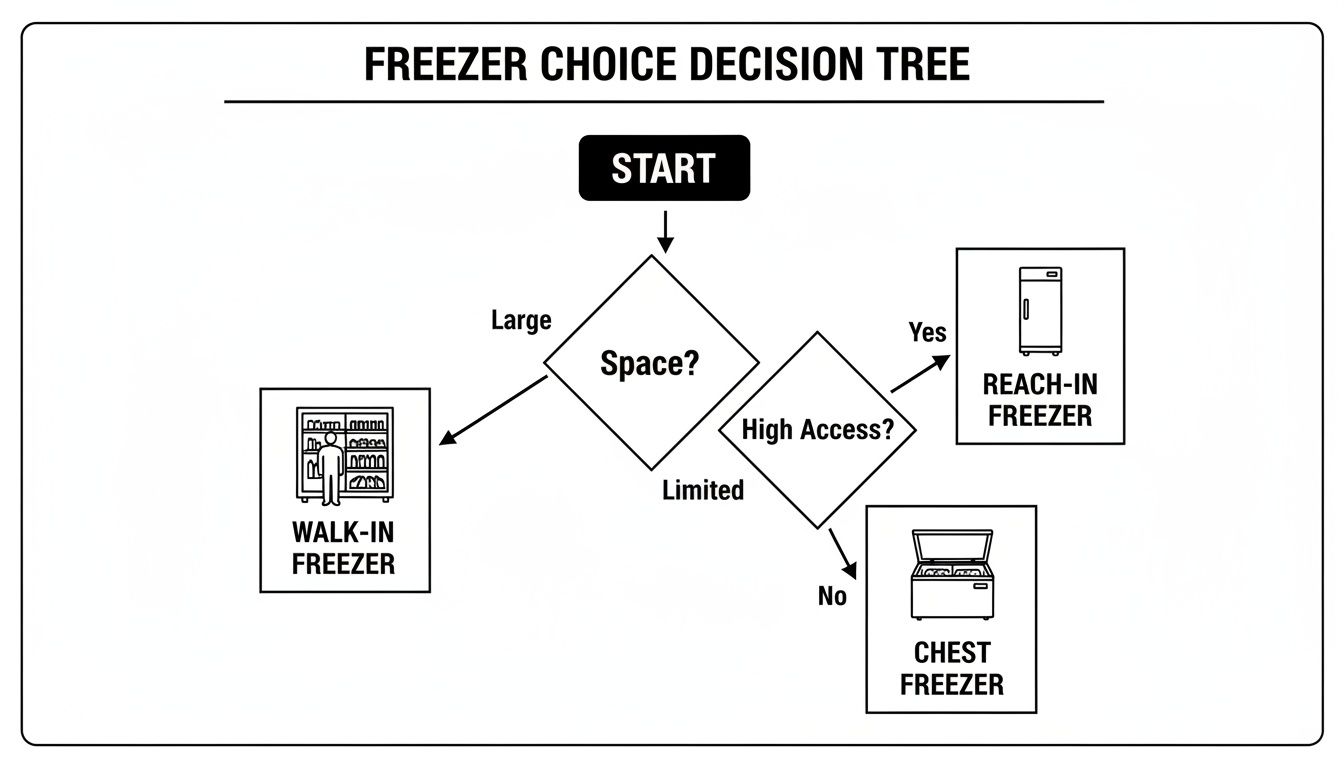
As you can see, if you've got plenty of room, a walk-in is a no-brainer. But for tighter kitchens, the choice comes down to a reach-in for constant access or a chest freezer for long-term storage.
To give you an even clearer picture, here’s a quick-glance table breaking down the four main types of commercial freezers.
Commercial Freezer Quick Selection Guide
| Freezer Type | Best For | Typical Capacity (Cubic Ft) | Pros | Cons |
|---|---|---|---|---|
| Reach-In | Busy kitchens, frequent access to ingredients | 20 - 70 | Vertical design, easy organization, quick access | Smaller capacity, higher energy use per cubic foot |
| Undercounter | Bars, food trucks, prep stations, small kitchens | 2 - 12 | Space-saving, fits under counters, point-of-use storage | Limited capacity, not ideal for bulk storage |
| Chest | Bulk storage, long-term freezing, less-used items | 5 - 40 | High capacity, energy-efficient, great for oversized items | Takes up floor space, hard to organize, "first-in, last-out" access |
| Walk-In | High-volume restaurants, caterers, large inventory | 100+ | Massive storage capacity, can store palletized goods | Requires significant space, higher upfront cost, complex installation |
This table should help you quickly narrow down which freezer type aligns with your operational needs. Remember to balance the pros and cons against your daily workflow.
Key Takeaway: The "best" freezer isn't one specific brand or model. It's the one that seamlessly fits your business's physical space, your menu's demands, and the pace of your service. A mismatch here will absolutely create headaches and drive up your operating costs.
A Practical Guide to Commercial Freezer Types
Picking the right commercial freezer isn't just about finding something that gets cold. It's more like casting the perfect actor for a role—each one is built for a specific job in your kitchen's daily drama. If you think beyond a simple feature list and really understand how each unit works in a real-world LA kitchen, you'll save yourself a ton of headaches down the road.
A freezer is more than a cold box; it’s a core piece of your restaurant equipment that dictates how smoothly your team operates.
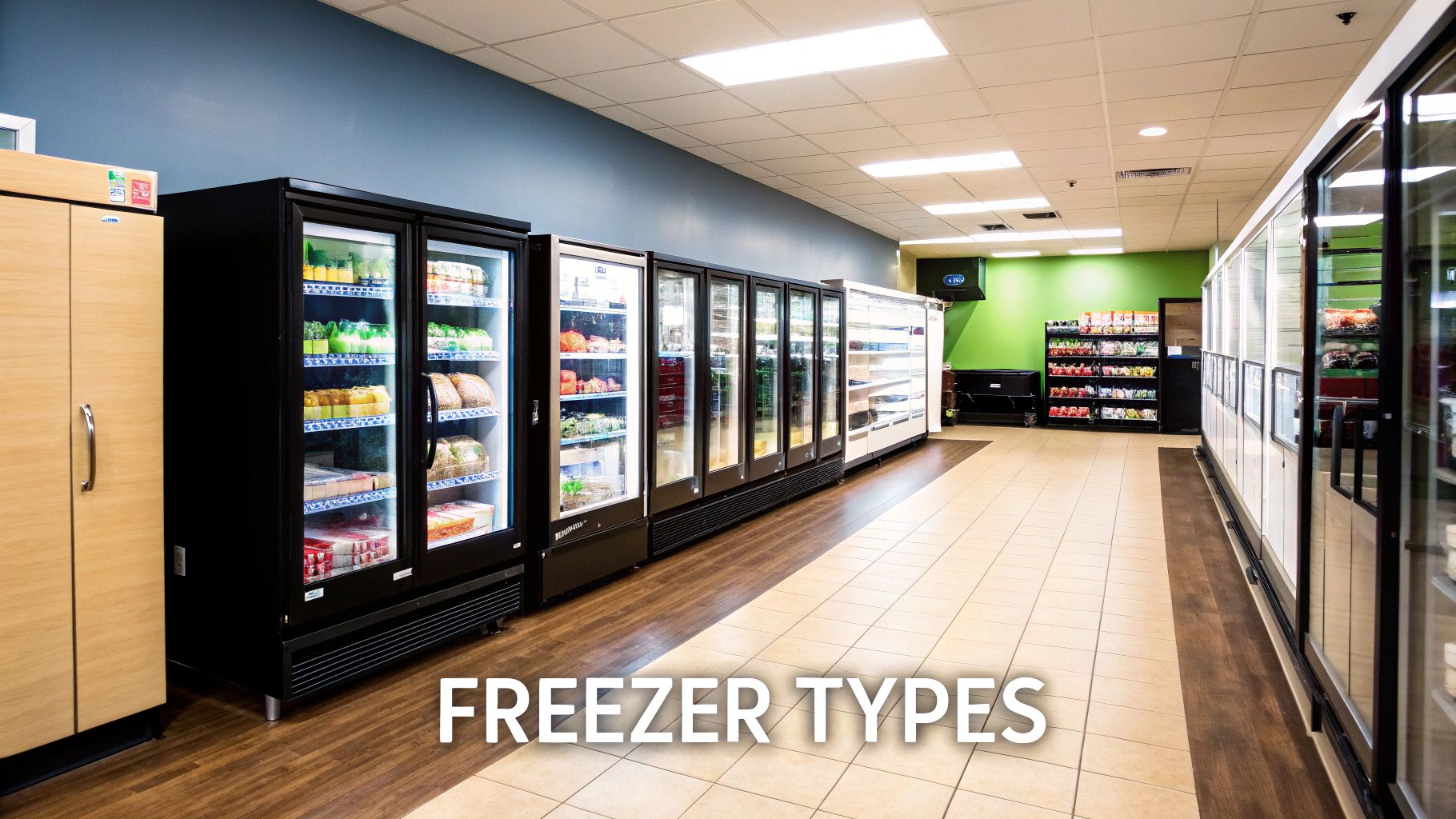
Let's break down the main players, using some simple analogies to show you exactly how they'd fit into your own operation, whether you're slinging tacos from a food truck or running a high-volume Mexican Food spot.
Reach-In Freezers: The Kitchen Command Center
Think of a reach-in freezer as your kitchen's command center. It's the upright, organized hub where your line cooks grab what they need in the middle of a chaotic dinner rush. For a slammed Los Angeles Pizza spot, this is where you keep the pre-portioned dough, cheese, and toppings for lightning-fast access.
Its vertical layout with adjustable shelves makes organization a breeze. Everything is at eye level, so your staff isn't wasting precious seconds digging around for that one specific ingredient. This is the freezer built for speed and constant use.
Undercounter Freezers: The Chef's Personal Toolkit
An undercounter freezer is like a chef's personal toolkit. It tucks neatly under a prep station or countertop, keeping essential, high-use ingredients right where they're needed most. This design is a lifesaver for kitchens tight on space, like one of the many gourmet Los Angeles Food Trucks or a packed bar.
Imagine a grill cook grabbing frozen burger patties without ever having to leave their station. That’s the magic of an undercounter unit—it cuts down on unnecessary movement, streamlines the workflow, and makes every square inch of your kitchen count.
Expert Tip: Tuck undercounter freezers into key prep stations to create self-contained work zones. This simple layout trick can dramatically reduce foot traffic and chaos in a tight kitchen, boosting both speed and safety.
Chest Freezers: The Deep Storage Vault
If a reach-in is for daily grabs, a chest freezer is your deep storage vault. It's the go-to for bulk items you don't need to access multiple times a day. For a Mexican Food restaurant, this is where you’d stash big boxes of frozen tortillas, bulk meats, or bags of chiles.
Chest freezers are incredibly energy-efficient because cold air is heavy and doesn't spill out when you open the lid. While their "first-in, last-out" nature isn't great for rotating daily inventory, they are unbeatable for cost-effective, long-term storage of your staple goods. You can check out a variety of commercial freezer options to see which models are best suited for this bulk storage role.
Walk-In Freezers: The Inventory Warehouse
Finally, there’s the walk-in freezer—the undisputed warehouse of the commercial kitchen. These are built for high-volume operations like large restaurants, caterers, or commissaries that handle inventory on a massive scale. This is where you store entire pallets of frozen goods before they get moved to the smaller, day-use freezers.
A walk-in is a serious investment in capacity, but it allows you to buy ingredients in bulk at better prices and manage a deep, diverse inventory with total ease.
Specialty Units: The Blast Freezer
Beyond the big four, you’ll find specialty restaurant equipment built for specific tasks. A blast freezer, for instance, does one thing exceptionally well: it freezes food fast. Instead of slowly lowering the temperature, it uses powerful fans to blast frigid air over the food, freezing it in a fraction of the time.
This rapid process creates smaller ice crystals, which is critical for preserving the texture and flavor of delicate items like pastries, seafood, or fresh-made pasta. For a high-end restaurant obsessed with quality, this can be a true game-changer. The demand for this technology is growing fast, with the global market expected to hit $857.2 million in 2025 and projected to soar past $1.3 billion by 2035, all thanks to tougher food safety rules and the demand for top-tier preservation. You can read more about the growth of this technology and its impact on the foodservice industry.
How To Calculate Your Freezer Capacity Needs
Picking the wrong size freezer is one of the easiest—and most expensive—mistakes you can make in the restaurant business. Go too big, and you're just paying to cool empty air. But go too small, and you’re looking at lost inventory, wasted product, and absolute chaos during a weekend rush.
The real trick is to stop thinking in generic cubic feet and start thinking about your kitchen's actual flow of inventory.
Every single business in Los Angeles is different. A high-volume Los Angeles Pizza joint needs a massive amount of space for cases of cheese and stacks of dough. One of the many Los Angeles Food Trucks, on the other hand, has to make every single inch count for a tightly curated menu. It's all about matching the freezer's capacity to the rhythm of your operation.
A Simple Formula For Sizing Your Freezer
To nail down your ideal capacity, you really just need to know two things: how much product you burn through and how often you get deliveries. Getting this right stops you from overbuying or, even worse, 86-ing a key ingredient in the middle of a dinner service.
Here’s a straightforward formula you can adapt for your kitchen:
(Total Weekly Frozen Inventory ÷ Number of Deliveries Per Week) + 20% Safety Stock = Your Ideal Freezer Capacity
This simple calculation gives you enough room to hold everything you need between deliveries, plus a 20% buffer for those unexpectedly slammed nights or a supplier delay. Think of that safety stock as your insurance policy. It's what saves you when a delivery truck breaks down or you get a surprise Friday night rush.
Putting The Formula Into Practice
Let's see how this plays out for a couple of different LA food businesses. The right calculation ensures you’re shopping for the best commercial freezers for your kitchen, not someone else's.
1. Los Angeles Food Trucks Example:
- Weekly Inventory: They need about 10 cubic feet of space for specialty frozen items.
- Delivery Frequency: They get 2 small drops per week to manage their tiny footprint.
- Calculation: (10 cubic feet / 2 deliveries) = 5 cubic feet.
- Add Safety Stock: 5 cubic feet + 20% (1 cubic foot) = 6 cubic feet.
- The Verdict: A compact undercounter freezer is the perfect fit here.
2. Busy Mexican Food Restaurant Example:
- Weekly Inventory: This place flies through 150 cubic feet of bulk meat, tortillas, and produce.
- Delivery Frequency: They get one massive delivery per week to lock in better pricing.
- Calculation: (150 cubic feet / 1 delivery) = 150 cubic feet.
- Add Safety Stock: 150 cubic feet + 20% (30 cubic feet) = 180 cubic feet.
- The Verdict: This operation absolutely needs a spacious walk-in freezer. No question.
Dont Forget Your Kitchen Layout
Finally, don't forget the physical space you're working with. Before you even think about buying, get out the tape measure and check your doorways and hallways.
You also need to account for door swing clearance—make sure there’s enough room for the freezer door to open all the way without blocking a busy walkway. A perfectly sized freezer is totally useless if you can’t get it into the building or open it properly during service. A little planning here ensures your new restaurant equipment works with your space, not against it.
Understanding Energy Efficiency And Lifetime Costs
Don't just look at the sticker price—that’s only the beginning of the story. The real cost of a commercial freezer shows up month after month on your utility bill. Here in Los Angeles, where every dollar of overhead counts, understanding the long-term operating expense isn't just a good idea; it's how you make a smart investment.
An older, used freezer might look like a steal upfront, but it can be a wolf in sheep’s clothing. Those old models quietly guzzle electricity, draining your profits without you even noticing. Thinking about energy efficiency isn't just about being green—it's a core financial strategy for any restaurant, bar, or food truck that wants to stick around.
Translating ENERGY STAR Ratings Into Real Dollars
That little blue ENERGY STAR sticker isn't just for show. It's a guarantee of lower operating costs. These units are built from the ground up to do the exact same job while using way less power. If you want a clear sign you're picking one of the best commercial freezers for your bottom line, look for that certification.
Think of it like buying a car. One might be cheaper to buy, but if it gets terrible gas mileage, you'll pay for it every time you go to the pump. A commercial freezer runs 24/7, 365 days a year, so its "fuel" efficiency is one of the most important features it has.
How Modern Freezers Slash Operating Costs
Modern freezers aren't just slightly better; they use smart technology to stop energy waste in its tracks. These are major design upgrades that add up to real savings.
- Advanced Compressors: New compressors are smaller, more efficient, and only run when they absolutely have to. This is a huge change from old units that seemed to run constantly, racking up your bill.
- Superior Insulation: High-density polyurethane foam locks the cold air in tight. The freezer doesn't have to work as hard to stay cold, which saves energy and reduces wear and tear on the machinery.
- LED Lighting: Old fluorescent bulbs get hot and use a ton of energy. Modern LEDs are bright, use a fraction of the power, and stay cool, so your compressor doesn't have to fight against the heat from its own lights.
New vs. Used Freezer Cost Analysis Over 5 Years
Let's break down how the costs stack up over time. While a used freezer has a lower initial price, the energy savings from a new unit often close that gap faster than you'd think.
| Cost Factor | New Energy-Efficient Freezer (Est.) | Used Standard Freezer (Est.) |
|---|---|---|
| Initial Purchase Price | $3,500 | $1,500 |
| Annual Energy Cost | $450 | $900 |
| Potential Repairs (Years 1-5) | $200 (under warranty for part) | $1,200 |
| Total 5-Year Cost | $6,250 | $7,200 |
As you can see, the initial "bargain" of the used freezer disappears over time. By year five, the new, efficient model has not only paid for its higher price tag but is actually the cheaper option overall, and it will continue to save you money for the rest of its life.
The Long-Term Financial Win
Putting your money into an energy-efficient freezer is a long game that pays for itself. You might spend a bit more today, but you'll often make that money back within a few years just from the savings on your utility bills. After that, all the money you save goes straight into your pocket.
For a new Los Angeles food truck or a local restaurant just getting started, keeping fixed costs low is the key to survival. Your freezer is going to be one of the hardest-working pieces of restaurant equipment in your kitchen—make sure it's working for you, not against you.
By prioritizing energy efficiency, you are not just buying a freezer; you are investing in a more profitable and sustainable business model. The savings compound over the unit's lifespan, delivering a powerful return on your initial investment.
For a deeper dive into how these principles apply to cooling, check out our guide on choosing energy-efficient commercial refrigerators in our blog. A smart choice here ensures your equipment works for you, not against you, for years to come.
Key Features That Boost Kitchen Efficiency
A commercial freezer does more than just keep things cold. The best units are packed with smart features designed to make a demanding kitchen run like a well-oiled machine. These aren't just bells and whistles; they're practical tools that save time, cut down on labor, and protect your expensive inventory.
For any busy Los Angeles restaurant, choosing the right features can be the difference between a chaotic service and a seamless one. When you understand what to look for, you can pick a unit that works as hard as your team does, turning a simple appliance into a cornerstone of your kitchen's efficiency.
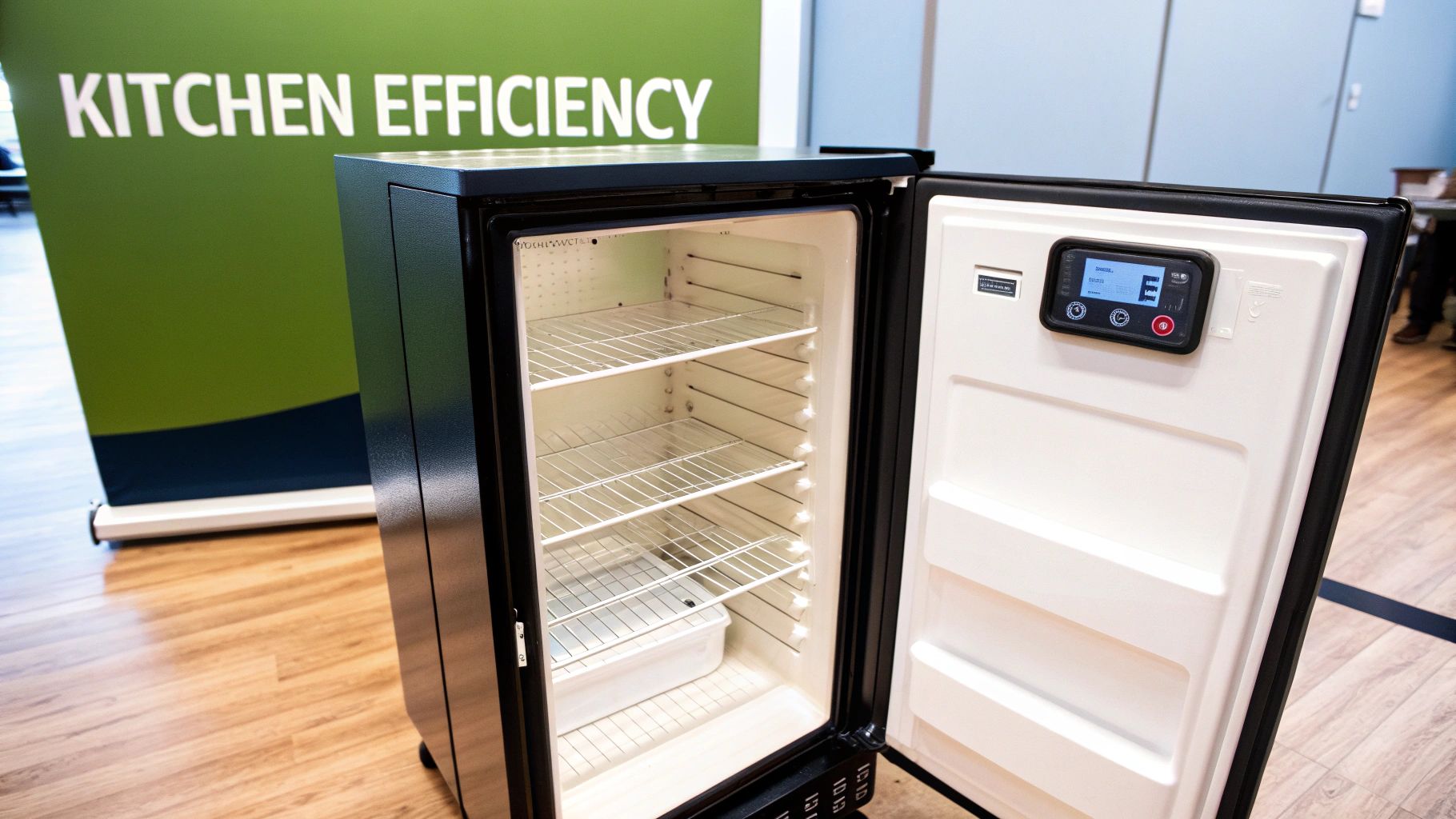
Door Types: Solid vs. Glass
One of the first big choices you'll make is the door type, and it’s a decision that directly impacts both your energy bills and your kitchen's workflow.
Solid doors are the champions of efficiency. They're packed with more insulation, which means they hold cold air in much better and force the compressor to work less. This makes them the go-to choice for back-of-house storage where your staff already knows what they're grabbing and doesn't need to browse.
On the flip side, glass doors are all about merchandising and quick access. While they aren't as insulated, they let staff (and sometimes customers) see what's inside without opening the door. This cuts down on how long the door stays open, minimizing temperature swings. They're perfect for front-of-house displays or busy prep stations where quick visual identification is everything.
Shelving and Defrost Mechanisms
What’s going on inside your freezer is just as important as the outside. A couple of key features here can make organization and maintenance a whole lot easier.
Adjustable shelving is non-negotiable in a fast-paced kitchen. It gives you the flexibility to store everything from small, shallow prep containers to bulky boxes of frozen goods without wasting an inch of space. As your inventory changes, you can adapt the freezer's layout to match.
Another critical feature to consider is the defrost mechanism:
- Manual Defrost: This is the old-school method where you have to empty the freezer and let the ice melt on its own. It's more work, but manual defrost units tend to be more energy-efficient and hold a steadier temperature, which is ideal for sensitive items like ice cream or delicate pastries.
- Automatic Defrost: This system uses a built-in heating element to melt ice buildup on a schedule. It’s a huge time-saver and incredibly convenient, but the slight temperature cycles can cause freezer burn on some products if they aren't wrapped tightly.
For most high-volume LA kitchens, the time saved with an automatic defrost system is a clear win, easily outweighing the minor temperature shifts.
Key Insight: The debate between manual and auto-defrost isn't about which is "better," but which is right for your inventory. For bulk meats and durable goods, auto-defrost is a no-brainer for convenience. For delicate pastries or gelato, a manual defrost unit provides the stable, frigid environment needed to protect their quality.
Practical Add-Ons That Make a Difference
Finally, a few smaller features can make a huge quality-of-life improvement for your kitchen staff.
Casters (heavy-duty wheels) are an absolute must. They let you roll the freezer out of the way for deep cleaning, which is essential for meeting health codes and keeping your kitchen spotless. A digital thermostat is another game-changer, offering precise temperature control so you know your food is always held at a safe and consistent temperature.
Many modern units also come with a high-temperature alarm. This simple feature sounds an alert if the internal temperature creeps into the danger zone, giving you a chance to save thousands of dollars' worth of inventory before it spoils. These are the kinds of practical additions that elevate a good freezer to one of the best commercial freezers you can have in a professional kitchen.
Smart Financing For New Restaurant Equipment
When you're outfitting your Los Angeles restaurant, the "new versus used" debate over a commercial freezer is a huge financial crossroad. A used freezer might look like a win with its lower sticker price, but that initial saving can vanish in a flash. The reality is, used restaurant equipment often comes with a handful of hidden risks that can cost you way more in the long run.
Think of it like buying a used car with zero service history. You might save a few bucks today, but you're rolling the dice on tomorrow. These units almost never have a warranty, leaving you high and dry when that first unexpected repair bill shows up. On top of that, older models are notorious energy hogs, sucking up electricity and bloating your monthly utility bills.
The Value Of Reliability And Peace Of Mind
On the flip side, investing in a new freezer backed by a manufacturer's warranty gives you something much more valuable than a low price tag: peace of mind. For a brand-new food truck or pop-up, reliability is non-negotiable. Knowing your most critical piece of restaurant equipment is covered lets you focus on what really matters—your food and your customers.
Financing a new unit makes this kind of reliability accessible to everyone. Instead of dumping your startup capital into one massive purchase, you can spread the cost out into predictable, manageable monthly payments. It's a strategic move that keeps cash in your pocket for other essentials like inventory, marketing, and payroll.
Smart Funding For Long-Term Growth
Buying modern restaurant equipment isn’t just an expense; it’s a foundational investment in a competitive and compliant business. The demand for dependable refrigeration is exploding. The U.S. commercial refrigeration equipment market—the engine behind freezers for bars, restaurants, and food trucks—was valued at USD 9.77 billion in 2024 and is projected to nearly double to USD 18.54 billion by 2034. That kind of growth shows just how vital the best commercial freezers are for success.
Securing the right equipment upfront is not about spending more; it's about investing smarter. A new, efficient freezer is an asset that pays for itself through lower energy bills, avoided repair costs, and uninterrupted operation.
Exploring different payment options is key. Beyond traditional loans, you can look into alternatives like revenue-based financing, which can get you capital for equipment without giving up a piece of your company. This kind of flexibility allows you to get top-tier freezers while staying financially nimble. To see how it all works, check out our detailed guide on financing restaurant equipment and find a plan that fits your business.
Your Top Commercial Freezer Questions Answered
Even with all the specs and details laid out, a few questions always pop up when you're on the verge of picking a freezer for your LA kitchen. I get it. This is a big investment. Here are the straight-up answers to the most common questions we hear every day.
What’s The Right Temperature For A Commercial Freezer?
You’ll want to keep your commercial freezer set to 0°F (-18°C), or even a touch colder. This is the magic number in the food service world. It completely stops bacteria in its tracks, locking in the flavor, texture, and quality of everything from prime steaks to bags of fries.
Every good commercial freezer needs an external thermometer. It’s a small feature that makes a huge difference, letting your crew in a busy LA kitchen check the temp with a quick glance. No need to open the door and let cold air out, which keeps your food safe and makes it a breeze to stay on the right side of the health department.
How Often Should I Get My Commercial Freezer Serviced?
The absolute minimum is once a year for a professional service check. But let's be realistic—for a high-traffic kitchen here in Southern California, I always recommend scheduling service every six months. Think of it as cheap insurance against a total meltdown during a Friday night rush.
When a tech comes out, they’ll clean the condenser coils, check the refrigerant, inspect the door gaskets for any costly leaks, and make sure your thermostat is accurate.
Pro Tip: Sticking to a regular maintenance schedule is the single best thing you can do to get more years out of your unit. It also keeps your energy bills down and helps you dodge the nightmare of an emergency breakdown.
Can I Just Use A Home Freezer In My Restaurant?
Absolutely not. It’s a tempting shortcut for new restaurant owners trying to save a buck, but it's a mistake that will cost you way more in the long run.
Your freezer from a big-box store just isn't built for the grind of a commercial kitchen. It can't handle the constant door-opening or the high heat of a busy cookline. More importantly, its compressor can't recover temperature quickly enough, which is a massive food safety risk. The real deal-breaker? It’s not NSF-certified, and your health inspector will shut that down immediately.
Why Does NSF Certification Matter So Much?
NSF stands for the National Sanitation Foundation. When you see that NSF seal on a freezer, it means the unit has been put through the wringer and passed strict tests for material safety, durability, and—most importantly—how easy it is to clean. It’s designed so that gunk and bacteria have nowhere to hide.
Health departments, including the one right here in Los Angeles County, demand that your restaurant equipment is NSF-certified. It’s not optional. Whether you're running one of the many Los Angeles Food Trucks, a corner Los Angeles Pizza joint, or a fine-dining spot, that certification is your ticket to passing inspections and running a safe, legal kitchen.
Ready to find the perfect freezer for your Los Angeles business? Explore our full range of new, energy-efficient, and warranty-backed commercial freezers at LA Restaurant Equipment and get fast, free shipping across Southern California. Shop our commercial freezer collection today.